
Grammar
Why Spanish says se lo and not le lo
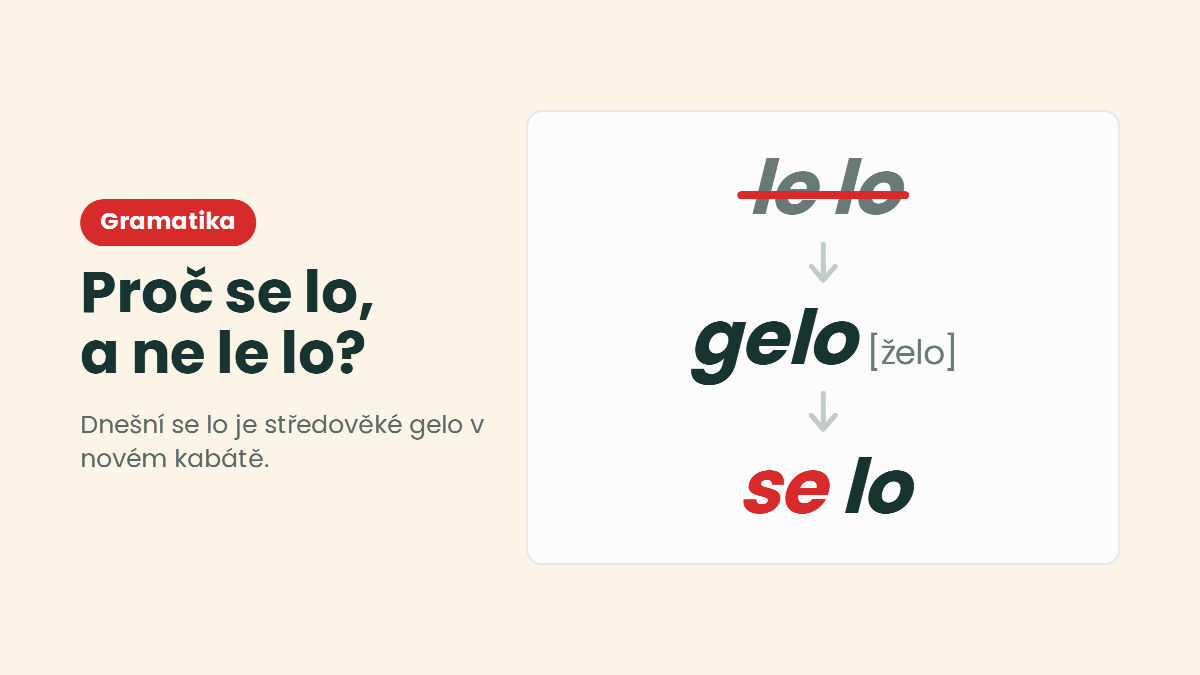
Spanish se lo comes from medieval gelo, its g said like the s in measure. Its se is le in disguise and shares only sound and spelling with reflexive se.
You know that le means “to him” and lo means “it”. You want to say “I’ll give it to him”, so you put together le lo doy, and your teacher corrects it to se lo doy. But you know se from se lava, “he washes himself”, and nobody here is washing. So what is it doing there?
It got there in the Middle Ages and has nothing to do with washing. Once you know the story, se lo stops looking like an exception somebody made up to trip learners up.
Where you run into it
Spanish has two sets of short pronouns for the third person. One answers the question to whom: le (to him, to her, to you) and les (to them). Grammar books call it the indirect object, or dative. The other answers the question whom or what: lo, la, los, las. That is the direct object, or accusative.
Each works without any trouble on its own. But as soon as both turn up in the same sentence, le and les alike become se:
- Le doy el libro. → Se lo doy. (I’ll give it to him.)
- Les mando la carta. → Se la mando. (I’ll send it to them.)
- Le compro las flores. → Se las compro. (I’ll buy them for her.)
The forms *le lo and *les la are never said at all; that is exactly what an asterisk in front of a word means in linguistics. With the other persons nothing happens: me lo das, te lo doy, nos lo dan. The order is first to whom, then what, the same as in English “give him the book”: se lo.
Why it is confusing
The trouble is that you meet se long before this, and in two other roles. In se lava it is reflexive, like English “himself” in “he washes himself”. On a sign saying se habla español it makes the sentence impersonal: “Spanish is spoken here”. And then along comes se lo doy, where the doer is perfectly specific, me, and nobody is doing anything to themselves.
The usual explanation stops at saying that le lo would sound bad. But Spanish speakers didn’t pick se because it sounded nicer. They inherited it, by a roundabout route through a form nobody uses any more.
From Latin to gelo
It starts with two Latin demonstrative pronouns: illī, “to that one, to him”, and illum, “that one, it”. On its own, illī gave today’s le; on its own, illum gave today’s lo.
Things turned out differently when the two stood side by side. In spoken LatinThe spoken Latin of ordinary people, from which Spanish and the other Romance languages grew. “Vulgar” here means common, not rude., illī illum was said in one breath and with a single stress, like one word. That put the final i of the first pronoun right up against the vowel of the second, and the consonant l before it softened. Linguists call this softening palatalisation. The stage in between is reconstructed as *(e)liélo (here the asterisk marks a form that nobody wrote down and that is worked out from what came before and after it). Italian suggests that this probably began in Latin itself: to this day it has glielo for “it to him”.
In Old Castilian the result was gelo. The letter g here was pronounced like the s in measure or vision, a sound usually written zh, so the word sounded like zhelo [ʒelo]. Alongside it were gela, gelos, gelas. The Poem of the Cid, for instance, has the line E bien gelas guardarien fasta cabo del año, roughly “and they would keep them safe for him until the end of the year”.
Two things about gelo are odd, and both still come in useful today. First, it held together. In the manuscript of the Poem of the Cid other pairs of pronouns are written sometimes together and sometimes apart (nos lo, vos lo), whereas gelo is always written as one, and it never appears in the reverse order. French, by contrast, settled on the opposite order, le lui. Second, it had no plural. Gelo meant “it to him”, “it to her” and “it to them”; a form *geslo never existed.
How gelo became se lo
At the end of the Middle Ages the sibilants of Spanish began to change. The zh sound lost its voicing and was pronounced sh, as in ship, so gelo sounded like shelo [ʃelo]. And sh is only a short step from s.
That brought together two words nobody had mixed up until then. Ge was a loner among the pronouns: it was not used by itself and it resembled no other form. Se, on the other hand, was known to everyone, stood in the same place before the verb (gelo dice, se lo dice) and, like ge, had no plural. So speakers replaced the odd word with a familiar one that sounded almost the same. At the end of the 15th century gelo starts to give way, and in the 16th it is already vanishing from written documents.
There is one thing about this change that nobody would expect. Elsewhere in Spanish the sh sound turned into today’s j, a sound close to the ch in Scottish loch: dixo became dijo, fijo became hijo. Gelo went a different way and ended up with s. Similarity of sound alone would not have been enough; what settled it was that a ready-made se stood right beside it. How much each of these causes weighed is something historians of the language still argue about. That se lo is the continuation of gelo, they agree.
The se in se lo is not the se in se lava
This is the thing to take away from the whole story. Spanish has two different words that are now spelt and pronounced the same. One is reflexive se, which Spanish has from Latin sē. The other is le in disguise: a remnant of Latin illī that came down through ge. Linguists call it “spurious se”. It is the same kind of coincidence as English “bear”, which is an animal in one sentence and means “to carry” in the next.
| reflexive se | se in se lo | |
|---|---|---|
| Example | Se lava. (He washes himself.) | Se lo doy. (I’ll give it to him.) |
| What it means | himself, herself, themselves | to him, to her, to them, to you |
| Where it comes from | from Latin sē | from Latin illī via ge |
| When lo goes | se stays: Se lava las manos. | le comes back: Le doy el libro. |
The last row is a test you can use at any time. Take lo out of the sentence and say the whole noun instead. If se turns back into le or les, it was “to whom”. If it stays, it is reflexive: se lo pone (“he puts it on”) gives se pone el abrigo.
What se lo once was explains three things that look like separate rules in class:
- Se doesn’t tell you who. From gelo it inherited having no plural, and le never showed gender either. Se lo doy is “I’ll give it to him”, “to her”, “to them” and “to you”. When the conversation doesn’t make it clear, a Spanish speaker adds it: Se lo doy a ella.
- Se los dije. In much of Latin America you will hear this sentence meaning “I told them that”, even though “that” is one thing. The plural that won’t fit on se is put off to the end, onto lo. According to the academies’ grammar, in Mexico and other areas this is making its way into educated speech too; in Spain or Chile it is not. In writing, stick to se lo dije; but when you hear se los dije, you will know where it comes from.
- They hold together. Either both before the verb, Se lo voy a decir, or both after it and joined on, Voy a decírselo. They cannot be split: nobody says *Le voy a decirlo. It is the same cohesion that gelo had.
Hiroto Ueda of the University of Tokyo, on whose paper this article rests, concludes from this that se lo is in fact still a single word, like al or del, and that we merely write it as two. It is a hypothesis, not a settled matter, and he says so himself. For learning, though, it comes in handy: learn se lo, se la, se los and se las as four ready-made chunks and don’t build them from scratch every time.
How to learn to use it
Once you know where se lo comes from, it stops being a puzzle. For it to come out by itself, you need to say it aloud many times in sentences that mean something: ¿Se lo dijiste? Sí, ya se lo dije. The best place for that is a class where people talk, and that is how we teach in our group courses.
Sources
- Hiroto Ueda (University of Tokyo): Razones de «gelo» medieval y «se lo» moderno. Una hipótesis monolexicista. Everything said here about how the form developed comes from this paper, as do the line from the Poem of the Cid (l. 162) and the counts from the CODEA corpus.
- Corpus de Documentos Españoles Anteriores a 1700 (CODEA), Universidad de Alcalá. The figures in the chart are from the table in Ueda’s paper.
- Also, as cited by Ueda: H. Keniston, The Syntax of Castilian Prose. The Sixteenth Century (1937), on Italian glielo and the Latin origin of the combination; H. Lausberg, Lingüística románica II (1973), on the stress; J. L. Girón Alconchel, Cambios gramaticales en los Siglos de Oro (2004), on when gelo gave way; R. Penny, Gramática histórica del español (2006), on why there was no *geslo.
- Real Academia Española and Asociación de Academias de la Lengua Española: Nueva gramática de la lengua española (2009), on how widespread se los dije is; T. Takagaki et al., Encuesta sobre problemas sintácticos de la lengua española (2) (2008). Both cited from Ueda.
Frequently asked questions
Why does Spanish say se lo instead of le lo?
Is the se in se lo a reflexive pronoun?
How can I tell whether se lo means to him, to her or to them?
Is se los dije a mistake?
Where does se lo go with an infinitive?
Article topics Common mistakes
Sdílet článek
Co číst dál
Guide
Is Spanish hard to learn?
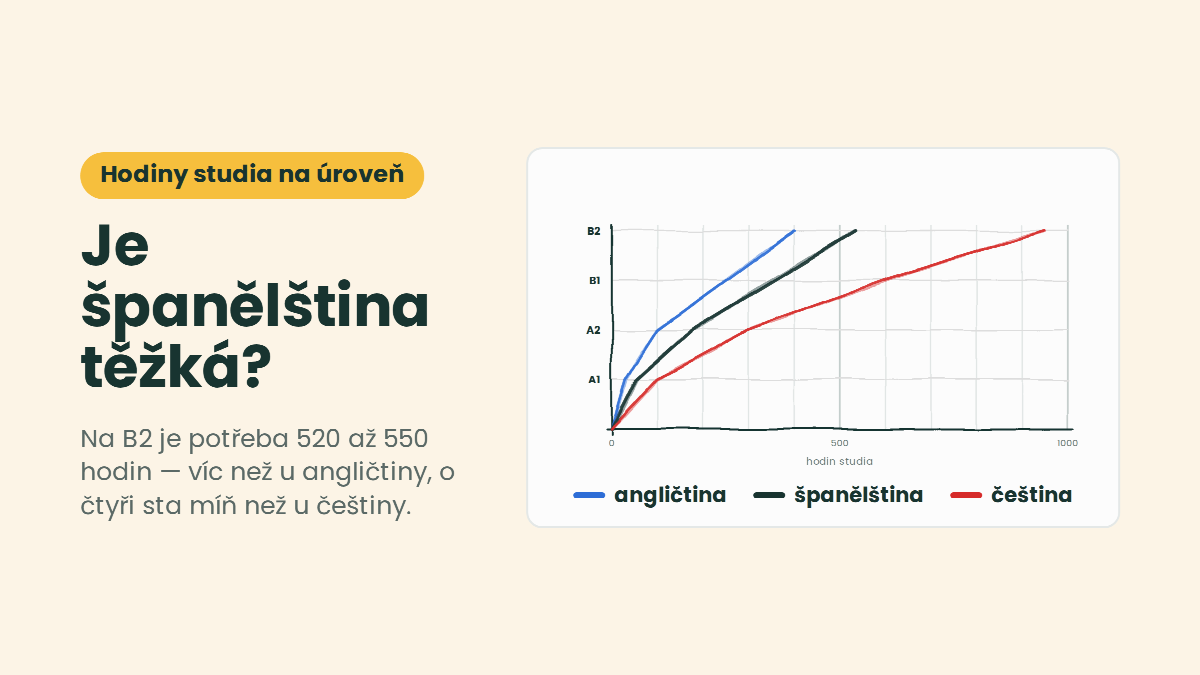
For a Czech speaker, Spanish is harder than English and far easier than Czech is for a foreigner. More telling is where each language keeps its hard part.

Pronunciation
Perejil: the word that decided who lived
In October 1937, the story goes, the way you said perejil, Spanish for parsley, decided whether you lived or died on the Haitian–Dominican border.
Guide
DELE or the Czech state language exam?
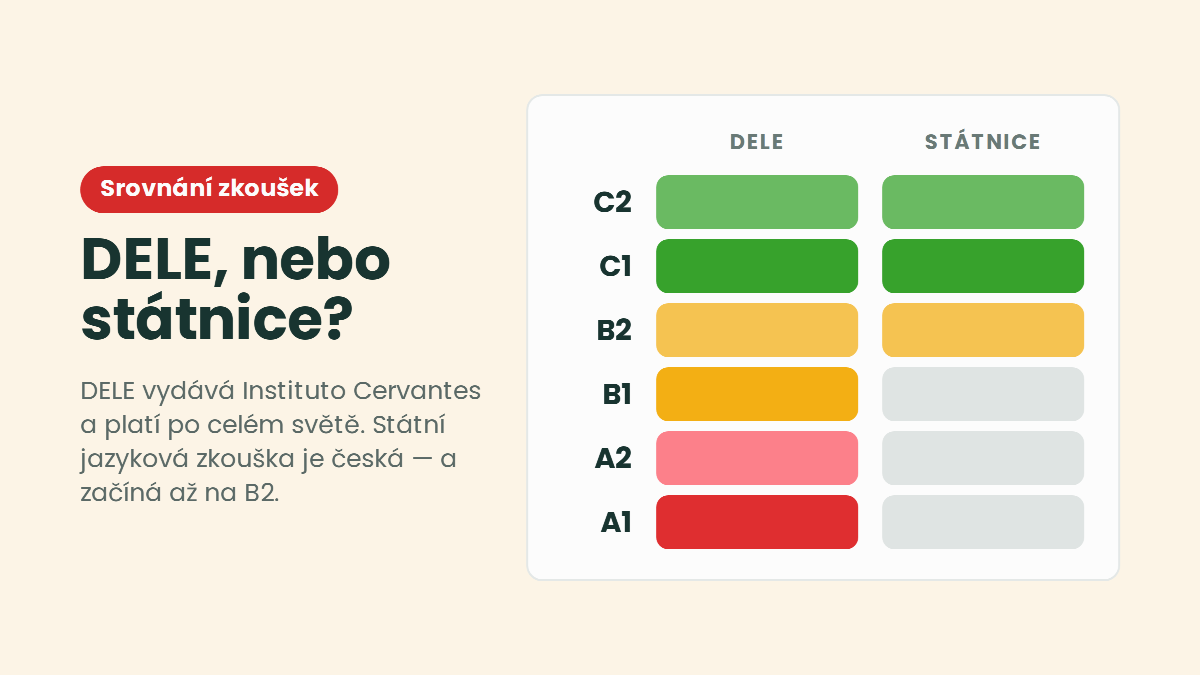
The Instituto Cervantes issues DELE, valid worldwide; the Czech state exam starts at B2. What each involves, where to sit it in Brno and who accepts it.
