
Pronunciation
Perejil: the word that decided who lived
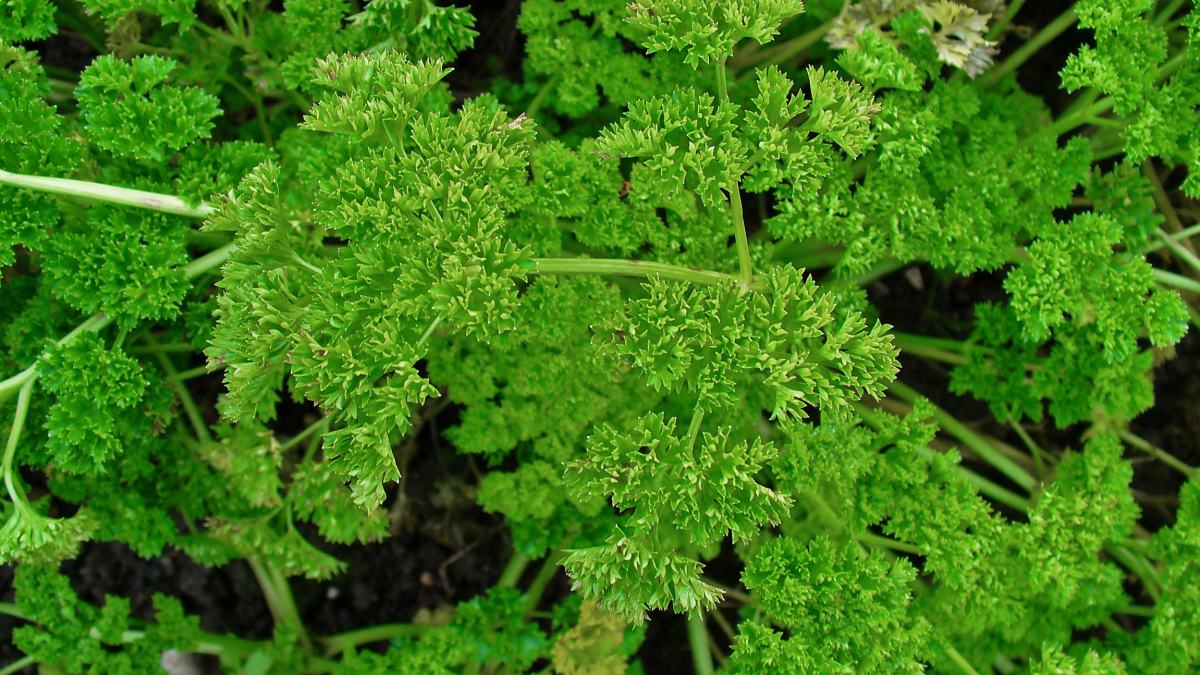
In October 1937, the story goes, the way you said perejil, Spanish for parsley, decided whether you lived or died on the Haitian–Dominican border.
The story is told like this. It is early October 1937. In the north-west of the Dominican Republic a soldier stops someone on the road, holds a sprig of parsley up to their face and asks: ¿Qué es esto? What is this? Everyone knows the answer; the Spanish for parsley is perejil. But at that moment, life depends on how the word comes out.
The story is nearly always told the same way, and nearly always without what comes next. What comes next is the part worth having. It shows how pronunciation really works in a language, and that history knows a whole series of words like this one. One is in the Bible, one is used at Ukrainian checkpoints, and four more were used in fourteenth-century Kraków to pick out Germans and Czechs.
What is hard about the word perejil
That depends on the language you grew up with. For a Czech, almost nothing; for an English speaker, rather more. We will come to both at the end. For someone raised on Haitian Creole it is three traps in a row. Creole grew up in Haiti out of French and African languages, and its sound system is not the Spanish one.
| Sound | In Spanish | In Creole |
|---|---|---|
| r between vowels | one quick tap of the tongue tip on the ridge behind the upper teeth, like the tt in an American butter | a friction sound at the back of the mouth; no tap |
| j, called jota in Spanish | depending on the country, anything from a rough ch as in Scottish loch to a mere breath | does not exist; the nearest sound is the s in measure |
| final -l | a clear l | dropped at the end of a word |
The jota deserves a closer look, because it varies from country to country more than any other Spanish sound. In central and northern Spain it is a harsh, scraping sound, made even further back in the mouth than the ch of Scottish loch or German Bach. In Mexico, the Andes and Argentina it is more or less exactly that loch sound. In southern Spain, the Canary Islands, Central America and the whole Caribbean, the Dominican Republic included, all that is left of it is a breath, closest to an English h. So in Madrid perejil sounds like pe-re-KHEEL, with kh standing for the sound in loch, while in Santo Domingo it is more like pe-re-HEEL.
What a Creole speaker produces instead is a word with a different r, the s of measure where the jota should be, and no l at the end. Even someone who has never given phonetics a thought can hear the difference, and that was the point. A word on which a foreign pronunciation shows up especially clearly has a technical name: a shibboleth. Where that comes from, in a moment.
What happened in October 1937
Haiti and the Dominican Republic are two countries on one island. It is called Hispaniola, it lies in the Caribbean, and the border between the two is just under four hundred kilometres long. Creole and French are spoken in the west, Spanish in the east. For a long time the border was little more than a line on the map: people crossed it for work and for family, and tens of thousands of Haitians lived on the Dominican side. A large share of them had been born there.
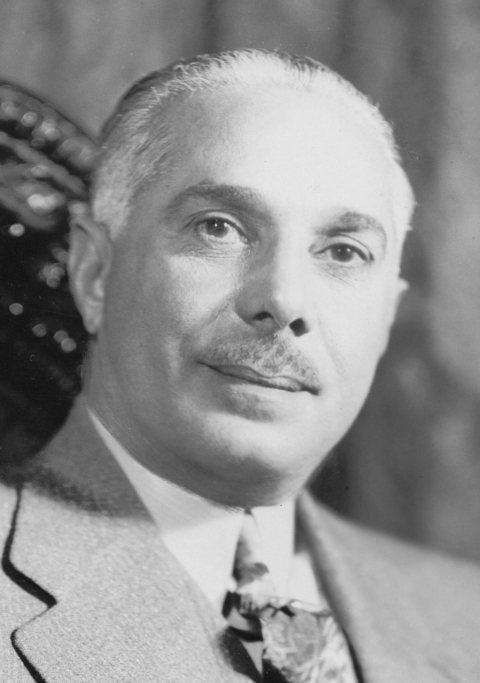
The Dominican Republic had been ruled since 1930 by Rafael Leónidas Trujillo. He was a dictator of the old school, who had the capital renamed after himself and spoke of the borderlands as something that needed to be “Dominicanised”. On 2 October 1937, in the border town of Dajabón, at a celebration held in his honour, he gave a speech that made clear what was going to happen to the Haitians on his side of the border.
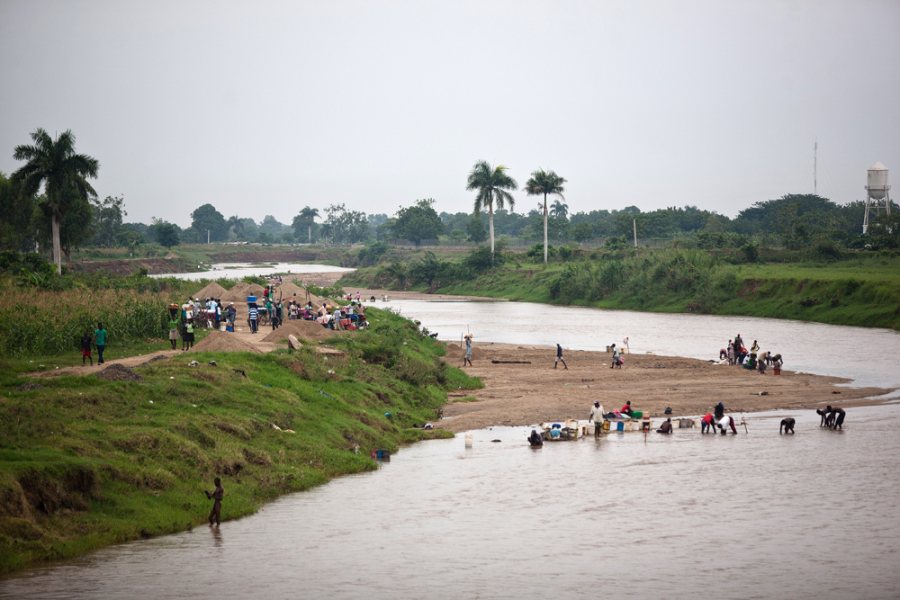
Between 2 and 8 October the army swept through the borderlands. The killing was done with machetes, knives and bayonets. Firearms were used sparingly, because the whole thing was meant to look like a spontaneous outburst of peasant anger, not an order. People trying to flee back to Haiti died in the river that forms the border. It is known as the Río Masacre, Massacre River. The name has nothing to do with 1937; it has been on maps since the seventeenth century.
How many people died is not known exactly and never will be. Estimates range from fourteen to forty thousand. The historian Richard Turits works with a figure of around fifteen thousand. After the massacre the Haitian authorities registered about twelve thousand names, and that was the number later used to calculate compensation.
The Haitian president, Sténio Vincent, at first forbade any discussion of the matter, and as late as mid-October declared that relations between the two countries had not suffered at all. Only after international pressure and a failed coup at home did he ask for an investigation. The Dominican Republic avoided one by offering money: 750,000 dollars was agreed, 525,000 was paid, and the Dominican government accepted no responsibility whatsoever. Nobody was ever put on trial.
Was the parsley really held up?
This is where the story usually ends. In recent years, though, historians have reassessed it. Lauren Derby, a historian at the University of California, calls the parsley test a myth outright: none of the survivors or witnesses mentions parsley. At the same time, she and Richard Turits describe a test that did exist, only earlier and for a different purpose. It was used in the borderlands before the massacre, when local guards needed to tell new arrivals from families who had lived there for generations and held Dominican papers. By October 1937 it no longer distinguished anything.
Three things speak against a parsley test during the massacre itself.
- A large share of those killed had been born on the Dominican side and had spoken Spanish all their lives. A pronunciation test would not have marked them out as foreigners, and yet they died.
- There was no single “correct” pronunciation of perejil. The Dominican jota is only a breath, and in the Cibao region, which the massacre reached, local people turn a final -l or -r into an i sound. A Dominican from there would not say pe-re-KHEEL himself, but something far softer, with neither the rough kh nor a clear final l.
- The soldiers had simpler ways of knowing who they were looking for. They knew the villages, they had lists and they had informers.
So why does the story persist, to the point that the killings are known in English as the Parsley Massacre? Most likely because it sums the whole thing up in a single image: a state decided who belonged on its territory and who did not, and took the way people speak as its measure. That holds true even if nobody ever lifted a single sprig of parsley.
Why it is called a shibboleth
The word comes from the Bible, from the Book of Judges. Jephthah’s men had defeated the tribe of Ephraim and seized the fords of the Jordan. Anyone who wanted to cross had to say one word. In the Ephraimite dialect the sound sh was pronounced s, so listening was enough.
Then said they unto him, Say now Shibboleth: and he said Sibboleth: for he could not frame to pronounce it right. Then they took him, and slew him at the passages of Jordan…
That is the King James Version, Judges 12:6. The text says that forty-two thousand Ephraimites fell at that time. The word shibboleth itself is Hebrew for an ear of grain, and is sometimes also translated as a stream of water. The meaning played no part, though; all that mattered was that it had a sh in it. Linguists now use shibboleth as a technical term for any word that reveals where a speaker is from.
Shibboleths are not usually tongue-twisters. They are ordinary words that happen to contain exactly the sound or the stress the other language lacks.
Food makes the best password
Strikingly often these stories are about food, and there are reasons for that. Everyone knows the name of an everyday foodstuff, including people who cannot read. Asking about it does not look like an interrogation. And there is no preparing for it, because the victim does not know in advance which word is coming.
- Sicily, 1282. During the uprising against French rule known as the Sicilian Vespers, the rebels made suspects say ciciri, chickpeas. The word holds three traps at once: the ch of church, which French does not have, a different r, and stress on the first syllable instead of the last.
- Bruges, 1302. The Flemings made French soldiers say schild en vriend, shield and friend. The Flemish sch is all but impossible for a French mouth.
- Kraków, 1312. During a revolt against the Germans and Czechs, foreigners were identified by the Polish words soczewica, koło, miele, młyn: lentil, wheel, grinds, mill. Anyone who could not manage the hard Polish ł was killed or driven out. This time it was the Czechs who stood on the wrong end of the shibboleth.
- Frisia, 1515 to 1523. The Frisians had people repeat the sentence Bûter, brea, en griene tsiis: butter, rye bread and green cheese.
- Lebanon, 1975 to 1990. At checkpoints during the civil war people were asked for the Arabic word for tomato. The Lebanese say banadura, Palestinians bandura.
- The Netherlands in the Second World War. Members of the resistance made suspects read out the name of the town Scheveningen or the word beschuit, a rusk. A German reads sch as sh; a Dutchman does not.
The oldest of these stories call for some caution. Both Sicily and Bruges come down to us in chronicles written long after the event, so part of them may be literature. It is the same problem as with the parsley: a well-told story travels faster than anyone can check it.
Ukraine 2022: palianytsia
After the Russian invasion in February 2022, people at Ukrainian checkpoints began to be asked to say palianytsia, in Ukrainian паляниця. It is a round white loaf, the kind of bread offered to guests with salt on an embroidered cloth. Alongside it another word was used: Укрзалізниця, the name of the Ukrainian railways.
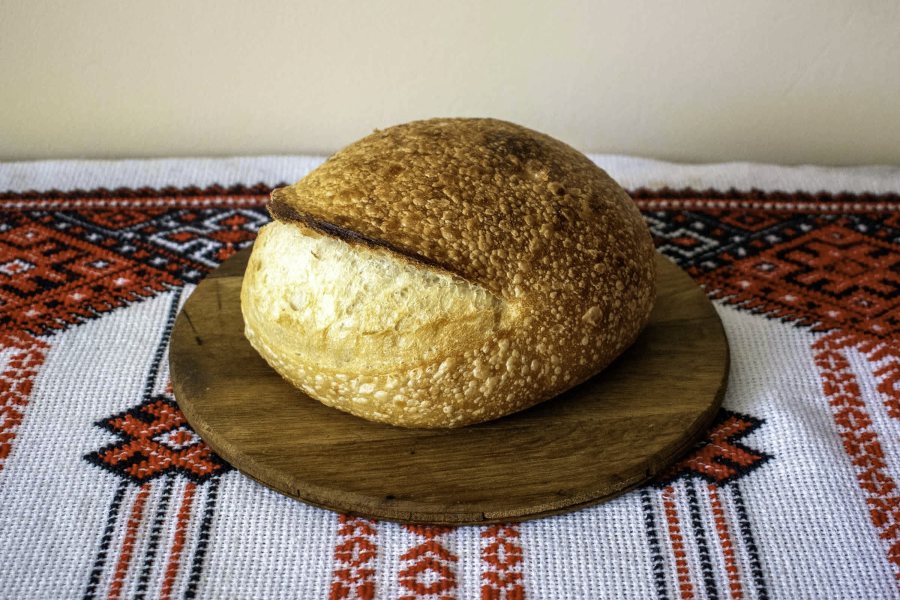
In Ukrainian it sounds roughly like pa-lya-NI-tsya, with the stress on the third syllable, a hard n and a soft ts. Russian has no soft ts, and the Ukrainian и, a vowel much like the i in English bit, slides towards ee in a Russian mouth. A Russian therefore says palianitsa, and you can hear it at once.
This test has the same flaw as the Dominican one, however. Many Ukrainians grew up in Russian-speaking families and learnt Ukrainian only at school or as adults. Pronunciation tells you what someone heard as a child. It says nothing about whose side they are on.
Is perejil an easy word for an English speaker?
Easier than for a Creole speaker, harder than for a Czech. Czech happens to have a sound for each end of the jota’s range, a tapped r and a clear final l, so nobody would have caught a Czech out on this test. English gives you less. The breathy Caribbean jota is simply your h, and it is a perfectly good choice: that is how the letter sounds across the Caribbean, Central America and southern Spain. The rough version is the ch of loch, which you have only if you say loch the Scottish way. The real trap is the r. The usual English r, made without the tongue touching anything, is not the Spanish sound; the tap you need is the one in an American butter. And the final -l should stay light, like the l in leaf, not the darker one most English accents use at the end of feel.
Beyond this one word, it is other sounds that give an English speaker away. Most often the vowels: Spanish has five, each of them short and steady, and none of them fades into the blurred sound English uses in unstressed syllables, like the a in about. Then p, t and k, which English releases with a small puff of air and Spanish does not. Then ll and y, where an English y is the obvious choice but a Spaniard often says something firmer, heading towards the j of jam. Then b and v, which in Spanish are one and the same sound. And finally d between vowels, which softens almost to the th of this, a sound you at least already have.
All of this is a matter of habit; you do not need any special talent for it. Learning a new sound means finding out where the tongue goes in the mouth and then repeating it aloud a few times with someone who can hear the difference. We go into the details in our articles on pronouncing r and rr and on ll and y (both in Czech), and we correct it in every lesson: in our group courses and in one-to-one tuition.
An accent, by the way, never disappears completely, and it does not have to. A Spaniard can spot an Argentinian, an Argentinian can spot a Spaniard, and nobody minds. Recognising someone by the way they speak is a perfectly normal thing. It is just that a few times in history someone has turned it into a verdict.
- Photograph of parsley — Petroselinum crispum 002, H. Zell, CC BY-SA 3.0, cropped to landscape.
- Portrait of Rafael Trujillo — Rafael L. Trujillo en la silla presidencial, author unknown, public domain.
- Photograph of the border river — Frontera Dajabón – Ouanaminthe, Fran Afonso, CC BY 2.0.
- Photograph of the bread — Паляниця, спечена в пекарні, Віщун, CC0.
- The quotation from Judges 12:6 is from the King James Version on Wikisource, public domain.
- On the massacre and the doubts about the parsley test: Lauren H. Derby and Richard L. Turits, Terreurs de frontières. Le massacre des Haïtiens en République Dominicaine en 1937 (2023); Richard L. Turits, A World Destroyed, A Nation Imposed, Hispanic American Historical Review 82/3 (2002).
- The overview of other shibboleths is based on the entry Šibolet on Czech Wikipedia.
Frequently asked questions
What does perejil mean in Spanish?
Was parsley really held up during the 1937 massacre?
What is a shibboleth?
Why do people in Ukraine ask about the word palianytsia?
Is perejil hard to pronounce if I am learning Spanish?
Article topics Vocabulary Varieties of Spanish
Sdílet článek
Co číst dál
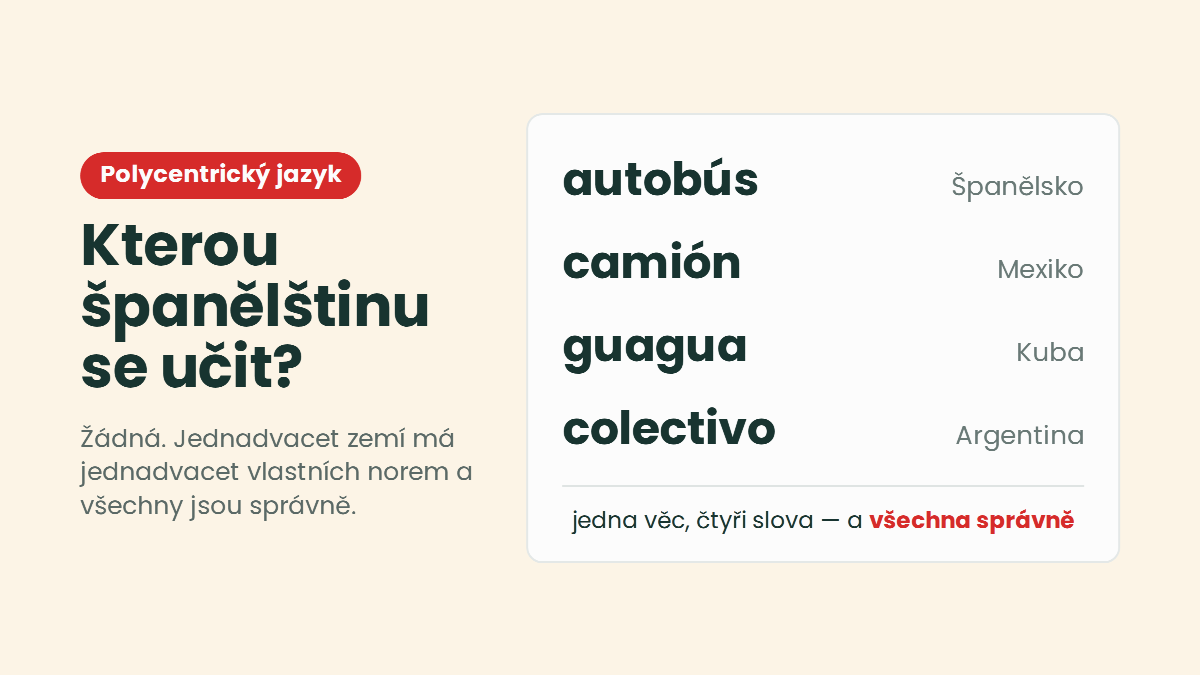
Guide
Which Spanish should you learn?
The one within reach. Spanish is a pluricentric language: each of its twenty-one countries has its own variety and all are correct. No Spanish is wrong.
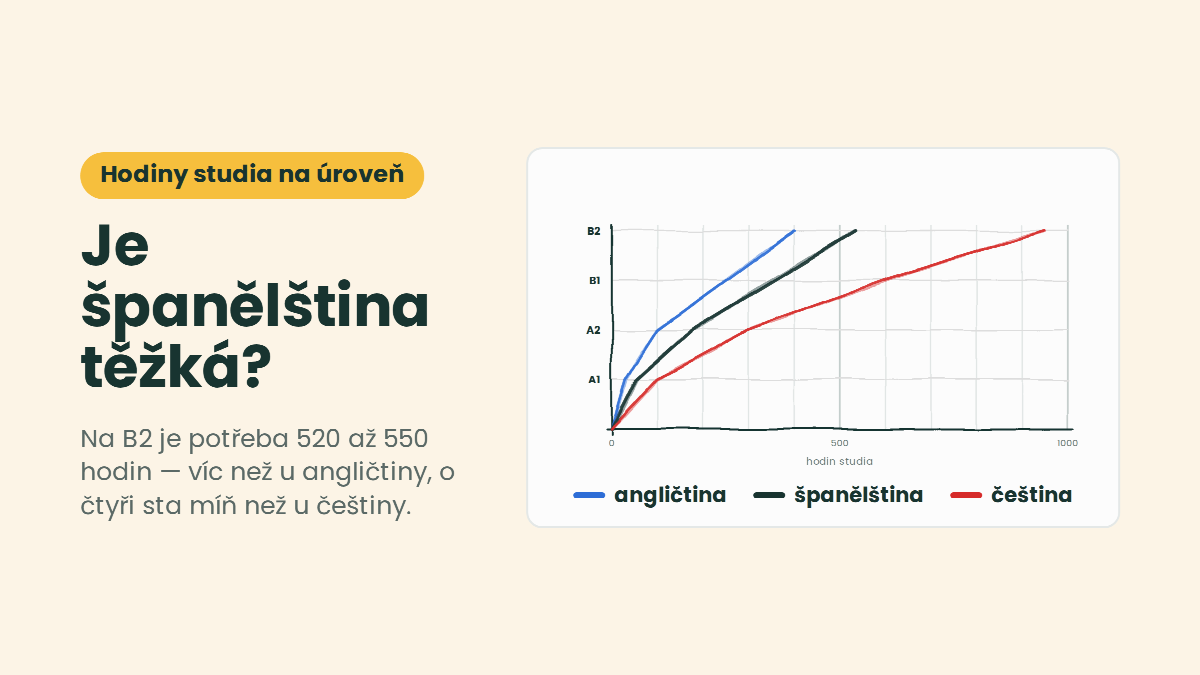
Guide
Is Spanish hard to learn?
For a Czech speaker, Spanish is harder than English and far easier than Czech is for a foreigner. More telling is where each language keeps its hard part.
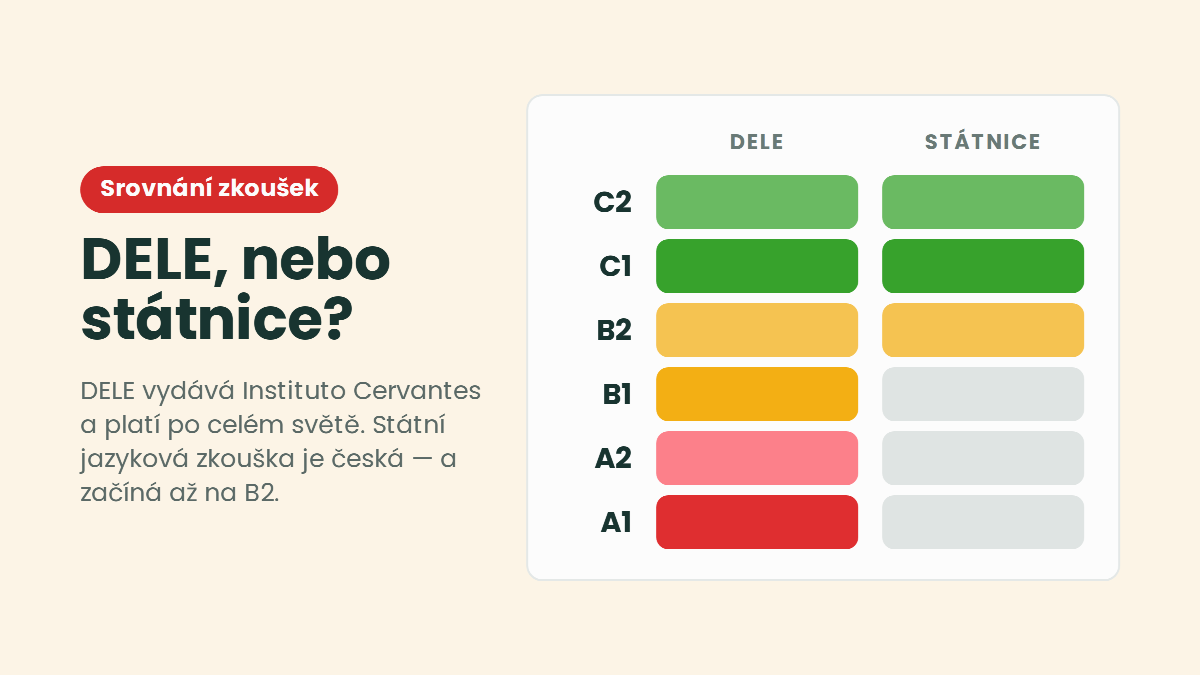
Guide
DELE or the Czech state language exam?
The Instituto Cervantes issues DELE, valid worldwide; the Czech state exam starts at B2. What each involves, where to sit it in Brno and who accepts it.



