
Guide
Is Spanish hard to learn?
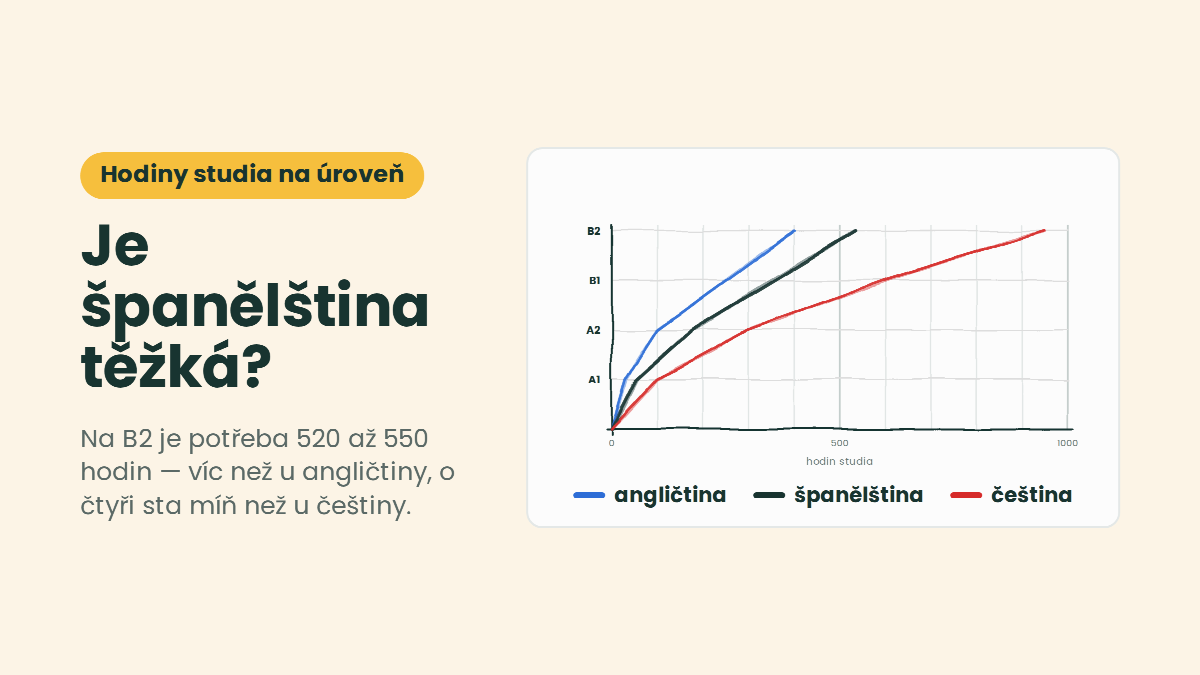
For a Czech speaker, Spanish is harder than English and far easier than Czech is for a foreigner. More telling is where each language keeps its hard part.
It depends on what you compare it with – and above all at which level. For a Czech speaker, Spanish is harder than English and considerably easier than Czech is for a foreigner. More interesting than that total, though, is the distribution: each of the three languages has its hard part somewhere else.
Three languages, three shapes
The chart shows how many hours of study each level takes. English and Spanish are counted for a Czech learner, Czech for a foreigner learning it. If your first language is not Czech, read the English and Spanish figures as a guide rather than a promise. The default view stops at B2, because that is the level at which you can get by at work and when travelling; the second button adds C1 and C2.
| Level | English | Spanish | Czech | |||
|---|---|---|---|---|---|---|
| extra | total | extra | total | extra | total | |
| A1 | 30 | 30 | 40–70 | 40–70 | 100 | 100 |
| A2 | 70 | 100 | 120 | 160–190 | 200 | 300 |
| B1 | 150 | 250 | 180 | 340–370 | 300 | 600 |
| B2 | 150 | 400 | 180 | 520–550 | 350 | 950 |
| C1 | 250 | 650 | 250 | 770–800 | 450 | 1400 |
| C2 | 350 | 1000 | 350 | 1,120–1,150 | 500 | 1900 |
English: easy at the start, treacherous at the end
English is the easiest of the three at the point where a learner decides whether to stick with it – from A1 to B1. Thirty hours for A1 really is very little, and the experience gets generalised: “English is easy”. It helps that people hear it in films, in music and online, so they put in some of the hours without noticing.
The hardest things are still waiting for the learner, though, and they come after B2: phrasal verbs, idioms, articles, prepositional patterns and a pronunciation that cannot be worked out from the spelling. That is why the English line flattens out at the top: the last two levels take six hundred hours between them, more than the whole way to B2.
It is also why so many people say for years that they “speak English” and yet make no headway in all that time. Most of them have not stopped learning; they have simply reached the point where the curve changes shape, and from there every further step is much longer than the ones before.
Czech: all the grammar right at the start
Czech has the opposite problem. At A1 and A2 the learner already has to face practically the whole grammatical system – seven cases across three genders, number, declension patterns, verbal aspect – and all of it before managing a simple sentence about themselves. It cannot be put off: without cases you cannot even build “jdu do obchodu” (I am going to the shop).
A hundred hours for A1 is more than three times the figure for English. That is where Czech gets its reputation as one of the hardest languages in the world – and the reputation rests on what the learner goes through in the first year, not on the overall total.
Interestingly, the ratio evens out higher up. Between C1 and C2 Czech needs five hundred hours and English three hundred and fifty: still more, but not three times as much. So Czech is at its hardest mainly at the start.
Spanish: an even slope
Spanish behaves like neither. It does not hand you the beginning for free the way English does – the pronunciation has to be done properly from the first lesson, the verbs conjugate and grammatical gender is compulsory from the outset. But it has no wall like Czech either: nothing arrives all at once, and from A2 upwards no step is several times longer than the one before.
The spelling is almost phonetic, so what is written is what you read out. For a Czech learner much of the vocabulary is transparent through Latin and through English – and as you are reading this in English, you hold that second key as well. And the grammar comes in measured doses: the present tense, then the past tenses, then the subjunctiveThe verb mood Spanish uses for wishes, doubt and uncertainty. English keeps only traces of it, as in “if I were you”. – each level adds one big thing, not ten.
The result is a curve with no kink. The hard part of Spanish is neither at the start nor right at the top; it is spread along the whole way – and that makes the pace predictable. From A1 to A2 it is 120 hours, to B1 and to B2 180 each, then 250 to C1 and 350 to C2. Anyone who got through A2 at a certain pace needs about half as much time again for B1 at the same pace, not ten times as much.
With Spanish, do not expect a turning point. Neither the feeling of “it comes by itself now” nor “I will never manage this” hits as abruptly as with the other two. Progress is predictable, so regularity pays off: that is exactly why coming twice a week beats coming once for twice as long.
So is it hard or not?
Spanish is a moderately demanding language, and you can get it to a usable state sooner than most people think. B2, the level at which you can get by at work and when travelling, takes 520 to 550 hours. That is roughly a hundred and thirty hours more than English and four hundred fewer than Czech.
What “hard” means for you depends mainly on two things that are in no table: how many foreign languages you already speak and how regularly you get to the language. The first shortens A1 above all; the second decides everything else.
Where next
How long it will take you in particular is something you can work out in the guide to how long it takes to learn Spanish – it has a calculator that allows for attendance, homework and what you forget between lessons. Why Spanish differs from country to country and yet remains one language is explained in the article on which Spanish to learn.
What you can do at each level is described on the language levels page. You can start in a group course or one-to-one – and if you are not sure where you belong, the placement interview with us is free.
Frequently asked questions
Is Spanish harder than English?
Why is Czech said to be the hardest language?
What is the easiest thing about Spanish?
What is the hardest thing about Spanish?
Article topics Getting started Pronunciation Grammar
Sdílet článek
Co číst dál
Guide
Which Spanish should you learn?
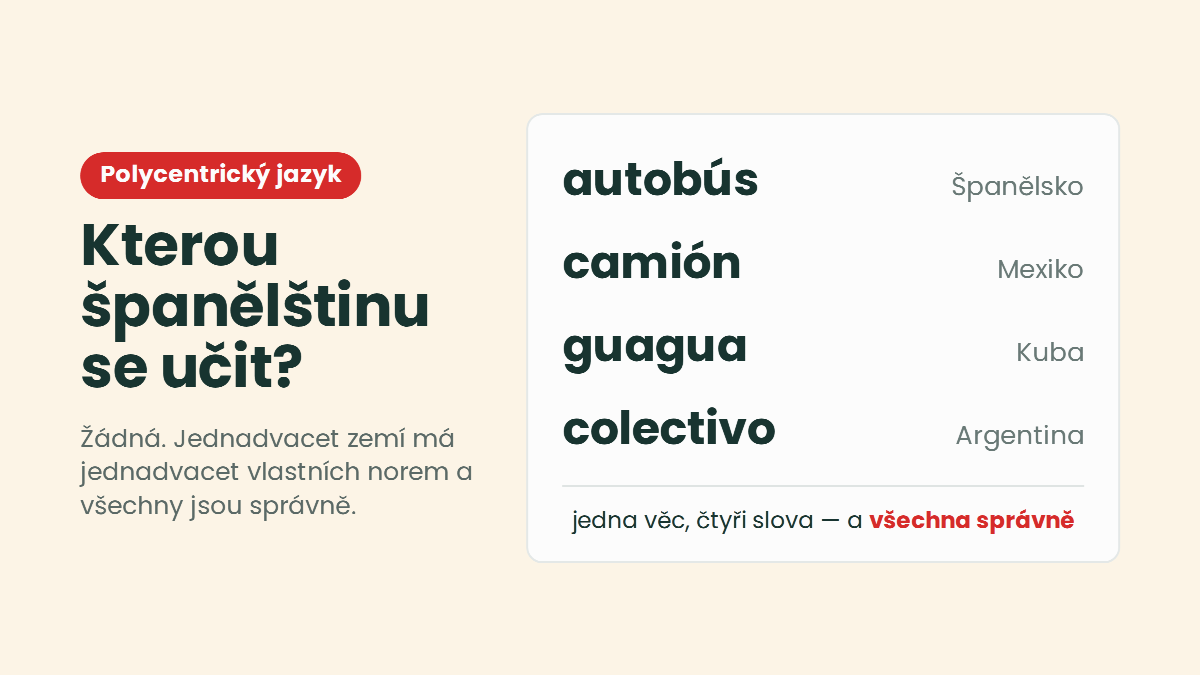
The one within reach. Spanish is a pluricentric language: each of its twenty-one countries has its own variety and all are correct. No Spanish is wrong.
Guide
DELE or the Czech state language exam?
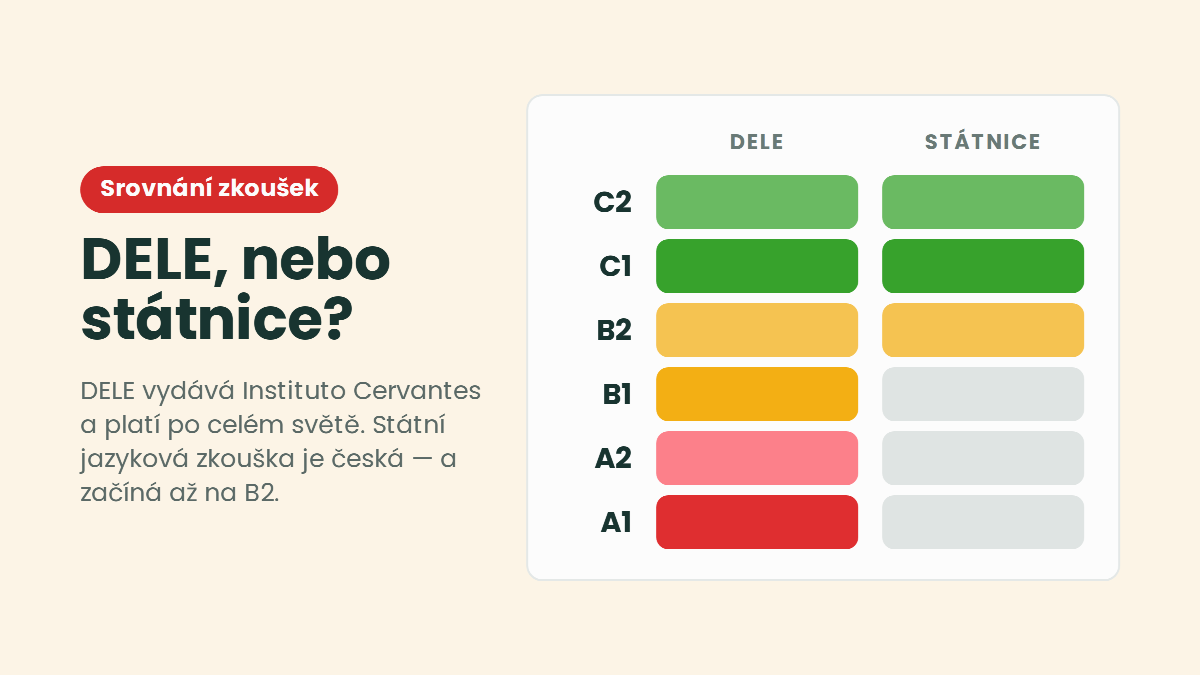
The Instituto Cervantes issues DELE, valid worldwide; the Czech state exam starts at B2. What each involves, where to sit it in Brno and who accepts it.

Guide
In-person or online Spanish course?
The same course: same levels, same coursebook, groups of up to six. It comes down to the trip across town, lesson recordings and how you focus at home.
