
Guide
DELE or the Czech state language exam?
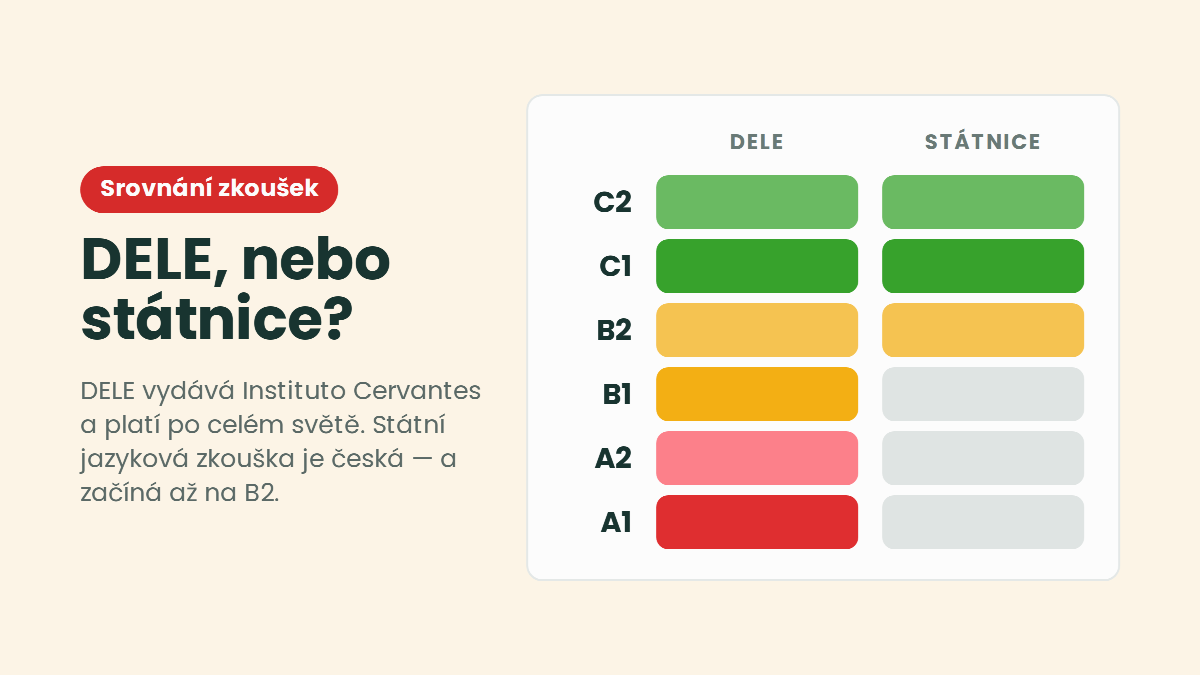
The Instituto Cervantes issues DELE, valid worldwide; the Czech state exam starts at B2. What each involves, where to sit it in Brno and who accepts it.
How the two exams differ
Both exams are official and both leave you with a certificate. That is where the similarity ends.
DELE is a Spanish certificate of proficiency in Spanish. It is issued by the Instituto Cervantes on behalf of the Spanish Ministry of Education and it is internationally recognised: it carries the same weight in Madrid, in Bogotá and in Brno.
The státní jazyková zkouška (state language examination) is an institution of the Czech school system. It rests on the Czech Education Act and on the decree on language schools, it is taken at a language school authorised to hold it, and what you receive is a vysvědčení o státní jazykové zkoušce, a state language examination certificate. It is a document for use in the Czech Republic; whether it is valid abroad is something no regulation says anything about.
And then there is the difference that settles the matter for a lot of people before anything else does: DELE has six levels, from A1 to C2, whereas the state exam only starts at B2. If your Spanish is at A2 or B1, you cannot sit the state exam yet, and of the two that leaves you with DELE.
What the Czech state language exam is
Not just anyone can run it: it is held at a jazyková škola s právem státní jazykové zkoušky (a language school with the right to hold the state language examination), which is a separate type of school entered in the Czech register of schools. The written paper is set by the Czech Ministry of Education, which also fixes the dates; you are examined by a board of three. There are two exam sessions a year, in spring and in autumn.
You do not have to be a student of that school: the Act says in so many words that the exam can be taken without any previous study at a language school. You apply, you pay and you turn up.
The exam always has a written and an oral part, and the order is fixed: if you fail the written part, you do not go on to the oral at all.
Basic (základní), level B2
The exam covers topics from everyday life in the Spanish-speaking world and in the Czech Republic; the decree assumes a knowledge of 2,000 to 2,500 lexical unitsA word or a fixed phrase learnt as a single item — roughly what people mean when they say “a vocabulary item”.. The written part lasts four hours and consists of reading, a piece of continuous writing of about three hundred words, listening and a test of grammatical and lexical structures; you may use a dictionary for the reading and the writing. The oral part lasts fifteen to twenty minutes.
General (všeobecná), level C1
Political, economic and cultural affairs are added to everyday life. About 4,000 lexical units are required and the piece of writing is twice as long. And there is a requirement that takes people by surprise: you hand in a list of your own reading with your application — fiction in the original amounting to at least five hundred pages, and what you have read is discussed in the oral exam. The oral part lasts twenty-five to thirty minutes and includes a question on the culture and institutions of the Spanish-speaking countries.
Special (speciální), level C2: translation and interpreting
These two are a different kind of exam: they do not test how good your Spanish is, but how well you can work between Czech and Spanish. For them the decree assumes five thousand lexical units in active use and a further two to three thousand passively.
- The translation exam is weighted towards the written part: translating a difficult text into Czech, one or two texts into Spanish, and summarising a five-hundred-word Czech text in Spanish. In the oral part a text is rendered aloud in both directions.
- The interpreting exam is weighted towards the oral part, which lasts forty to forty-five minutes and has consecutive interpretingInterpreting in stretches: the speaker finishes a passage, pauses, and only then does the interpreter render it. The opposite is simultaneous interpreting, which runs alongside the speaker. in both directions at its core. A sound recording is made of the oral performance.
You cannot go straight to the special exam: you must have passed the general one first. The school may make an exception if you can show another exam that matches it in content and scope.
What it costs. Each school sets its own price; the decree only sets the ceiling: CZK 5,000 for the basic exam, CZK 7,000 for the general, CZK 9,000 for the special translation exam and CZK 10,000 for the interpreting exam. Anyone resitting the exam pays again.
Can you take the state exam in Spanish in Brno?
Yes. It is held by Jazyková škola s právem SJZ Brno, and Spanish is one of the languages in which you can take both the basic and the general exam there; for each of them the school also publishes a list of conversation topics.
With the special exams it is less certain: the school lists the languages for those date by date, and Spanish is not among the ones listed. If you are aiming for the translation or the interpreting exam in Spanish, check with the school directly — we cannot speak for it.
What DELE is
DELE stands for Diplomas de Español como Lengua Extranjera. The exam covers all six levels of the Common European Framework of Reference, from A1 to C2, and there are also versions adapted for young people aged eleven to seventeen. The diploma is issued by the Instituto Cervantes on behalf of the Spanish Ministry of Education.
The whole exam is about Spanish and in Spanish; Czech plays no part in it. That sets it apart from the special state exam, where working between the two languages is the heart of the exam.
We hold the DELE exams in Brno as an examination centre. Which levels are sat when, and what they cost, you will find on the DELE page. The details there are always up to date, which is why we deliberately do not give them here.
Who recognises which exam
This is the question most people came here for, and there is no single answer to it: it depends on who is asking you for the certificate. In four cases there is a Czech regulation to go by:
The maturita (the Czech school-leaving examination). The head of a Czech secondary school may allow the foreign-language exam in the profile part (profilová zkouška) to be replaced by a standardised exam evidenced by a certificate. The list of exams the school will accept, and the level required (at least B1), is published by the school itself. Both exams commonly appear on such lists — but what decides is your school’s list, not a general rule.
Teaching at a language school. The Czech Act on Pedagogical Staff allows the qualification to be obtained, among other ways, by passing a language examination in the relevant foreign language at a level corresponding to at least C1 (in the original: „vykonáním jazykové zkoušky z příslušného cizího jazyka odpovídající minimálně úrovni C1“) together with supplementary study in teaching methodology. The Act names a level, not a particular exam: C1 can be shown by the general state exam and by DELE C1 alike.
Court interpreter and court translator (soudní tlumočník, soudní překladatel). Here the state exam has an advantage given to it by law. The Czech Act on Court Interpreters and Court Translators lists the conditions of professional competence, all of which must be met together, and one of them is this: to have passed the special state language examination in interpreting or in translation, unless the language in question was the subject of your university studies. The Act also allows another comparable language examination for the same level of knowledge of the language (in the original: „jinou obdobnou jazykovou zkoušku pro shodnou úroveň znalosti jazyka“), but whether a particular certificate falls under that is assessed by the Czech Ministry of Justice — not by us and not by the Instituto Cervantes. If you are aiming for the court translator’s stamp, the safer route is the one the Act names.
Abroad. Here it is the other way round. DELE is an official Spanish certificate with international recognition, and in the Czech Republic it is, in addition, officially recognised by the Czech Ministry of Education. The state exam is established by a Czech regulation and the certificate is issued by a Czech language school; nothing indicates that a university or an employer abroad would recognise it. For an application to Salamanca, DELE is the one to have.
How long they are valid
Both indefinitely. For DELE the Instituto Cervantes says so in as many words: the diplomas certify your level of Spanish throughout the world and for good. For the state exam it is not stated anywhere, and the answer follows from exactly that: neither the Act nor the decree lays down any period of validity, so the certificate is issued once and stays valid.
How old a certificate will be accepted by whoever you are presenting it to is a different matter: an employer may want one that is no more than five years old, even though the exam itself does not expire. Check that with them beforehand.
Which one suits whom
| DELE | Czech state language exam | |
|---|---|---|
| Levels | A1 to C2 | B2, C1, C2 |
| Issued by | the Instituto Cervantes on behalf of the Spanish Ministry of Education | a language school holding this right |
| Language of the exam | Spanish only | Spanish; in the special exam also translation and interpreting to and from Czech |
| Validity | indefinite | indefinite |
| Where you take it | at examination centres all over the world; in Brno, with us | at a language school holding this right; in Brno it is the one on Kounicova |
| Recognition abroad | international | not addressed |
| Route to the court translator’s stamp | assessed case by case | the special exam is named in the Act |
And the same in sentences:
- You are below B2 — DELE, because the state exam only starts at B2.
- You want a certificate for use abroad, for a Spanish university or for a CV you are sending to a foreign company — DELE.
- You are aiming to become a court translator or interpreter — the special state exam. The Act names it; other routes are assessed case by case.
- You want to show that you can translate and interpret between Czech and Spanish — again, only the special state exam. DELE does not test that skill at all.
- You need proof of C1 for a teaching qualification — either will do; the Act speaks of a level.
- You want to replace an exam in the maturita — go by the list your secondary school publishes.
Why trust this comparison. We are a DELE examination centre, so we have an interest in one of the two outcomes — and a comparison that always comes out in favour of whoever wrote it is worth nothing. That is why everything said here about the state exam rests on the Czech Education Act and on the decree on language schools — both are listed, section by section, at the end of the article. And if the article points you to the state exam, take the state exam.
How to prepare for either of them
Both have a fixed structure, a set time for each part and a logic of their own in how the tasks are set, and anyone who sees all of that for the first time on the day loses marks on things that have nothing to do with Spanish. So sit at least one complete mock exam, against the clock.
With us, preparation for DELE is one-to-one: it starts with an interview that establishes your level, and then you practise the individual parts of the exam. We will not prepare you specifically for the state exam, because we do not hold it — but B2 or C1 is learnt the same way whichever exam is waiting at the end, and our group courses lead to those levels.
Where to go next
- DELE exams in Brno — levels, dates and prices for the current period.
- Language levels — what you can do at B2 and what at C1.
- How long does it take to learn Spanish? — the calculator works out how much time separates you from B2 or C1.
- Get in touch — the interview is free and it tells you what level you are at.
Where the claims about the state language exam come from
We do not hold the state language exam, so everything the article says about it comes from here (the sources are in Czech):
- Act No. 561/2004 Sb., the Education Act (školský zákon) — § 110 and § 81a and § 81b.
- Decree No. 33/2005 Sb., as in force from 23 October 2020 — full text including the annex with the examination rules.
- Act No. 563/2004 Sb., on Pedagogical Staff — § 12.
- Act No. 354/2019 Sb., on Court Interpreters and Court Translators — § 8.
- The list of exams offered by Jazyková škola s právem SJZ Brno.
- Instituto Cervantes — about the DELE diplomas and the exams page.
Frequently asked questions
Which is better, DELE or the Czech state language exam?
Can you take the state language exam in Spanish in Brno?
How long is DELE valid, and how long the state exam?
Do I have to attend a language school to sit the state exam?
Can DELE replace the Spanish exam in the maturita?
Do I need the state exam to work as a court translator?
Article topics Exams Levels
Sdílet článek
Co číst dál
Guide
How long does it take to learn Spanish?
A1 takes 40 to 70 hours of study, A2 another 120, and B1 and B2 180 each. The calculator in the article works out how many weeks that means for you.
Guide
Which Spanish should you learn?
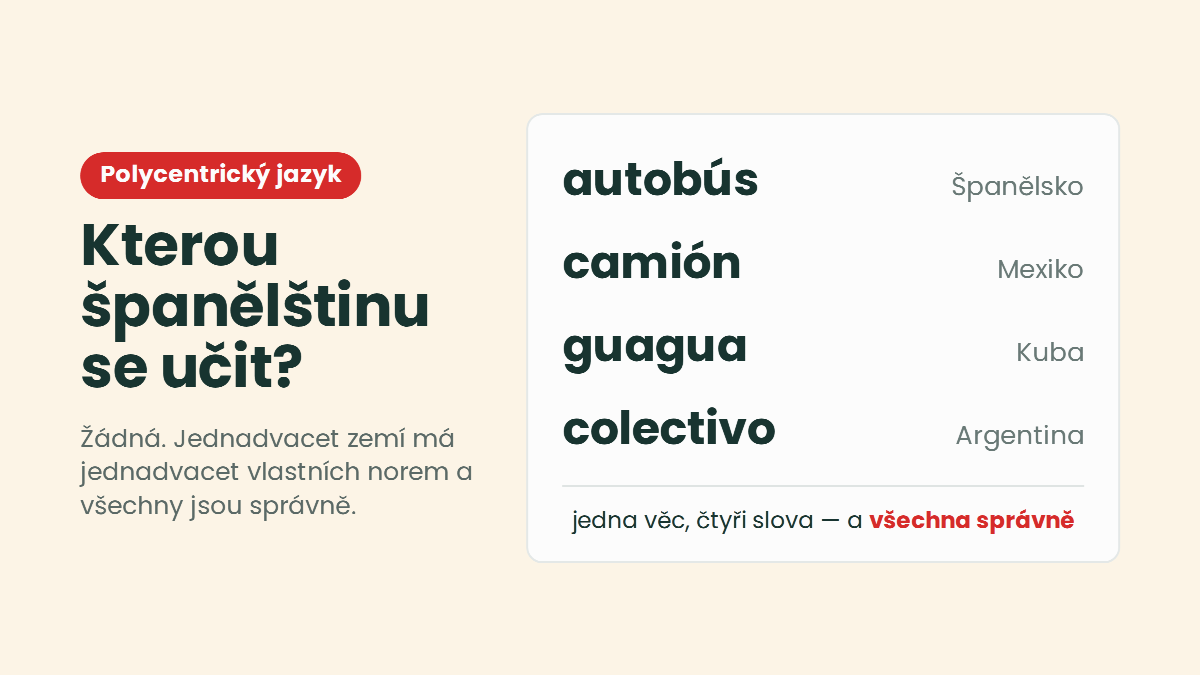
The one within reach. Spanish is a pluricentric language: each of its twenty-one countries has its own variety and all are correct. No Spanish is wrong.

Guide
In-person or online Spanish course?
The same course: same levels, same coursebook, groups of up to six. It comes down to the trip across town, lesson recordings and how you focus at home.
