
Guide
Which Spanish should you learn?
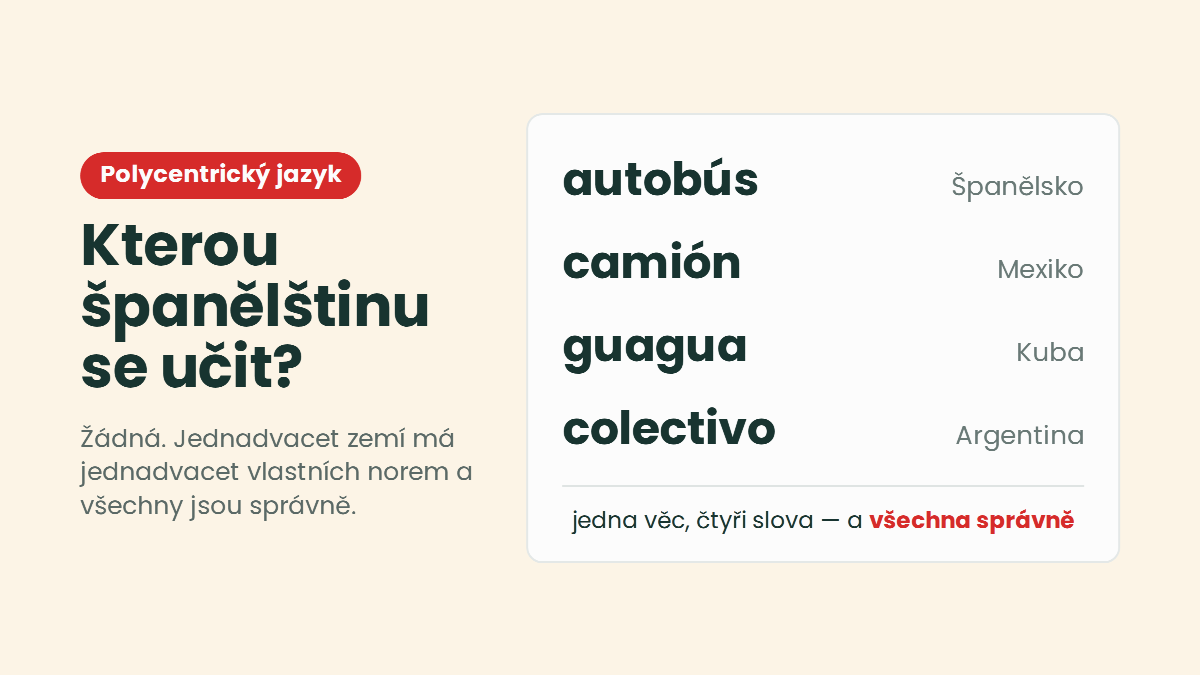
The one within reach. Spanish is a pluricentric language: each of its twenty-one countries has its own variety and all are correct. No Spanish is wrong.
Sooner or later almost every student asks. Which Spanish am I actually learning? Will people understand me in Mexico if my teacher was Spanish – and the other way round? And is there such a thing as the one correct, standard Spanish at all?
The short answer is: learn the one within reach. The longer one is more interesting, because it explains why none of the varieties is the correct one – and why that is good news for you.
The short answer: learn the one within reach
You cannot learn the wrong Spanish. Whether your teacher is Spanish, Mexican or Argentinian, you are speaking Spanish and you will make yourself understood in all twenty-one countries. That does not make the differences between the varieties go away: they are there in pronunciation, in grammar and in vocabulary, and you need to know them and learn them.
On our courses you will meet native speakers as well as bilingual Czech teachers, so you have different accents in your ear from the start; who teaches which course is shown in the timetable. Choosing a variety is therefore the very last thing a beginner needs to worry about. The rest of this article is about why that is, how the varieties differ and what to do about those differences.
There is no single standard Spanish
Spanish is a pluricentric languageA language with several equally valid standard forms: each country has its own norm and none of them outranks the rest. English and German work the same way.. It has no single centre that decides what counts as standard – each country has its own educated standard and none of them stands above the others. Different ways of speaking carry different social status in different countries and regions: a word or a pronunciation that sounds vulgar or uneducated in one region is prestigious, or simply normal, in another.
It is not alone in this: English is pluricentric too, and so is German, which has its own codified standard in Germany, in Austria and in Switzerland – Austrian Jänner is not a mistake measured against German Januar. The contrast is with languages such as Czech or Slovak: those have one standard and one institute that looks after it. Anyone who learnt at school that a language has one correct form should drop that habit when it comes to Spanish.
The core of the grammar and of the pronunciation is nevertheless shared across countries; the differences can be listed, and further down this article they are. Spanish is spoken in twenty-one countries on several continents – in some it is the official language by law, in others simply the language in which the state and the schools run – and yet it keeps a remarkable degree of unity. The Instituto Cervantes, the Royal Spanish Academy (RAE) and the national language academies of the individual countries share one policy on this: all varieties are correct.
“Spanish” Spanish and “Latin American” Spanish do not really exist
That division works as a geographical label, not as a label for varieties of the language. The Spanish of the Canary Islands has far more in common with the Caribbean island varieties – Cuban, Dominican, Puerto Rican – than with mainland Spain. In the Canaries, Venezuela is nicknamed la octava isla, the eighth island – that is how many people left the islands for it.
And the other way round: the Caribbean varieties share a great deal with mainland Spain in turns of phrase, expressions and vocabulary. One reason is the early disappearance of the indigenous population and the close contact with Spain, “just across the sea”. The Andean countries, for their part, share a heritage of Quechua and Aymara that you would look for in vain in Mexico or Central America.
On top of that comes the history of immigration: particular areas took in larger waves from particular Spanish regions. People went to the Caribbean from Andalusia and the Canary Islands; the last great waves came from Galicia, one of the poorest Spanish regions of the time, to Cuba, Mexico and Argentina. Each of them brought a piece of Spain with it, in culture and in vocabulary.
So the map of varieties does not follow the map of continents. It follows seas, mountains and shipping routes.
Today the language is, if anything, converging
The most recent influence works in the opposite direction: in pronunciation and in vocabulary the language is slowly growing more uniform. The internet and international media are doing it: expressions from one variety make their way into the others, so in Spain today you will find newly adopted words from Latin America, and vice versa.
For you this means that you do not have to choose your material by country. Spanish series, Mexican podcasts and Argentinian football commentary will serve you equally well, whoever teaches you.
How the varieties really differ
Mainly in vocabulary. Everyday things can easily have two to five synonyms, and each country has taken to a different one. So when one teacher gives you one word and another teacher a different one, both are right, and you should learn both.
A native speaker has a wider vocabulary than a student, and so usually understands expressions they do not normally use themselves. Yours is not that wide yet, which is why you should learn the synonyms used in different countries as you go along: to the word you know from your teacher, add the ones that are used elsewhere.
The second thing is accent and intonation – what you hear straight away and what your ear has to get used to. Then there are differences in pronunciation, such as whether ll and y are kept apart – there is a separate article on yeísmo (in Czech) about that.
The grammar differs too – in Argentina or in Central America you will hear vos instead of tú, and in Latin America people say ustedes instead of vosotros. The system is one all the same, which is why Spanish can be learnt as a single language. But these differences are part of it: you need to know them, and so they are taught.
Five pieces of advice to sum up
- Learn the one within reach. You will make yourself understood with it everywhere, and it closes no doors.
- Learn the words that are used elsewhere as well. A native speaker understands them because their vocabulary is wider; you still have to build yours.
- Before travelling to a particular country, go through the local words. Above all the ones used there for everyday things that you know by another name.
- Listen to more than one variety. The more accents you have in your ear, the less any further one will surprise you. And it costs nothing.
- Do not look for “the correct one”. There is no such thing, and the energy you would spend looking is better invested in vocabulary.
Where to go next
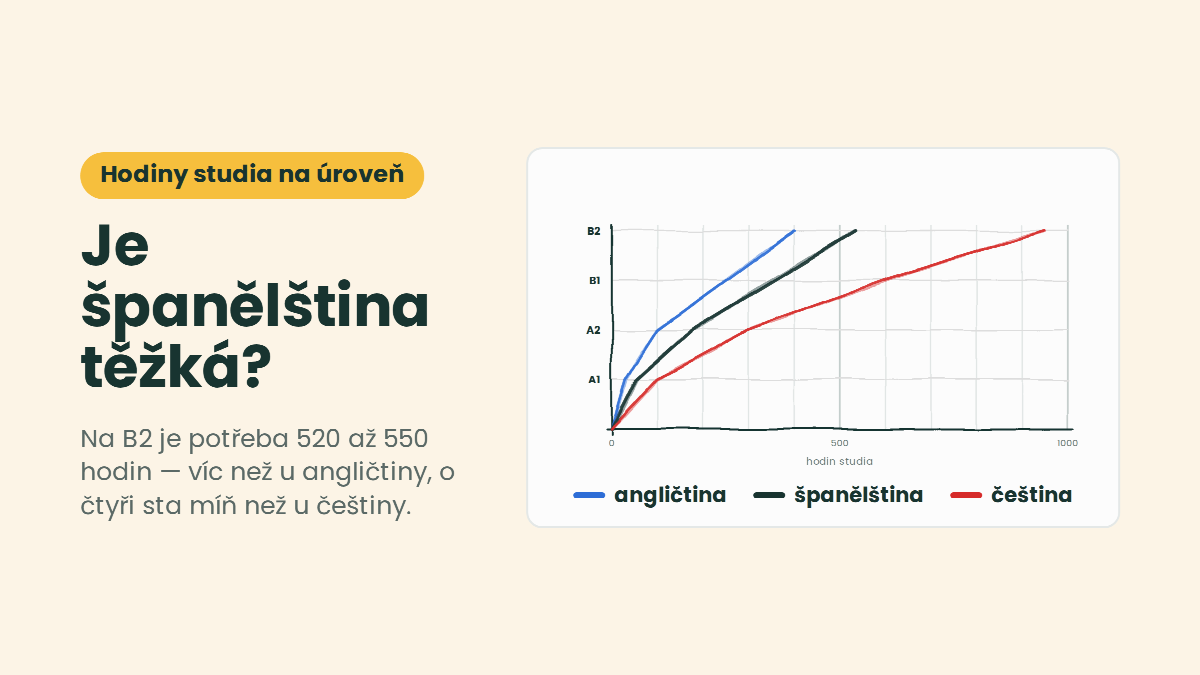
How many hours each level takes, and how long it will take in your case, is worked out in the article on time, calculator included. How demanding Spanish is next to English and Czech is shown in the article on how demanding languages are.
And if you would like to hear it in person, we teach in group courses and one to one.
Frequently asked questions
Which Spanish is the standard one?
Is there a big difference between the Spanish of Spain and of Latin America?
Which Spanish should I learn?
Will I understand people in a country other than my teacher’s?
Article topics Varieties of Spanish Pronunciation Vocabulary
Sdílet článek
Co číst dál

Pronunciation
Perejil: the word that decided who lived
In October 1937, the story goes, the way you said perejil, Spanish for parsley, decided whether you lived or died on the Haitian–Dominican border.
Guide
Is Spanish hard to learn?
For a Czech speaker, Spanish is harder than English and far easier than Czech is for a foreigner. More telling is where each language keeps its hard part.
Guide
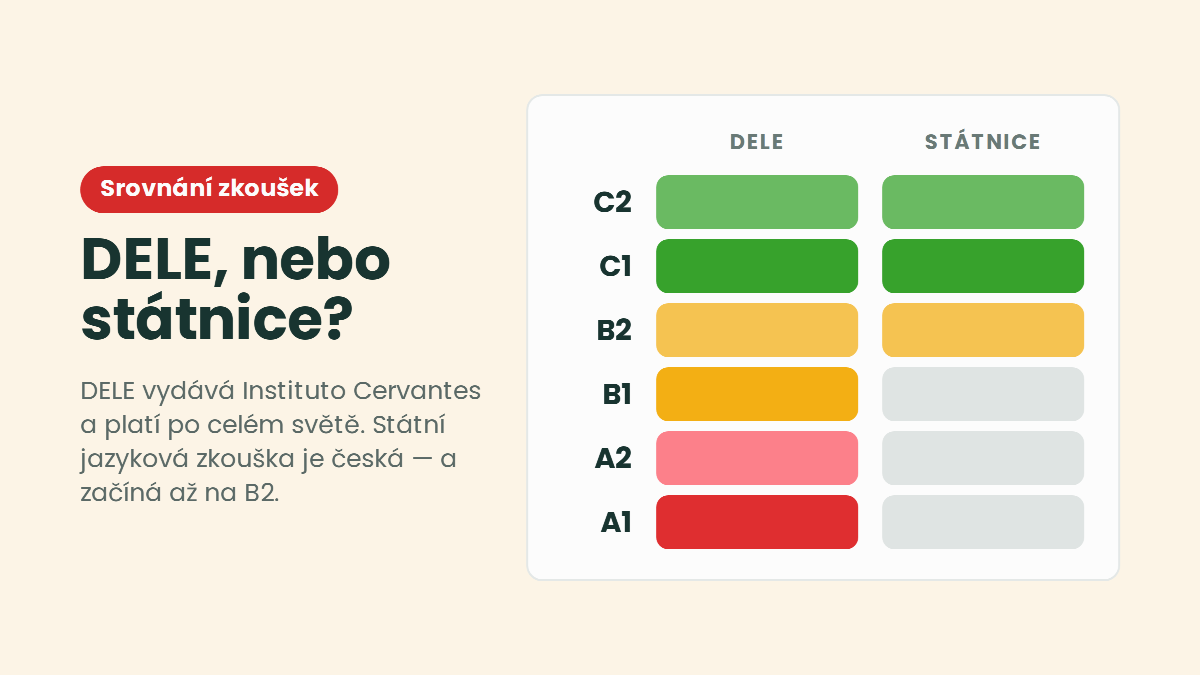
DELE or the Czech state language exam?
The Instituto Cervantes issues DELE, valid worldwide; the Czech state exam starts at B2. What each involves, where to sit it in Brno and who accepts it.
