
Guide
In-person or online Spanish course?

The same course: same levels, same coursebook, groups of up to six. It comes down to the trip across town, lesson recordings and how you focus at home.
Whether you come to the classroom in Brno or join through Google Meet, at Hispánica it is the same course and all you are choosing is the place. Both strands have the same levels, the same coursebook and the same group sizes, and they run in the same term. What differs is everything around the lesson.
One course, two places
In-person and online groups follow the same schedule. A term has sixteen lessons of ninety minutes each, eighteen from level B1 upwards, and there are three to six students in a group. You work from the coursebook for your target level (Nuevo Prisma at A1 and A2, Inmersión at B1 and B2) and the groups are taught by the same teachers, native speakers and bilingual Czechs alike. Enrolment, payment and the terms and conditions are identical for both formats.
Both timetables run during the working week, Monday to Thursday, and both have early-evening as well as early-morning and mid-morning slots. The course pages link to each other: if the times in one list do not suit you, look at the other one for the same period.
The difference at a glance
Classroom in Brno
Online through Google Meet
Getting to the lesson
Classroom Allow for it. Across town twice, there and back.
Online None. The lesson starts wherever you happen to be.
Where you have to be
Classroom On Křenová. The course is held in the centre of Brno.
Online Anywhere. All you need is quiet and a decent connection.
What surrounds the lesson
Classroom People in the flesh. You can finish the conversation in the corridor.
Online Materials and recordings. Both come with the course.
Weekend intensive
Classroom Not offered. Weekdays only.
Online Saturday and Sunday. Mornings, in one block.
Two things are deliberately missing from the table: which levels are open right now and what they cost. The timetable and the prices are put together afresh every term, so in an article they would go out of date and nobody would notice. What applies is always what is shown for the particular group in the listing of in-person and online courses. Both tables show the same period, so you can compare them side by side.
There is no point adding up the pluses in the table. What decides it is more likely whether you feel like going halfway across town at six on a Tuesday.
What the classroom gives you
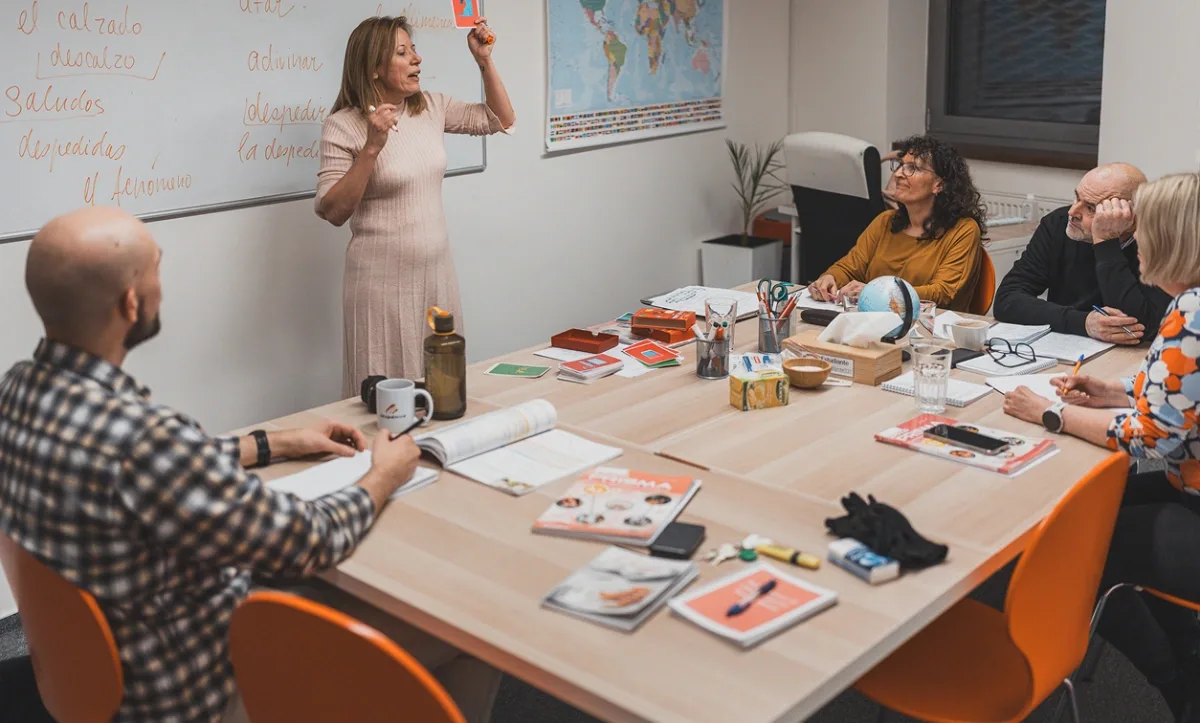
The trip to Křenová is the most tiresome part of an in-person course and also the reason it works. Once you have left the house, the lesson can no longer be put off or done by halves. There are a few people in the room in much the same position as you, and the teacher can tell who is trying to be invisible.
In the room you also hear far more Spanish than you say yourself. The teacher corrects your neighbour, another neighbour asks about something that would never have occurred to you, and someone else’s mistake sticks almost as well as your own. And a conversation that got going in the lesson does not end when somebody closes a browser window.
What Google Meet gives you
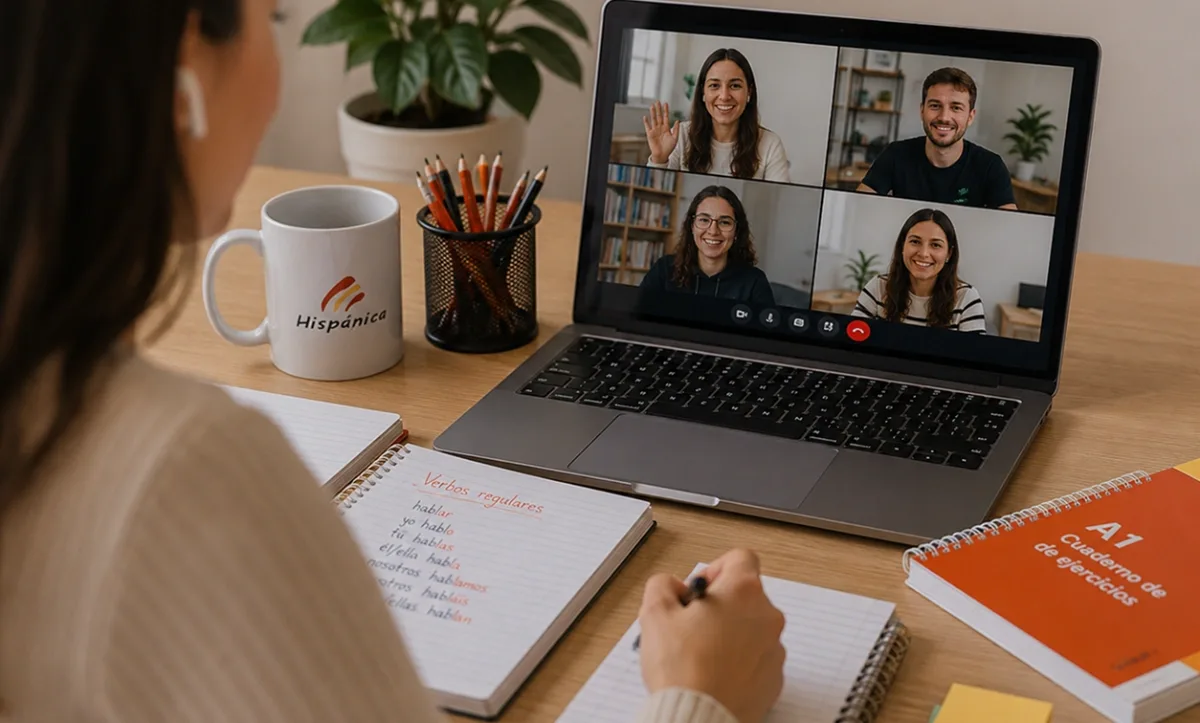
Online courses are live, not recorded: the same time, the same teacher, the same group of three to six people. The difference is where you join from: your living room, the office ten minutes after a meeting, a flat in another town. An hour and a half stays an hour and a half, with no travelling added on.
The course comes with study materials and recordings of the lessons, so you can go back over earlier material even in a week when something crops up in the evening. And with online groups it is worth looking through the morning slots too: a lesson you do not have to travel to can be fitted in before work. The listing of online courses shows what is on offer at the moment.
One thing is not on the Brno timetable at all: weekend courses are taught through Google Meet only, on Saturday and Sunday mornings in one continuous block. And then there are the highest levels: how far up the Brno strand goes and how far up the online one goes is worked out afresh every term, so the only way to find out is to compare the two listings.
Learning does not end with the lesson

Half of the learning happens outside lessons – and that is equally true of both formats. In the lesson you work through the language block by block, in an order that makes sense as a whole, you ask about whatever is not clear, you speak aloud with other people and the teacher corrects your pronunciation on the spot. You cannot arrange any of that for yourself at home. Between lessons, what took shape in class then settles over vocabulary, during listening and over a few written sentences. It comes to a quarter of an hour a day and the course counts on it: the term is built around that ratio.
Neither works without the other. Without that quarter of an hour the lesson would become a pleasantly spent evening, much of which has evaporated by next time – and without the lesson you would be revising at home something you had only ever heard from yourself, including the mistakes you cannot hear.
For choosing a format, one thing follows from this: the part outside lessons looks exactly the same in both formats. Whether you travel to the lesson or join online, at home you sit over the same coursebook and work to the same plan. If the journey into Brno takes up the very time you would need for vocabulary, you have a good reason to try Google Meet.
The course also includes a quarter of an hour’s consultation a week, for when something from the lesson is still unclear. It is arranged by email and can take place in person, by phone or through Google Meet; the format of your course makes no difference here at all.
If you are not sure
You do not have to choose blind. The language interview is free, and besides your level it gives you a recommendation of which time slot and which format will suit you best. On courses for complete beginners, moreover, if you say after the first lesson that it is not for you, you get the course fee back in full.
And if it turns out during the term that the course does not suit you in level or in the make-up of the group, you can transfer to another one once a term, provided there is a place on it. For in-person courses the school also reserves the option of moving teaching online temporarily, so a closed classroom does not mean a missed week.
So where should you enrol?
The classroom in Brno, if…
- you live or work somewhere that puts Křenová on your way,
- you cannot make yourself study at home and need to get out of the house,
- you want to talk to people you can see in full, not just from the shoulders up,
- you are starting from scratch and want the teacher within arm’s reach,
- you can rely on having a weekday early evening free in your diary.
Online, if…
- you are not from Brno, or the journey would cost you an extra hour,
- your week looks different every time and now and then you are somewhere you did not expect to be,
- you want to start early in the morning or study at the weekend,
- you are aiming for a level that is not on offer in Brno right now,
- price is the deciding factor and at your level it differs between the formats.
If both cards spoke to you, decide by the timetable, not by the format. The exact time, the teacher and the places left are shown for every group in both the in-person and the online courses, and both tables show the same period.
Not sure what level you are? Get in touch and we will arrange a free interview. It takes a short while and gives you a level, a time slot and a format – quite possibly one you had not considered.
Where next
- In-person group courses in Brno – timetable, prices and places left for this term.
- Online group courses – the same period, taught through Google Meet.
- Weekend courses – an intensive Saturday and Sunday, online only.
- One-to-one tuition – taught both in person and online, at times you set yourself.
- Language levels – what you can do at A2, at B1 and beyond.
- Group course or one-to-one tuition? (in Czech) – the other half of the same decision: here you choose where from, there you choose who with.
- How long does it take to learn Spanish? – a calculator for the hours and weeks to your goal.
Image sources
The photographs of the classroom and of the online lesson are our own. The others come from Wikimedia Commons and are stored on our site reduced in size and cropped, otherwise unchanged.
- Lead photograph – Laptop and books, Kari Shea, CC0.
- Photograph of note-taking at a table – Taking notes at a coffee table, Tran Mau Tri Tam, CC0.
Frequently asked questions
Is an online Spanish course as good as an in-person one?
Is an online course cheaper than an in-person one?
What platform is used for online lessons?
Can I attend the higher levels in the classroom in Brno?
Can I study Spanish at the weekend?
How much do I have to study at home on an online course?
Article topics Choosing a course How to study
Sdílet článek
Co číst dál

Guide
How long does it take to learn Spanish?
A1 takes 40 to 70 hours of study, A2 another 120, and B1 and B2 180 each. The calculator in the article works out how many weeks that means for you.
Guide
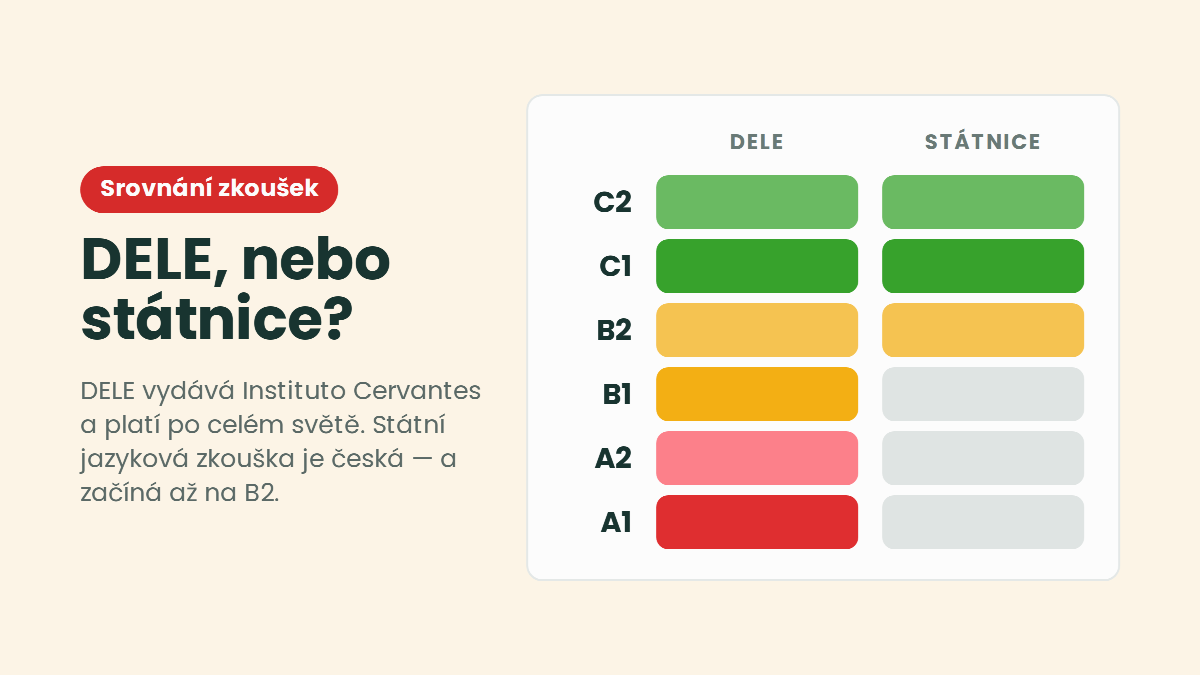
DELE or the Czech state language exam?
The Instituto Cervantes issues DELE, valid worldwide; the Czech state exam starts at B2. What each involves, where to sit it in Brno and who accepts it.
Guide
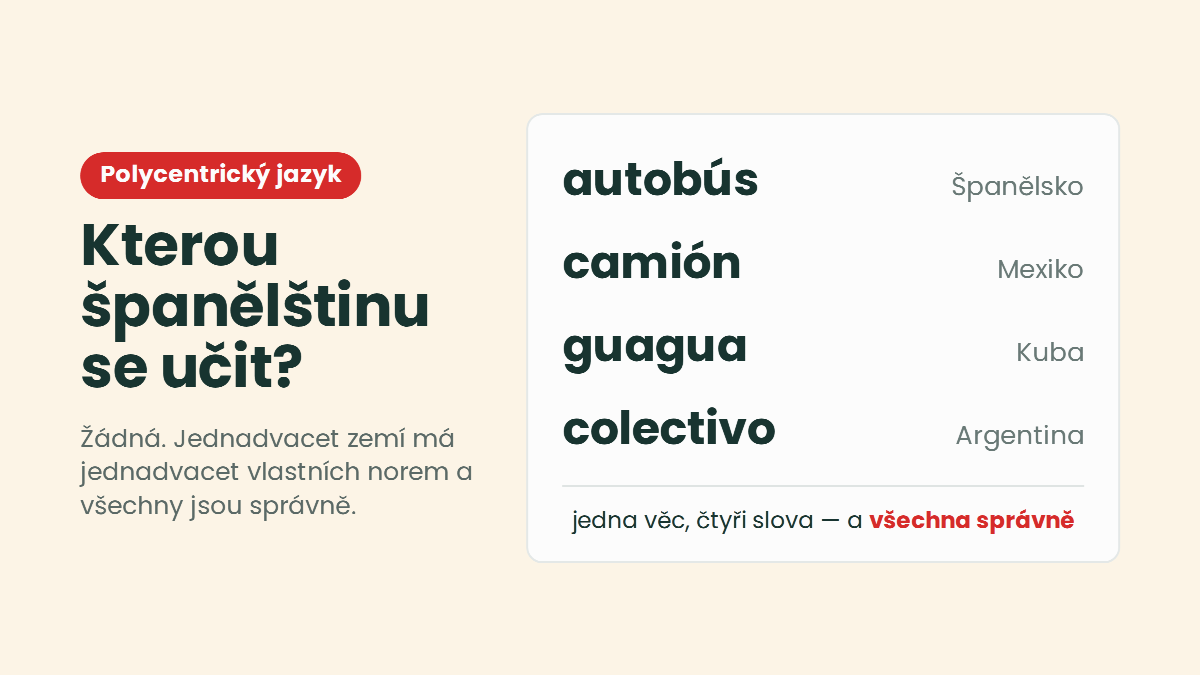
Which Spanish should you learn?
The one within reach. Spanish is a pluricentric language: each of its twenty-one countries has its own variety and all are correct. No Spanish is wrong.


