
Guide
How long does it take to learn Spanish?

A1 takes 40 to 70 hours of study, A2 another 120, and B1 and B2 180 each. The calculator in the article works out how many weeks that means for you.
The most common answer online is “it depends”. It does, but less than people say. For someone starting from scratch, the number of hours can be estimated, and quite precisely at that. Here are the figures we work with for our own students, and right below them a calculator that turns them into a number of weeks at your own pace. The figures come from teaching Czech and Slovak speakers; if your first language is a different one, read them as a close guide rather than a promise.
Before you look at the big numbers further down: you will say your first sentences after a few lessons. Ordering food, asking the way, saying where you are from and what you do – one term is enough for that. The rest of the article is about what comes afterwards.
How many hours each level takes
Each figure is one step, that is, the way from the previous level to the one shown; on the right is the running total from zero. An hour means an hour of real work with the language, whether it is a lesson with a teacher or study at home: both count the same.
Why A1 has a range and the rest a single figure. At the start, what matters is how many foreign languages you already speak and whether you have any experience of learning one. If you have English or German behind you and know how to revise vocabulary, you will get through A1 in forty hours. If this is the first foreign language of your life, you will need seventy – and that is no criticism, you are simply learning how to learn a language alongside the Spanish. From A2 upwards the difference fades. In the bar above, the solid part is the forty hours everyone needs and the lighter part is that difference.
Why there are so many hours at the top. C1 takes 250 hours and C2 another 350, which together is more than the whole way from zero to B2. At those levels you are no longer adding new words and tenses; you are polishing accuracy, style and nuance, and that goes slowly. Most people never need to get there at all – the section further down explains why.
Do not read this as a course timetable. The table counts net time spent working with the language, not hours spent in the classroom. Part of every course goes on revising and settling what has already been covered, and the higher you go, the larger the share of the work you take outside the classroom – listening, writing, exercises, speaking when you travel. By B2, a lesson is more of a signpost for what you do all week.
What you can do at each level
| Level | Total from zero | What you can do with it |
|---|---|---|
| A1 | 40–70 h | You can introduce yourself, order, and ask the way. |
| A2 | 160–190 h | You can handle everyday situations on holiday and give a simple description. |
| B1 | 340–370 h | You get by on your own, tell a story and briefly defend your opinion. |
| B2 | 520–550 h | You speak fluently, work in the language and argue your point. |
| C1 | 770–800 h | You command the language for professional work and writing. |
| C2 | 1,120–1,150 h | You understand practically everything and express yourself precisely, shades of meaning included. |
Work it out for yourself
The total number of hours is half the answer. The other half is how long it takes you to collect them and how many of them stay in your head. Move the sliders to suit you – how often you would come and how much time you can realistically find at home – and you have your own number. Our term course is one ninety-minute lesson a week; the calculator starts at two shorter ones, because that way you progress faster.
From scratch to A1
15–25 weeks
Getting from scratch to A1 takes 40 to 70 hours of study. With two lessons of 60 minutes a week, 90% attendance and 50% of your study done at home, that works out at 3.6 hours a week — and once you allow for how effective group teaching is and for 20% forgotten between lessons, it leaves 2.8 hours of effective study. That is 15 to 25 weeks, or 3 to 6 months.
| Hours with a teacher each week | 2 hours |
|---|---|
| Of which you actually attend | 1.8 hours |
| Study at home each week | 1.8 hours |
| Total time each week | 3.6 hours |
| Gap between lessons | 3.5 days |
| What is left after forgetting | 89% |
| Effective study each week | 2.8 hours |
Why you cannot simply divide the hours
If dividing were enough, the calculation would fit on one line. But three things stand between an hour in the timetable and an hour that really counts. All three are in your own hands.
Attendance will never be one hundred per cent
A business trip, an illness, a child with a temperature. Something always comes up during the term, and hardly anyone gets above ninety per cent. That spoils nothing. In a group course you ask the teacher for the content of the lesson you missed and catch up at home; in one-to-one lessons there is nothing to catch up on – you just cancel the lesson at least twenty-four hours in advance and it moves to another date. That is why attendance has its own slider in the calculator, so you can see in advance what it does to your pace.
The course and the work at home go together
The lesson with a teacher is the part you cannot replace at home. It takes you through the language block by block in an order that makes sense as a whole, you ask about whatever is not clear, you speak out loud and answer other people – and someone corrects your pronunciation before a mistake sets in. At home you do the things that keep the material from the lesson in your head: vocabulary, listening, reading, a few written sentences. One does not work without the other, and the figures in the table above count both together. For anything from the lesson that did not click, the course also gives you fifteen minutes of consultation a week; it does not replace a missed lesson, but it is plenty for one unclear point.
Half of the learning happens outside the lessons, and our group courses are built around that. A term has sixteen ninety-minute lessons (eighteen in the more advanced courses), that is, 24 hours in the classroom, and the work at home between them takes roughly the same amount of time. That comes to an hour and a half a week, or a quarter of an hour a day. Nobody asks more of you. With one-to-one lessons the ratio shifts according to how much time you have and how often you come; there you build the timetable yourself.
With us, one step is several courses in a row: A1 is A1.1 and A1.2, A2 is then A2.1 to A2.3. How long the step takes, though, is your choice – the same content can be covered in a term course, in a summer intensive or at weekends, and accordingly one course works out at a term, two months or one month.
There is one more thing the hours alone do not show. In a group, which with us has six people at most, speaking time is shared and the whole group sets the pace, so an hour with the teacher gives you less than an hour that is yours alone. The calculator allows for this: with everything else set the same, one-to-one lessons come out a tenth to a fifth faster, and the more time you add at home, the smaller the difference. Time at home is not affected; it is just as effective either way.
A1 shows it best. If you come only in the main terms, in spring and autumn, you have it in a year. If you take the summer as well, when the courses are more intensive, you are done in half a year. And if you choose weekend courses, you can do A1 in two months. The same material, a different pace – all you choose is what fits your calendar.
That quarter of an hour a day is the whole secret. If you do it, you go exactly to plan; if you do not, you will get there too, it will just take you more courses. Nothing worse happens.
You forget between lessons
This is the one people underestimate most often. What you learn and then do not return to for a week is largely lost, and part of the next lesson then goes on what has already been covered once. The shorter the gap, the less is lost, which is why two lessons a week take you forward more than twice as fast as one.
And even a little helps. Ten minutes on the tram on the way home from work keeps the material from the last lesson fresh until the next one. Just mind one difference: revision alone keeps you where you are; only revision and new material mean that in a month you know more than you do today. That is why it makes sense to attend a course and revise at home, not one or the other.
The calculator simplifies this: the percentage you enter is the loss over a week without revision, and a shorter gap reduces it proportionally. It is useful for comparison – try switching from one lesson a week to two and see what that does to the end date.
What “speaking Spanish” means
This is where most people set the bar far higher than they need to. The average native speaker of any language, English included, operates at B1 to B2 in everyday life. They do the shopping, sort things out at work, tell stories, have an argument, read the news. They need nothing more – and most likely neither do you.
You do not reach C1 and C2 just by living in the language. It takes targeted training, a lot of writing and a lot of speaking – the work of an editor or a translator. That is also why it is six hundred hours more.
For you this is good news: for travel, for work and for life in a country where Spanish is spoken, B2 is enough. And that is just under six hundred hours – not a thousand, not two thousand.
Five things that will shorten the journey
- Coming more often beats coming for longer. Two sixty-minute lessons take up the same space in your timetable as one hundred-and-twenty-minute lesson, but the gap between them is half as long and you forget less in it. Switch it in the calculator and see how many weeks it saves.
- A quarter of an hour a day keeps you on plan. It is the cheapest part of the whole course: it costs nothing, fits between two stops, and is exactly what turns the lessons you have attended into knowledge you take away with you.
- One to one, it goes a tenth to a fifth faster. The whole lesson is yours, you speak more and the pace follows you. In a group, on the other hand, you hear the others and it costs less – both have something going for them.
- After a longer break, a short refresher pays off. A few days of listening or revising vocabulary before the term starts is enough for the first lessons not to go on warming up, so that you move forward straight away.
- The goal is B2, not C1. With B2 you get by at work and when travelling, and it takes fewer than six hundred hours. Aiming higher makes sense only once somebody asks you for it in writing.
Where to go next
Whether Spanish is hard compared with English and Czech is shown in the article on how demanding languages are. If you are wondering which Spanish you are actually learning, read the article on which Spanish to learn. What you can do at each level is described on the language levels page.
And if you would like to try it in person, we teach in group courses of six people at most and one to one. Not sure what level you are at? The placement interview with us is free, and we will recommend a course on the basis of it. Enrolment stays open until the course fills up.
Image source
- Photograph of writing in a notebook – Pen-writing-notes-studying, Tookapic, CC0.
Frequently asked questions
Can you learn Spanish in a year?
Do I need C1 to get by?
Why does A1 have a range of 40 to 70 hours and the rest a single figure?
Is one long lesson better, or two shorter ones?
How much do I have to study at home?
Are one-to-one lessons really faster?
How many hours do C1 and C2 take?
How many years is that if I attend a course once a week?
Article topics How to study Levels
Sdílet článek
Co číst dál
Guide
DELE or the Czech state language exam?
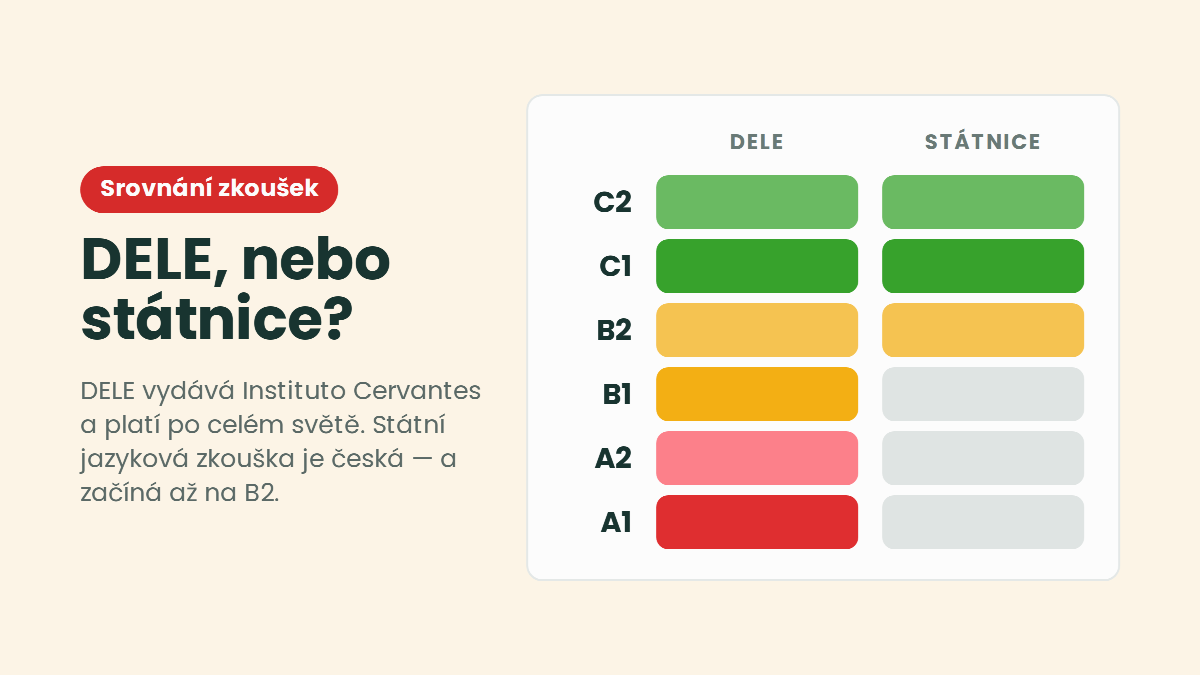
The Instituto Cervantes issues DELE, valid worldwide; the Czech state exam starts at B2. What each involves, where to sit it in Brno and who accepts it.

Guide
In-person or online Spanish course?
The same course: same levels, same coursebook, groups of up to six. It comes down to the trip across town, lesson recordings and how you focus at home.
Guide
Which Spanish should you learn?
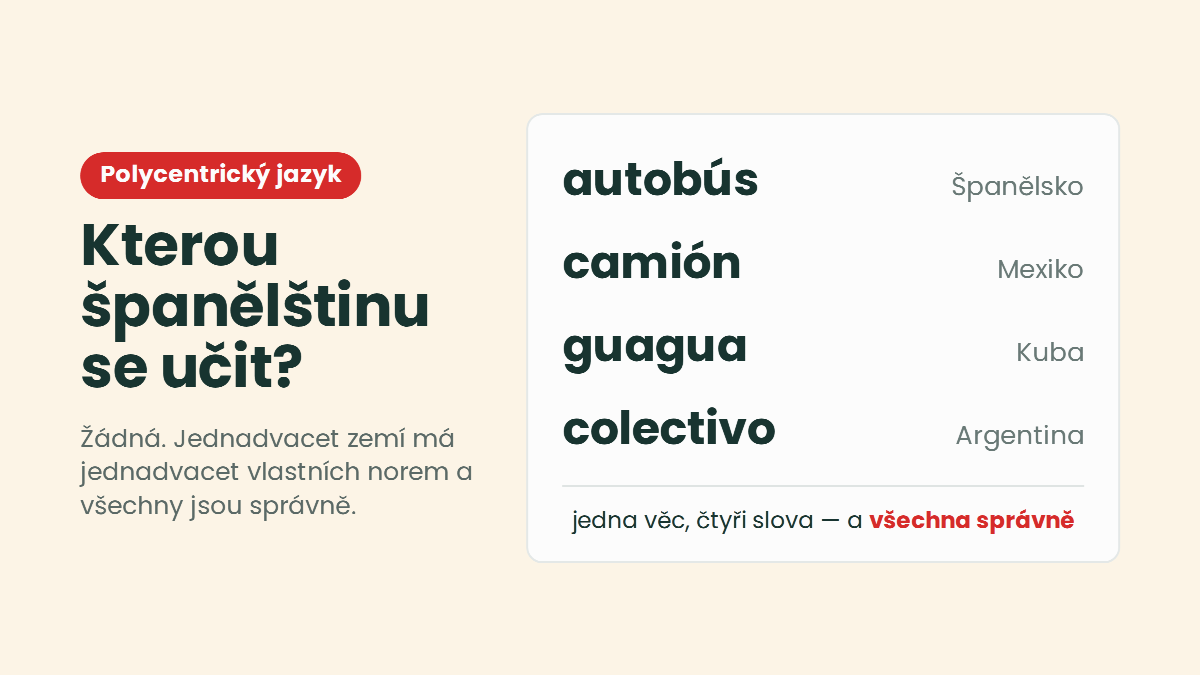
The one within reach. Spanish is a pluricentric language: each of its twenty-one countries has its own variety and all are correct. No Spanish is wrong.

