
Guide
Why Spanish speakers have two surnames
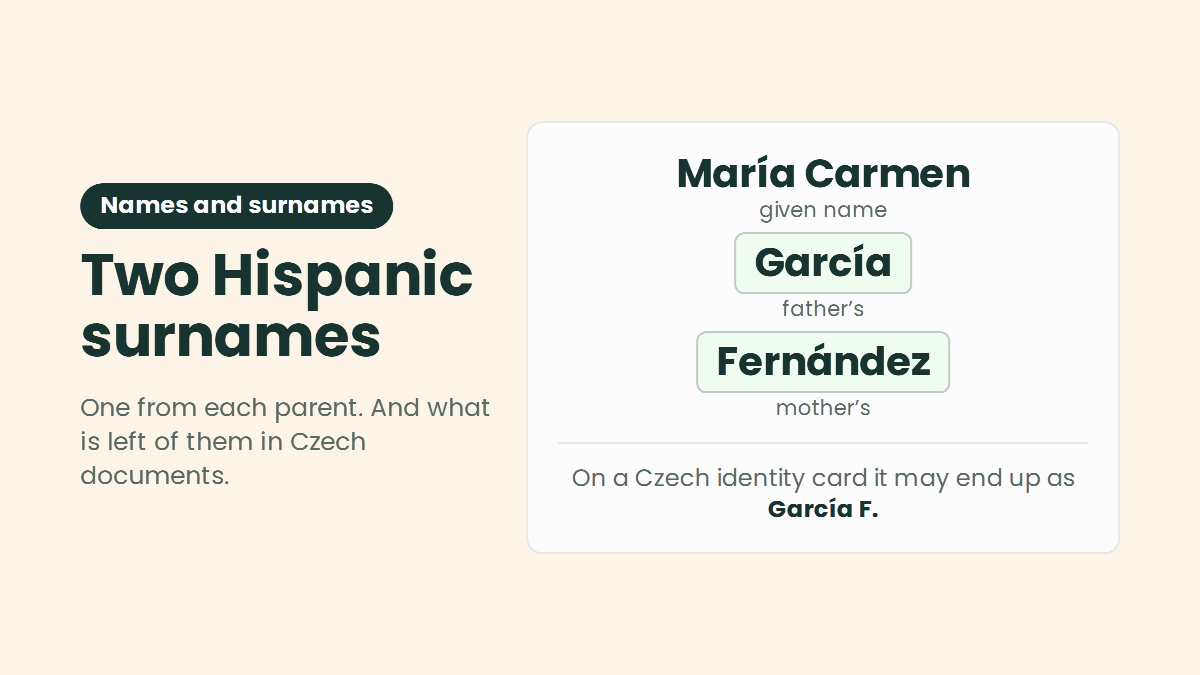
People in Spanish-speaking countries have two surnames, one from each parent. Which is the main one, what marriage changes and how Czechia records them.
A Mexican woman, a Colombian man and a Spaniard all have two surnames on their business cards. Neither comes from a husband or a wife, and none of the women in their families has a surname ending in -ová, as Czech women’s surnames usually do.
We will take it in order: what a name is made of in the Spanish-speaking countries and which of the two surnames is the main one, how to ask about a surname, why so many of them end in -ez, whose surname comes first, what marriage does, how Argentina differs, how Portuguese does it the other way round, and why accents go missing from documents. Czechia comes last: what a Czech register officeIn Czechia, the matrika: the official register in which births, marriages and deaths are entered, and also the office that keeps it. In Spanish-speaking countries it is called the registro civil. does with a Hispanic surname, and what is left of two surnames in a passport.
What a Hispanic name is made of
The spelling guide to Spanish, published jointly by the language academies of the Spanish-speaking countries, puts it in a single sentence: a name consists of a given name, simple or compound, and the first surname of each parent. Its examples are María Rosa Ordóñez Robles and Pedro Linares Cobo. The word that matters is “first”. A child does not receive just any two surnames. It receives the one that comes first for one parent and the one that comes first for the other.
According to the same guide, a surname belongs to the family and says whose child you are. That is why people do not choose it, and why it can be changed only exceptionally.
This is how names are put together in most of the Hispanic world. The exception is Argentina, where people traditionally bear one surname; it has a section of its own below.
Of the two surnames, the first is the main one. A child receives only the first surname of each parent, so only the first is passed on. Lists are ordered by the first surname too: the academies’ spelling guide calls it the axis of alphabetical ordering and gives the model Pérez García, José. So Gabriel García Márquez is found under G. And when only one surname is given, it tends to be the first.
One exception matters. When the first surname is so common that it does not tell a person apart, people reach for the second. The philologist Sebastián Mariner described it this way in 1988: second surnames turn up the more often, the more common the first is, and sometimes they push it out altogether. His examples are the Hellenists Fernández Galiano, Rodríguez Adrados and Sánchez Lasso, known as Galiano, Adrados and Lasso.
That is why people say García Márquez and García Lorca, and in the end call the poet simply Lorca. In its article on the two surnames, BBC Mundo asks whether you would recognise the pair as Gabriel García and Federico García.
How to ask, and how to address someone
Now for the part you will need when speaking. Czech asks what someone is called in a single sentence and gets both the given name and the surname. Spanish has a verb of its own for surnames, apellidarse. The academies’ dictionary of Spanish shows it in the sentence Marta se apellida Delgado, Marta’s surname is Delgado. The dictionary of Mexican Spanish has the question itself: ¿Cómo se apellida? To someone you are on first-name terms with, ¿Cómo te apellidas?
You can answer with both at once: Me llamo Juan y me apellido García. My name is Juan and my surname is García.
Three terms are worth knowing. You will meet them when people introduce themselves and on forms.
| Term | What it means |
|---|---|
| Nombre | given name, simple or compound |
| Primer apellido | first surname, traditionally the father’s |
| Segundo apellido | second surname, traditionally the mother’s |
In Latin America the two surnames are also commonly called apellido paterno and apellido materno, the father’s surname and the mother’s.
A fourth term comes in handy. The office that records names, the register office, is called the registro civil throughout the Spanish-speaking countries.
That leaves how to address people. Señor and señora go with the surname, el señor García. Don and doña go with the given name, don Francisco. Señor with a given name, el señor Pedro, exists as well, but according to the academies it is not usual in every country or in every social class. And mind the spelling: señor and doctor are written with a small letter, the abbreviations Sr. and Dr. with a capital.
Why so many surnames end in -ez
Fernández, Martínez, Rodríguez, López, Sánchez. BBC Mundo writes that Spain, and Latin America after it, has little variety of surnames, and that this is exactly why it is useful to have two: the second sets you apart from all the other Fernándezes.
All of these surnames are patronymicsA surname formed from the father’s given name. Rodríguez was originally Rodrigo’s son.. Rodríguez comes from Rodrigo, Martínez from Martín. García is one of them too, only without a suffix: the surname sounds the same as the given name it came from.
Why there are so many is explained by the Argentine genealogist Prudencio Bustos. Patronymics were the very first surnames; they appeared and spread around the tenth and eleventh centuries. And they were formed from given names, so the same surname arose many times over, independently. There may be as many families called González, he says, as there were Gonzalos who had children in the Middle Ages. Genealogists have a maxim for it: the same surname does not mean the same lineage.
Where -ez comes from
There is no simple answer. In 1982 the philologist Gabriel Verd wrote that patronymics in -z are one of the most complex and most debated problems in Hispanic linguistics. Jaime de Hoz, in his 2016 doctoral thesis on the emergence of surnames in Castile, writes that the origin of the suffix has still not been cleared up.
The explanation given most often is the Latin genitive: Rodericus, Roderici, Rodríguez. Yet even those who present this hypothesis as the prevailing one admit that it does not explain why the suffix appears with every vowel: -az, -ez, -iz, -oz, -uz. A second explanation relies on the Latin genitive in -onis and on Basque pronunciation. A third on a pre-Roman language. A fourth on a Germanic genitive of the kind seen in the surname Ericsson.
Against the idea that the suffix is Basque there is a neat objection. Basque forms such surnames differently, with the suffix -ena: Martín gives Martiñena, Juan Juanena, García Garziarena. The question is not settled. Verd speaks only of what is “more probable as a hypothesis”, and writes himself that proof is not what he is after.
The oldest accepted record dates from 824. The charter for Brañosera, in what is now the province of Palencia, has ego Monnio Nunniz, that is, Monnio, son of Nuño. De Hoz remarks that whatever gets written down must have been said for quite some time beforehand.
Son of a Munio who is no more
Some surnames have outlived the name they came from. Muñoz is from Munio, Bermúdez from Bermudo, Ordóñez from Ordoño. The names Munio, Bermudo and Ordoño have since died out.
At first the patronymic was not inherited and changed with every generation. Among the kings of Navarre this produced a regular series: Sancho Garcés I, his son García Sánchez I, his grandson Sancho Garcés II and his great-grandson García Sánchez II. Surnames began to be passed on unchanged from the fifteenth century, with exceptions as late as the seventeenth.
The preposition de does not belong with patronymics. It belongs with surnames taken from places and says where from: Juan de Toledo, Andrés de la Vega. It does not mean noble descent, although that is the received wisdom. Bustos calls it a mistaken assumption that came in from France in the eighteenth century, and points out that slaves bore de too. Navarro is a different case again. It means a person from Navarre, which is why it has no de.
Then there are surnames taken from trades. De Hoz explains why Castile has so many people called Herrero, Carpintero and Zapatero, that is, Smith, Carpenter and Shoemaker. There were not that many craftsmen. Those trades were exempt from taxes, and so they were carefully entered in the rolls. Pastor is documented too. Caballero and Escudero are not trades; they denote social standing.
Why exactly two
The genealogist Antonio Alfaro de Prado, president of the Hispagen association, explains it to BBC Mundo with a single custom: in Castile and Aragon a woman kept her own surname after marrying, unlike in the rest of Europe. So for centuries families knew that there was a father’s surname and a mother’s surname. For a long time there was no fixed order. In one family the eldest son might bear the father’s surname and the other children the mother’s, or that of one of the grandparents.
When this became a system is described by de Hoz. According to him, the pairing of the father’s and the mother’s surname takes hold from the reign of the Catholic Monarchs, and it had two reasons. The first was inheritance: one could inherit through the father’s line and through the mother’s, so it paid to state both. The second was proving “purity of blood”: two surnames showed that a person’s descent was not “suspect” on either side. As an early example he cites a document of 1503. In it María Pimentel y Osorio also bears her mother’s surname, which grounded her claim to an inheritance and a title.
The custom reached the Americas from Spain and stayed there after independence. Alfaro gives two reasons. The idea that a woman has a surname of her own was deeply rooted there. And two surnames suited the authorities, because they make it easier to tell people apart.
Whose surname comes first
Traditionally the father’s. The academies’ spelling guide says that the father’s surname usually comes before the mother’s, and adds straight away that many countries allow the order to be chosen.
In a 2023 overview the Colombian lawyer David Namen Baquero names Spain, Argentina, Mexico, Uruguay and Colombia among the countries where parents can now choose. Behind the change, he writes, was the campaign for women’s equal rights.
Custom changes more slowly than rules. It can rarely be counted, and there are no figures for the Hispanic world as a whole. One of the few sets was published by the register office of the Argentine province of Mendoza for 2025: of the children registered with two surnames, 95% had the father’s first. That is one province of one country, so take it as an illustration, not as a yardstick for the rest.
What marriage does
To the surname, nothing. In the Hispanic tradition a woman keeps her surnames after marrying and passes them on to her children. Alfaro sees this as the reason two surnames arose in the first place.
Alongside this there is the form María López de García: her own surname, the preposition de and her husband’s surname. It is an addition; the woman does not lose her own surname. The academies’ spelling guide describes the custom as increasingly rare and gives the examples María Soto de Alvarado and señora de Alvarado. The language advice service of the University of Piura, in Peru, adds that it is not a general rule and that it depends on the country.
The custom is not an old one. Bustos writes that it gained ground only in the second half of the nineteenth century, and warns of a common mistake: the wife of General San Martín is today called Remedios de Escalada de San Martín, although she never signed herself that way in her lifetime. Carmen Diana Deere and Magdalena León confirm it for Colombia. In the colonial period women there kept the surnames they were born with after marrying, de spread at the turn of the twentieth century, and by the end of that century it was already disappearing.
Today the same thing is heard from one country after another. The advice service in Piura writes that in Peru it was common until recently and is no longer used. In 2019 the Mexican writer María del Pilar Montes de Oca called it archaic; in her account it was still common among the post-war generation. The Spanish columnist Ignacia de Pano wrote of it in 2024: “that custom, a very bourgeois one, fell out of use long ago”. And from Mendoza in Argentina: once widespread, today it hardly exists.
Why is it fading? The reader who asked about de in Piura wrote that to her it “sounds like property”. The service replied that this is probably the very reason it is no longer used.
Argentina sits halfway
Argentina is the exception among the Spanish-speaking countries. Traditionally people there bear one surname, the father’s. BBC Mundo recalls that mass immigration from Europe brought the country a great wealth of surnames. Two surnames used not to be a popular habit there; they belonged to the upper middle class and to well-known families.
Today parents choose. A child may bear the first surname of one of them, or of both in the order they agree on, and brothers and sisters then have it the same way.
And more and more often they choose two. There is no national figure; only the figures for two provinces are known. In Mendoza, 67% of the 17,557 newborns registered in 2025 received two surnames: 64% with the father’s first and 3% with the mother’s. Just under 18% of children bore only the father’s surname, and 15% only the mother’s. In Santa Fe, three children in ten were registered with two surnames in 2024.
So Argentina sits halfway: one surname, as is the custom outside the Hispanic world, and more and more often a second one to go with it.
In Portuguese it is the other way round
The Portuguese-speaking world also has more than one surname, but traditionally puts them the other way round: the mother’s first, the father’s last. The one passed on is the last, so once again the father’s. That holds for Portugal and for Brazil alike. BBC News Brasil writes that the most widespread form of a name gave children the mother’s surname first and the father’s after it, the reverse of what took hold in Spain and its former colonies.
That is why names from Portuguese are looked up under the last surname in lists, and shortened to it as well. The academies’ spelling guide has an example: Fernando António Nogueira Pessoa is Fernando Pessoa and stands under P.
It is a custom, and parents do not have to keep to it. Portugal’s institute for registries says on its website that the order of surnames follows no rule, and that there may be as many as four. BBC News Brasil says the same of Brazil: children may have the father’s and the mother’s surnames in whatever order the parents choose.
In Portuguese-speaking Africa local customs come on top of that. From Angola the justice ministry official Lucas Guido describes it as very common for parents to make up a child’s surname from the given names of the grandfathers. For the south of Mozambique, Júlio Machele of Eduardo Mondlane University in Maputo describes a name in three parts: the person’s own name, the father’s name and finally the surname, or clan name. The father’s name in the middle can be seen in Guinea-Bissau too: in the name Besna Fernando Infangú, Fernando is the father’s name.
The biggest difference from Spanish is marriage. The custom of a woman taking her husband’s surname settled in Portugal, and after it in Brazil, in the nineteenth century. Today it is in retreat. According to figures from Brazilian register offices published by the newspaper O Globo, women took their husband’s surname in 39.7% of marriages in 2024; in 2003 it was over 49%. Fewer than one bridegroom in a hundred takes his wife’s surname.
One given name or two
A given name may be simple or compound: José Luis, José Manuel, María José. The academies’ spelling guide has a note on these that is useful when speaking. In compound names, especially those with José and María, only the second part is pronounced with stress, so José Luis sounds like a single word, joseluís. In writing, both parts keep their accent.
A preposition and an article inside a name are written with a small letter: María del Carmen, Juan de Dios, María de los Ángeles.
The academies call pet forms of names hipocorísticos and list, for example, Paco and Curro from Francisco, Pili from Pilar, Quique from Enrique, Goyo from Gregorio and Nando from Fernando. Pepe is more complicated. It did not arise directly from José but from the Italian Beppe, the pet form of Giuseppe.
Some pet forms now work as names in their own right. Among its examples the guide gives Lola, Álex, Malena, Marisa, Sandra and Tina.
The accent that is missing from documents
Some Hispanic surnames are written in documents without the accent over the vowel, although they should have one. The academies’ spelling guide says expressly that given names and surnames follow the same accent rules as other words, and names García, Gutiérrez and Martín straight away.
The usual reason is a widespread mistake: that accents are not written on capital letters. It is not true and never has been. According to the academies’ spelling guide, a capital and a small letter are two forms of the same thing, so there is no reason why they should differ in their accents, and right beside it stand the examples CÓRDOBA and Álvaro. The only exception is for abbreviations written entirely in capitals, such as CIA.
The mistake goes back to the typewriter, on which an accent could not be put over a capital letter without cutting into the body of the letter. The RAE, the academy in Madrid, adds a sentence on its website that says it all: the spelling rules have never changed on this point.
From paper it passed into documents. A teacher from Mexico writes to the language advice service of the University of Piura that all her life she wrote her surname Durán without the accent, because it is in capital letters on her birth certificate. A second query there comes from Peru: on the birth certificate the surname has its accent, on the identity card it does not. The service gives both the same answer: the accent belongs there.
Bear in mind, though, that not every name without an accent is a mistake. In Argentina and the Caribbean Óscar is also pronounced with the stress on the second syllable, and is then written Oscar.
A Hispanic surname in Czech documents
The Czech act on registers contains the sentence: “Women’s surnames are formed in accordance with the rules of Czech grammar.” That is přechylováníForming the feminine version of a surname from the masculine one. Czech usually does it with the ending -ová or -á: Novák and Nováková, Slabý and Slabá., the Czech practice of giving women’s surnames a feminine ending such as -ová, although the act does not use the word. The opposite it calls the “masculine form” (mužský tvar), that is, the surname without the -ová ending. Since 1 January 2022 any woman may ask for it and does not have to prove anything. Until the end of 2021 this was open only to foreign women and a few other groups of women, such as Czech women marrying a foreigner.
There is a way back. One change to the masculine form and one change back are free of charge. A third is already a change-of-surname procedure and, according to a 2022 handbook from the Czech Ministry of the Interior, costs a thousand Czech crowns. For an under-age daughter the parents apply, and a child over twelve must consent.
For Hispanic surnames another sentence in the same handbook matters more. The rule applies when the register office forms a surname, not when it merely copies a foreign one. So a Mexican or Spanish woman who marries in Czechia is not an exception to the feminine ending. The register office does not form her birth surname, and so does not give it one. And because the act speaks only of women, a Mr García is García in Czech documents.
And a word on accents. A register office does not translate a foreign name, it only transcribes it, and in doing so it follows a conversion table in a Czech government regulation. In that table accented vowels are transcribed as themselves, so García stays García. ñ fares differently: the table converts it to the Czech ň, so Muñoz becomes Muňoz in a Czech entry. The form from the foreign document is given by the register office in a note on the certificate it issues.
The clash comes with children. Czech rules do not allow a child two surnames taken from the parents. The ministry’s handbook says so by example: a child cannot be Vostrý Pokorný or Pokorný Vostrý.
There are two ways out. If the child holds the citizenship of another European Union state alongside Czech citizenship, then since 2014 the given name and surname can be entered on the Czech birth certificate in the form permitted by the “law and tradition” of that state. Among the Spanish-speaking countries that means Spain alone. It is evidenced by a document from that state; the declaration can be made only once and cannot be withdrawn.
The second way runs through the Czech act on private international law. Anyone habitually resident abroad may invoke the law of that country. In January 2022 the Ministry of the Interior expressly accepted that this applies to Czech citizens too. But the residence has to be proved, for instance by a tenancy agreement or energy bills. Being registered as a permanent resident is not enough.
The Czech “two surnames” are something else. They arise, among other ways, through marriage: the shared surname, with the previous one in second place. The Hispanic two are the default from birth. And there is no hyphen in the Czech act; it speaks only of second place.
That leaves the passport. It is often claimed that in foreign systems the second surname disappears or is joined to the first with a hyphen. The international standard for passports says the opposite and has an example with two surnames. Jose Ramon Vilarchao Fernandez appears in the machine-readable line as VILARCHAO<FERNANDEZ<<JOSE<RAMON. Both surnames stay. The hyphen, on the other hand, goes: MARIE-ELISE becomes MARIE<ELISE. What always disappears is the accent: García is GARCIA in that line. The line has 39 characters for the name, and whatever does not fit is shortened.
Czech law can shorten the second surname. Both the act on identity cards and the act on travel documents say that when a compound surname does not fit in the document, only the first letter of the second is written, with a full stop. García Fernández would become García F., and the full wording stays in the official record.
What two surnames give women, and what they do not
One thing is certain. In the Hispanic tradition a woman keeps her surnames all her life, and her children receive one of them. Alfaro tells BBC Mundo that the double surname gives weight to what a person has inherited from the mother as well.
But the equality of the two sides ends with the order, as the diagram above shows. Traditionally the father’s surname comes first, and a child passes on only its first. So the mother’s surname lasts one generation: the children still bear it, the grandchildren no longer do. Unidiversidad, a news site in Mendoza, puts it in a single sentence: the father’s identity is handed on and kept, the mother’s fades away.
This is changing. In a number of countries parents now choose the order, and the reason given for the change was precisely equality. So far, though, it is mainly a change in the rules. The only figures we have come from one Argentine province, and there parents almost always put the father’s surname first, even though they are free to choose.
The second objection is aimed at de. It is criticised as a sign that a woman belongs to a man. One of the women from Bogotá interviewed by Deere and León recalls friends who used to say: I belong to no one, marrying does not make me anyone’s property. For her it carried no such meaning, and she goes on using de.
And history once more. According to de Hoz, the pair of surnames was meant to document inheritance claims and “purity of blood”. Alfaro points to the Inquisition, which traced all four grandparents of the people it accused. So the pair of surnames did not come about for the sake of equality.
A woman in the Hispanic world does not lose her surname by marrying. Traditionally the father’s comes first, and more and more countries leave the order to the parents. The second surname is lost in the next generation.
What someone is called, and how to ask, is among the first things anyone learns in Spanish, in our group courses and in one-to-one tuition.
- How a name is made up, the order of surnames, alphabetical ordering, the married de, compound names and pet forms: Real Academia Española and Asociación de Academias de la Lengua Española, Ortografía de la lengua española (2010), sections Antropónimos españoles, Apellidos, Alfabetización de antropónimos, Personas and Formación y grado de sustantividad de los hipocorísticos.
- Why two surnames, where they are used, and how Argentina and Portuguese differ: Paula Rosas, Por qué en España y muchos países de Latinoamérica usamos dos apellidos, BBC News Mundo, 16 December 2024; the genealogist Antonio Alfaro de Prado is interviewed in it.
- The second surname in place of the first: Sebastián Mariner Bigorra, Antropónimos en Lexicografía clásica bilingüe, Minerva 2 (1988), pp. 37–43.
- How to ask, and how to address someone: Real Academia Española, entry apellidar and entry señor in the Diccionario de la lengua española, and Las formas de tratamiento in El buen uso del español; entry apellidarse in the Diccionario del español de México (El Colegio de México); Jorge Fernández Jaén, Los verbos «llamarse» y «apellidarse», Revista de Investigación Lingüística 22 (2019), pp. 95–123. Apellido paterno and apellido materno: Primera Hora (Puerto Rico).
- The origin of surnames: Prudencio Bustos Argañaraz, Orígenes de los apellidos hispanoamericanos, Real Academia Matritense de Heráldica y Genealogía; Jaime de Hoz Onrubia, La identidad personal en el tránsito de la Edad Media a la Moderna en la Corona de Castilla, doctoral thesis, UNED 2016; Gabriel M. Verd, ASJU 16 (1982); Ramón Menéndez Pidal and A. Tovar, Boletín de la Real Academia Española 42 (1962); I. M.ª Echaide, Euskera VIII–IX (1963–64).
- Choosing the order of surnames: David Namen Baquero, La reciente normatividad referente al orden de los apellidos en Colombia, IUSTA 59 (2023), pp. 57–75.
- Argentina: Unidiversidad (Universidad Nacional de Cuyo), 4 March 2026, figures from the register office of the province of Mendoza; La Capital, 31 July 2024 (Santa Fe); the Argentine Ministry of Justice’s plain-language guide Ley simple.
- The married de: Carmen Diana Deere and Magdalena León, Revista de Estudios Sociales 84 (2023); the language advice service of the Universidad de Piura, «de» García; María del Pilar Montes de Oca Sicilia, El arcaico apellido de casada, Excélsior, 4 January 2019; Ignacia de Pano, La señora Gómez de Sánchez, Vozpópuli, 5 March 2024 (an opinion column).
- Portuguese-speaking countries: Felipe van Deursen, Dos Moreira Salles aos Silva, a origem dos sobrenomes no Brasil, BBC News Brasil, 25 February 2025; Instituto dos Registos e do Notariado, Composição do nome (Portugal); Lucas Alberto Guido, A indicação ou atribuição do nome do registando a figurar no assento de nascimento, RECIMA21 5/1 (2024), on Angola; Júlio Machele, Nomeando e registando nomes dos changana e ronga no sul de Moçambique colonial, Axé UNILAB 1/2 (2025), pp. 199–212; Janifer Nunes da Fonseca and Léia Cruz de Menezes Rodrigues, Estudo dos antropônimos guineenses, UNILAB; the share of marriages in which the woman took her husband’s surname, as reported by the newspaper O Globo (data from Brazilian register offices, January 2026).
- Accents in surnames: Ortografía de la lengua española (2010), sections La mayúscula y los signos diacríticos and La acentuación gráfica de los antropónimos; Real Academia Española, Tilde en las mayúsculas and entry tilde in the Diccionario panhispánico de dudas; the language advice service of the Universidad de Piura, Acento en apellidos and Tildes en los apellidos del DNI.
- Czech law (the texts are in Czech): zákon č. 301/2000 Sb. (act on registers, names and surnames); zákon č. 270/2021 Sb. (the amendment in force since 2022); zákon č. 269/2021 Sb. (act on identity cards); zákon č. 329/1999 Sb. (act on travel documents); Czech Ministry of the Interior, the handbook Základy matričního práva (2022) and INFORMACE č. 1/2022; transcription of characters under Annex 1 to nařízení vlády č. 594/2006 Sb. (a government regulation) and INFORMACE č. 2/2025.
- The name in a passport: ICAO, Doc 9303, Machine Readable Travel Documents, 8th edition (2021), Part 3 and Part 4.
Frequently asked questions
Why are there two surnames in Spanish?
Which surname is the father’s and which the mother’s?
Which of the two surnames is used when one is enough?
How do you ask someone’s surname in Spanish?
Why do some people have their surname without the accent in documents?
Does a surname change on marriage in Spanish-speaking countries?
What does de mean in a Hispanic surname?
Can a child in Czechia have a surname from each parent?
Does a Hispanic surname get the -ová ending in Czech documents?
Article topics Varieties of Spanish Getting started
Share this article
What to read next
Guide
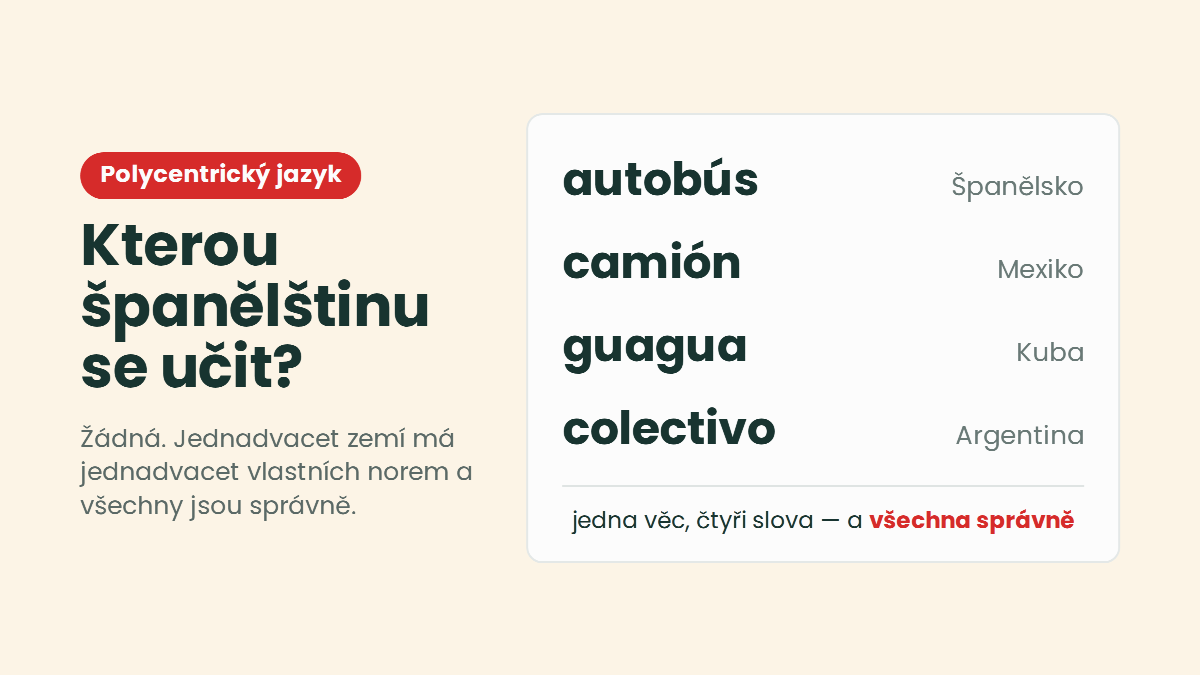
Which Spanish should you learn?
The one within reach. Spanish is a pluricentric language: each of its twenty-one countries has its own variety and all are correct. No Spanish is wrong.
Guide
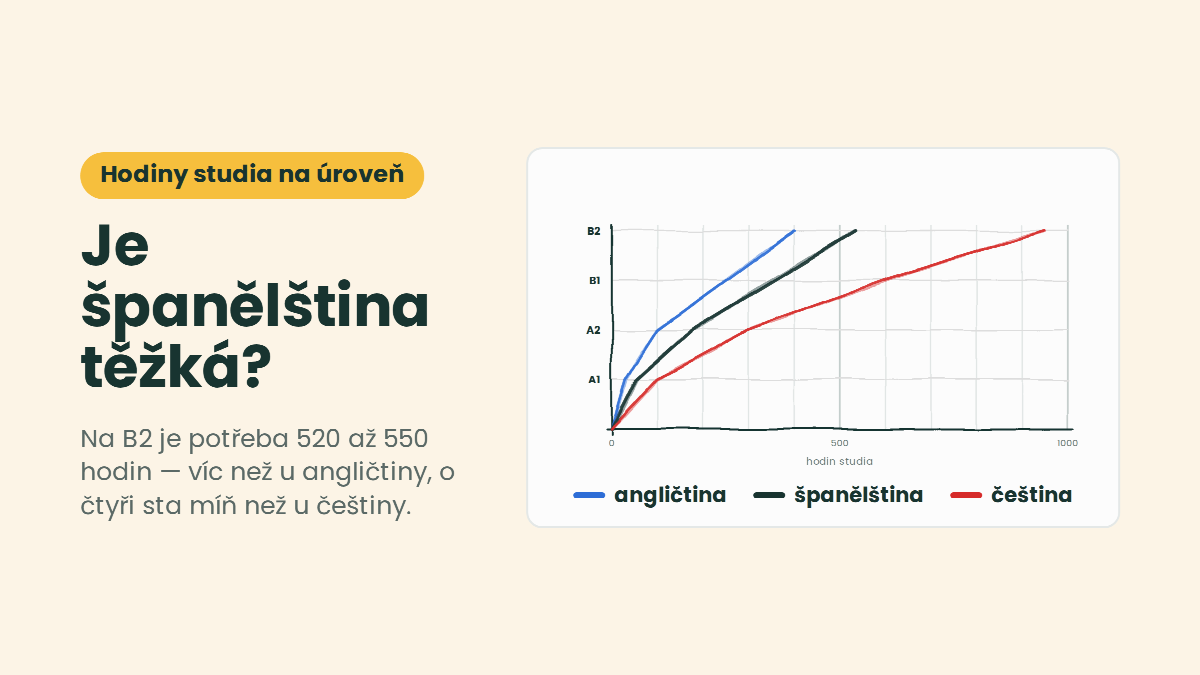
Is Spanish hard to learn?
For a Czech speaker, Spanish is harder than English and far easier than Czech is for a foreigner. More telling is where each language keeps its hard part.
Guide
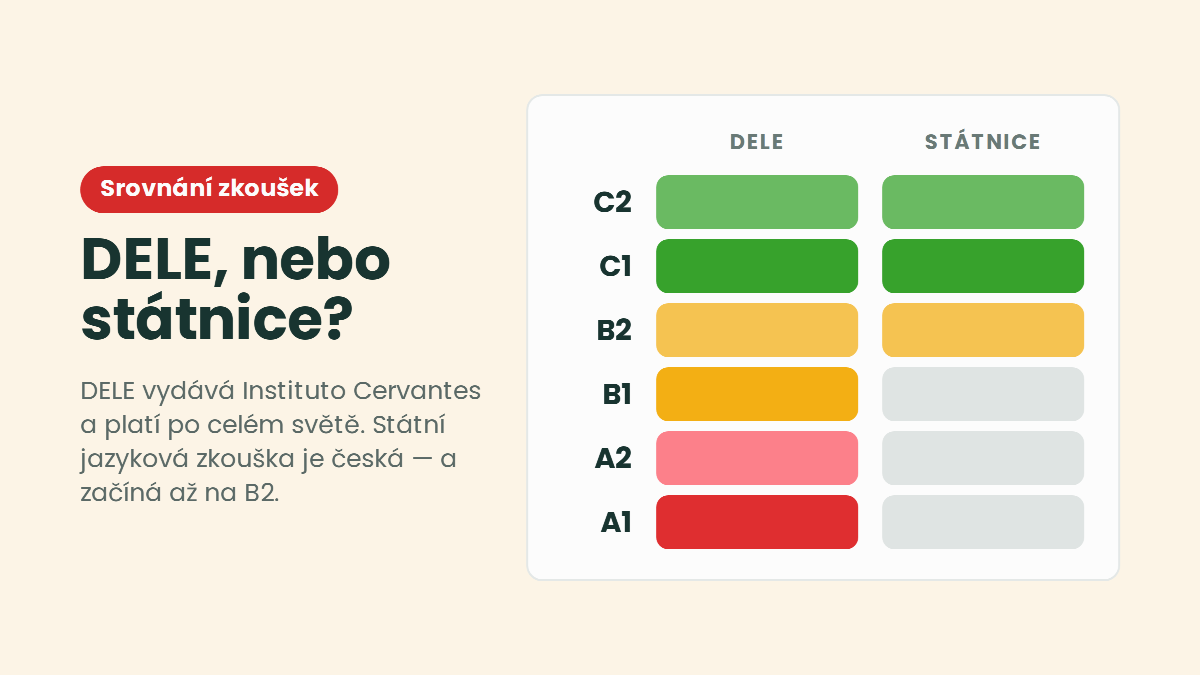
DELE or the Czech state language exam?
The Instituto Cervantes issues DELE, valid worldwide; the Czech state exam starts at B2. What each involves, where to sit it in Brno and who accepts it.
