
Vocabulary
Papa or patata? Potatoes as Peru knows them
Why Spanish calls the potato both papa and patata, how many varieties grow in Peru, what chuño is, and how the Colorado beetle became the American beetle.
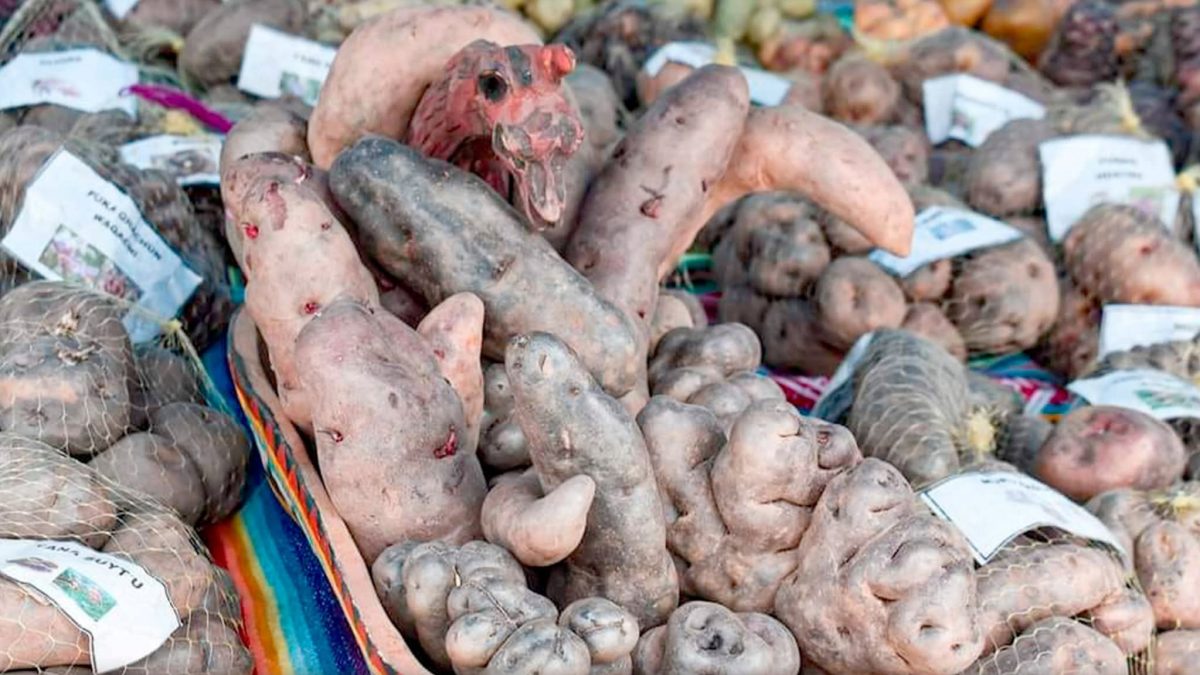
In a Czech shop you choose your potatoes by one of three letters: A, B or C. Now and then there is one with a red skin as well. At the market in Cuzco, Peru, yellow, pink, purple and nearly black potatoes lie side by side, some round, some as twisted as ginger, and every little pile has a name of its own. One is called puma maki, puma’s paw. Another is qachun waqachiq, the one that makes the daughter-in-law cry.
Potatoes come from the Andes, and Spanish brought them over from there, name and all. So we will start with the word: why it is papa in Lima and patata in Madrid. After that come all the things Peru does with potatoes, why an Andean variety sets no tubers in the hot lowlands, what McDonald’s chips are made of, and where the beetle came from that, in 1950, Czechoslovak newspapers said the Americans were dropping on the country.
Papa or patata
Both are right; it depends where you are. Throughout Latin America, in the Canary Islands and in the south of Spain a potato is la papa. In the rest of Spain it is la patata.
Papa is a word from Quechua, the language of the Inca empire, still spoken by millions of people in the Andes. The Spanish took it over in the sixteenth century just as they heard it. Patata arose later, in Spain, and by mistake. The dictionary of the Royal Spanish Academy explains it as a cross between two words: papa and batata. A batata is a sweet potato, a completely different plant, which the Spanish had met a few decades earlier in the Caribbean. Its name is from the Antilles, possibly, according to the Academy, from Taíno, the language of the people Columbus encountered there. The two tubers from the New World were confused in Europe for so long that their names merged. And patata in turn gave English potato.
With papa you need to watch the article and the stress:
| Spanish | English |
|---|---|
| la papa | potato |
| el papa | the Pope |
| el papá | dad, with the stress on the end |
Potatoes will also tell you where a menu is from. Tortilla de patatas and patatas bravas are from Spain, papas arrugadas from the Canary Islands, papa rellena and papa a la huancaína from Peru. Chips are patatas fritas or papas fritas, depending on the country. It is one of the differences we write about in our article on which Spanish to learn: you will be understood with either.
Where potatoes come from
From the Andes. Early this century geneticists showed that all cultivated potatoes share a single origin in what is now Peru. The usual account is that people domesticated them seven to ten thousand years ago around Lake Titicaca, on the high plateau at about 3,800 metres. Science knows of a hundred to a hundred and eighty wild relatives of the potato, depending on who is counting.
The earliest evidence of potatoes outside the Americas is from the Canary Islands: a record survives from November 1567 of a consignment from Gran Canaria to Antwerp. From there potatoes spread across Europe, at first mainly as a curiosity for botanical gardens. In the Czech lands the earliest mention is dated to 1623. Farmers distrusted them for a long time, and it took the wars and famines of the late eighteenth century to get them into the fields on any scale. The Czech word for them, brambory, most likely comes from Brandenburg, Branibory in older Czech, from where they reached the Czech lands.
Those first European potatoes were Andean, and they had one awkward trait, which we will come back to: they did not set tubers until autumn. Potatoes as we know them today have a large part of their inherited make-up from Chilean varieties. Those reached Europe at the beginning of the nineteenth century, and a European summer does not trouble them.
How many varieties there are in Peru
Nobody knows exactly, because nobody has counted them. The figures you see quoted are estimates, and they differ according to who is giving them and what is being counted:
- Around 3,000 to over 3,500 varieties in Peru is the figure given by the Peruvian authorities and the state news agency Andina.
- Over 4,000 native varieties is the figure given by the International Potato Center (Centro Internacional de la Papa, CIP) in Lima. It counts the Andes of Peru, Bolivia and Ecuador together, though.
- 4,797 landraces from eighteen countries are held by the same centre in its genebank.
- About 5,000 varieties worldwide is the figure given by the Food and Agriculture Organization of the United Nations.
For comparison: the Czech national list of varieties has about a hundred potatoes on it.
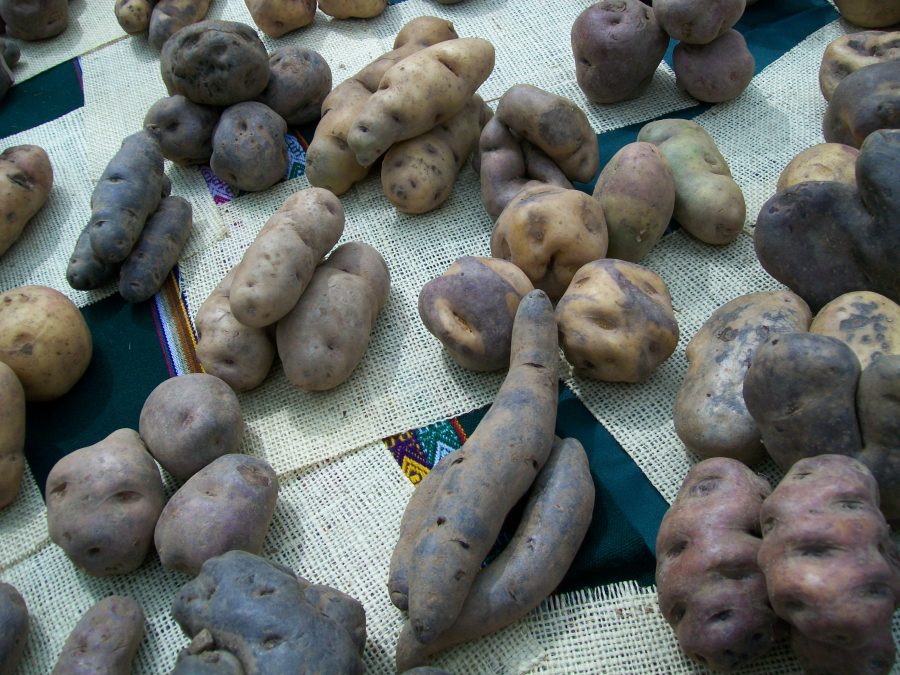
The number does not matter all that much. What matters is how many ways the varieties differ. The skin can be yellow, pink, red, purple or black, and is often mottled. So can the flesh: besides white and yellow there is purple, red and marbled. Some tubers are round, others long and curved, others all knobs. They also differ in whether they are floury or firm once boiled, and in whether they are sweet or bitter.
What they are called
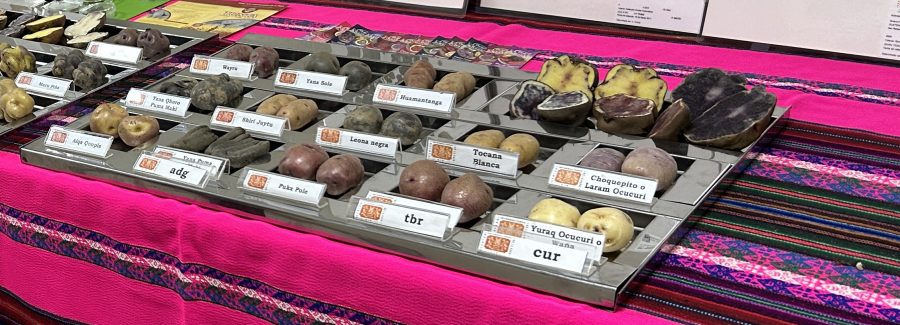
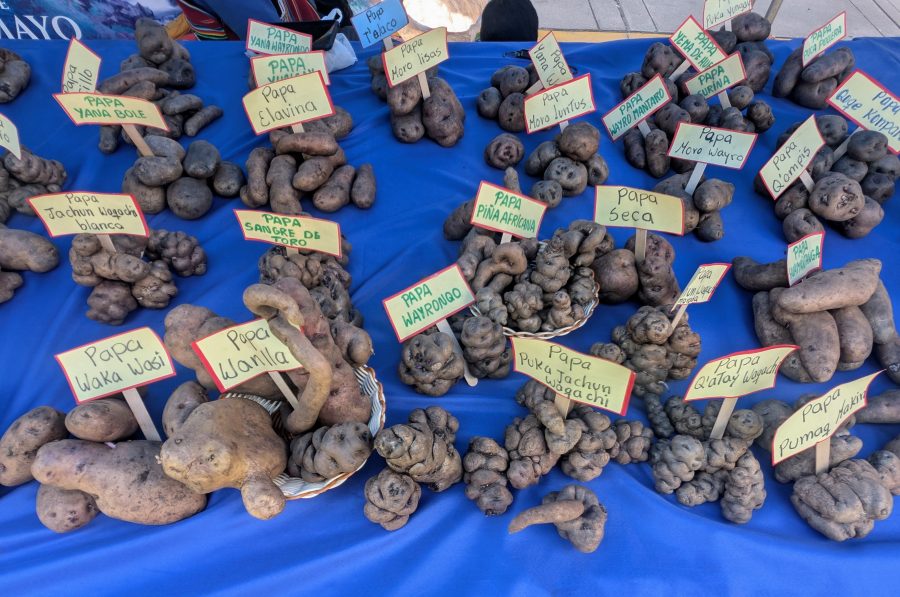
The varieties common in Lima’s markets have Spanish names; those from the mountain villages have Quechua ones. The Quechua names are mostly descriptions: a colour, plus the thing the tuber looks like.
| Name | Language | What it means |
|---|---|---|
| papa amarilla | Spanish | yellow potato |
| sangre de toro | Spanish | bull’s blood |
| peruanita | Spanish | little Peruvian; named after its colouring |
| puma maki | Quechua | puma’s paw, garra de puma in Spanish |
| kuntur runtu | Quechua | condor’s egg |
| waka waqra | Quechua | cow’s horn |
| qachun waqachiq | Quechua | the one that makes the daughter-in-law cry |
A colour goes in front of the name: yana is black, puka red, muru speckled. So yana puma maki is a black puma’s paw. Two of those words you already know, as it happens: puma and kuntur, condor, passed from Quechua through Spanish into English.
The potato that makes the daughter-in-law cry is elongated and has very deep eyes. According to a 2020 linguistic study by Domínguez Chenguayen, in Andean villages a bride was given one by the groom’s parents: anyone who can peel a tuber like that without cutting much of it away is handy with a knife and will manage a household.
Chuño, tunta, papa seca: potatoes for years ahead
A fresh potato keeps for a few months. In the Andes, where every so often the crop is lost to frost or drought, that was not enough, so people there learnt long ago to freeze-dry their potatoes. It is still done, in June and July, when the high plateau has fierce sun by day and frost at night.
| Name | How it is made | What you get |
|---|---|---|
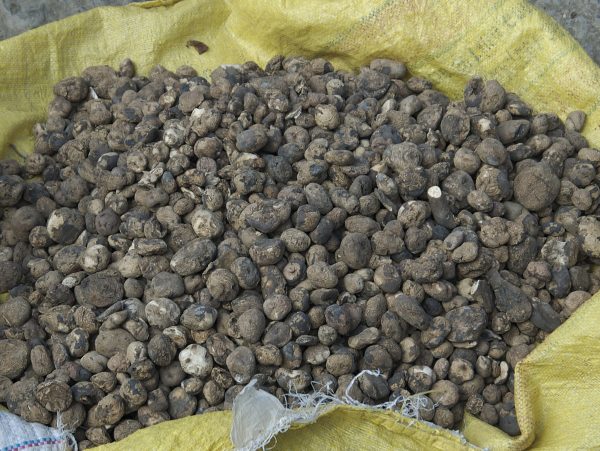
| chuño, also chuño negro | The tubers are spread on the ground, where for about a week they freeze at night and thaw by day. Then the water is trodden out of them with bare feet and they are dried off in the sun. | Dark, hard pieces that weigh very little. A hundred grams of potato leaves about twenty. They keep for years. |
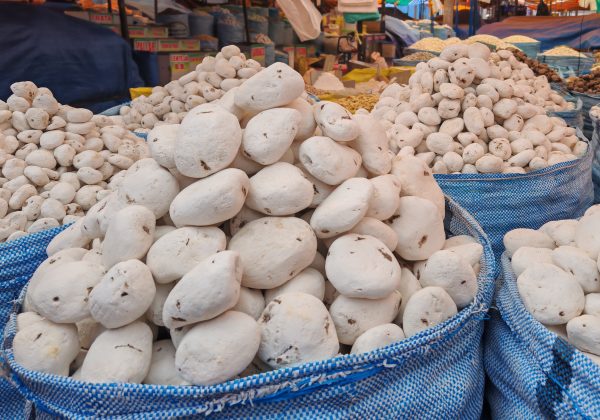
| tunta, moraya, also chuño blanco | The tubers freeze under a cover, to keep the sun off them. Then they are sunk in sacks in a stream or river for one to several weeks, and finally dried. | Chalk-white tubers with a milder taste. They take more work. |
| papa seca | No frost: the potatoes are boiled, peeled, cut up and dried in the sun. | Hard, dry pieces. The basis of the dish carapulcra. |
| tocosh | The potatoes are left for months in a pit with water running through it and allowed to ferment. | Fermented potatoes with a very strong smell. |
Chuño is a Quechua word, ch’uñu, and Spanish took it over as it stood. With white chuño the usual account is that tunta is the Aymara name and moraya the Quechua one; some producers also use the two words to say whether the soaking was done in running or in still water. Papa seca is simply Spanish for dried potato.
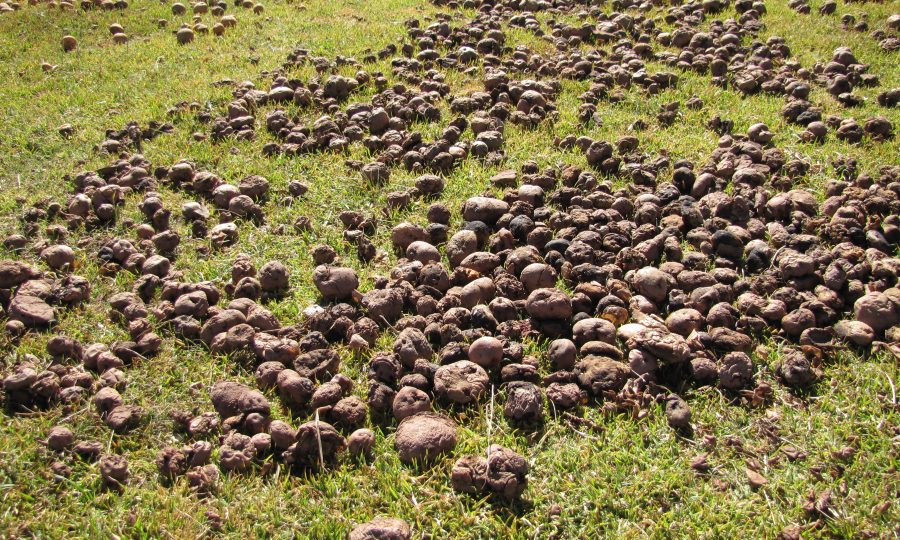
It is mostly bitter potatoes that go into chuño. They are separate species, which tolerate frost and grow even at the highest altitudes, where an ordinary potato can no longer survive. Fresh, they are barely edible. Freezing, treading and soaking get the bitterness out of them.
A, B, C: what a Czech shop sells
The letters on a bag of potatoes in a Czech shop are backed by a decree, and they tell you one thing only: how the tuber behaves in the pan.
| Cooking type | What it is like once boiled | What it is good for |
|---|---|---|
| A | firm, waxy, does not fall apart | salads, side dishes |
| B | fairly firm, slightly floury, falls apart a little or not at all | dishes of every kind, side dishes |
| C | soft, floury, falls apart | mash and doughs |
As a rough rule, the more starch a tuber has, the flourier it is. A variety can also carry two neighbouring letters, that is AB or BC. For potato salad you want an A, which holds its shape. For dumplings and mash you want a C, which falls apart without any help.
But the cooking type describes a single property. It says nothing about the colour of the flesh, the shape or the taste, because in those respects European varieties differ very little: nearly all are white to yellow inside and round to oval in shape. In the Andes a whole range of varieties is often planted together in one field, so that at least some of them survive frost, drought and blight. A European farmer plants one, and knows how it will behave in the harvester, in the store and in the fryer.
Why an Andean potato sets no tubers in the warm lowlands
People often say that a potato makes no tubers in the tropics because it has no winter to get ready for, and so goes straight into flower and seed. It sounds reasonable, but that is not how it works. A tuber is a store, and the plant lays it down on command. Two things give the command: the length of the day and the temperature, mainly at night.
It works like this. The leaves measure how long it is light. When the day is short enough, they start making a signalling protein, which travels down through the plant’s vessels to the underground shoots. Wherever it arrives, the shoot stops growing in length and its tip begins to swell. That is a tuber.
Andean landraces need a short day for this, of about twelve hours. Near the equator the day is that long all year round. That is also why the first potatoes in Europe gave so much trouble: in June, when central Europe has sixteen hours of daylight, no tubers came, and the plant made a start on them only once the days shortened in autumn. By then it was usually too late. Today’s varieties carry an altered form of one gene, which switches this safeguard off and which appeared in Europe in the nineteenth century, alongside the Chilean varieties; so they set tubers under a long day too.
The second condition is temperature, and that one applies to all potatoes, modern ones included. Tubers form best at 15 to 20 °C. Warm nights damp down production of the signal: depending on the source, this begins somewhere between 18 and 22 °C, and above 25 °C tubers may not form at all. The plant is not suffering, though. It goes on growing; it just puts everything it makes into stems and leaves.
In the tropical lowlands the days are short but the nights are warm, so a potato there throws up plenty of top growth and sets its tubers late, sparsely or not at all. That does not send it hurrying into flower. Flowering is governed by a different signal from the one for tubers, and great heat holds flowering back as well.
In the tropics potatoes are grown where the nights are cool: in the mountains, as they always have been in the Andes, or else in winter. In the lowlands of northern India and southern China they are planted after the rice harvest for the cool part of the year and lifted before it warms up.
What McDonald’s chips are made of
Chips call for the opposite kind of potato from the ones a Peruvian market is full of: big, long, identical to all the others, high in starch and low in sugar, so that it fries golden. Exactly what is used varies from country to country. We report only what the company itself publishes.
| Market | Varieties | Fried in |
|---|---|---|
| Czech Republic | Innovator, Ludmilla or Ivory Russet; the chips are supplied by Farm Frites from Poland | a blend of rapeseed and sunflower oil |
| Britain | Innovator and Ivory Russet on the company’s current British site; an older FAQ dated 2018 names Russet Burbank, Pentland Dell and Shepody; the chips are made by McCain | a blend of sunflower and rapeseed oil, with no animal fats |
| United States | Russet Burbank, Ranger Russet, Umatilla Russet and Shepody | a blend of oils that includes rapeseed; the supplier part-fries them in oil with beef flavouring |
The Czech details are from mcdonalds.cz, the company’s Czech website; those for Britain and the United States are from its websites there. The Czech page also describes how the chips are made: the potatoes are peeled, cut, blanched, and treated with a solution of dextrose, so that they all fry to the same colour, and with an agent that stops them browning. Then they are part-fried and frozen.
The main difference between America and Europe is that beef flavouring. Until 1990 the American restaurants fried in beef tallow. When they went over to vegetable oil, they kept the taste by adding the flavouring. British chips, by contrast, carry the approval of a vegetarian society in Britain, and the Czech ones, according to the company, contain no allergens.
And pesticides?
The subject was opened up by the American journalist Michael Pollan in a magazine report of 1998, which he followed three years later with the book The Botany of Desire. In the report an Idaho farmer told him that he sprayed his Russet Burbank against aphids with a product called Monitor. Aphids carry a virus that leaves brown spots inside the tubers, and the processor then rejects the whole crop. Once a field had been sprayed, the farmer said, he would not set foot in it for four or five days.
That account is nearly thirty years old, and a good deal has changed since:
- Monitor (active ingredient methamidophos) is finished in the United States: its registrations were cancelled with effect from the end of 2009. It is not approved in the European Union.
- Chlorpropham, used for decades on potatoes in storage to stop them sprouting, lost its EU approval when the European Union declined to renew it in 2019. It could be used until October 2020 at the latest. The stores stayed impregnated with it, however, so the EU had to set a temporary limit for the residues that pass from their walls into a new crop. In the United States, according to the information available, it may still be used.
- In place of chlorpropham, mint oil, ethylene or maleic hydrazide, among others, are now used against sprouting in Europe; what is permitted varies from one country to the next.
- Three neonicotinoids that were used on potatoes against insects were banned from fields by the EU in 2018 because of bees.
In 2009, under pressure from shareholders, McDonald’s undertook to find out from its American potato suppliers how the use of pesticides could be reduced. We have not been able to trace what figures came of that. Nor does the company publish exactly what the growers behind the Czech restaurants’ chips treat their fields with. All that is certain is that European rules apply to them and that the product in Pollan’s report is not among those permitted.
The Colorado beetle: an insect that long knew nothing of potatoes
The Colorado beetle, escarabajo de la patata in Spanish, has nothing to do with the Andes. It is from North America. It was described in 1824 by the naturalist Thomas Say, from beetles found on the upper Missouri and by the Arkansas River. It lived on the plains below the Rocky Mountains and in Mexico and fed on wild, prickly nightshades, chiefly the species Solanum rostratum. That is a distant relative of the potato. Potatoes did not grow there.
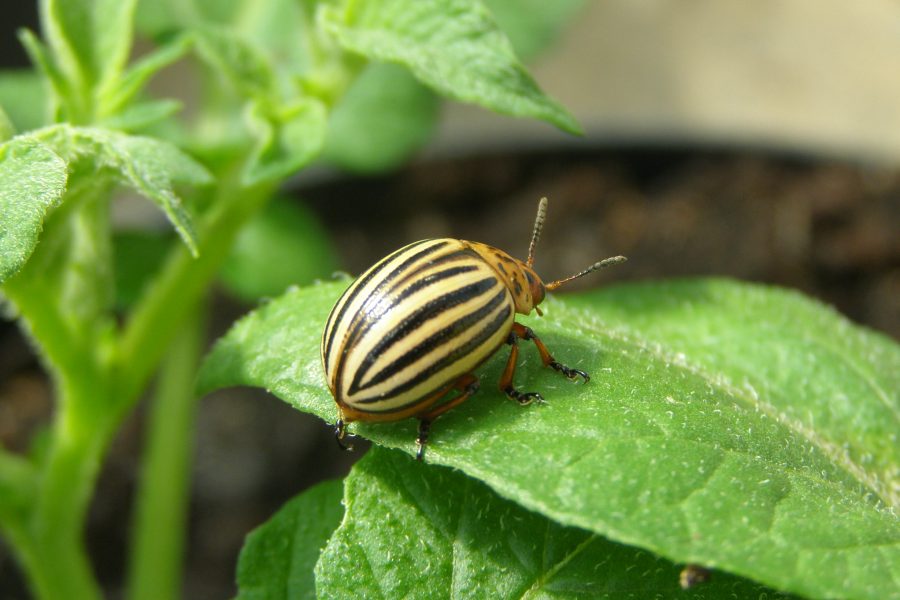
The two did not meet until 1859, in Nebraska, about 160 kilometres west of the city of Omaha, where potato fields had arrived with the settlers. The beetle found that the new plant tasted just as good and that there was a whole field of it. From then on it moved east, field by field. By 1874 it was on the Atlantic coast.
In English it is the Colorado beetle, or in America the Colorado potato beetle. The name is an accident: in 1865 the entomologist Benjamin Walsh heard from colleagues that Colorado was full of them, living on wild nightshade, and concluded that that was where the beetle came from. Older books place its original home in Mexico. A genetic study of 2018, however, showed that the beetles in potato fields descend from populations on the American plains and not from the Mexican ones.
How it reached Europe
Europe knew about it in advance and was afraid of it. Germany banned imports of American potatoes as early as 1875. The beetles still arrived by ship several times: in 1877 they turned up in a field at Mülheim on the Rhine, in 1901 at the port of Tilbury in England. Each time they were successfully wiped out.
In the end it did not work. In 1922 the beetle was reported near Bordeaux in France, already spread over an area of 250 square kilometres. Most likely it had arrived during the First World War with supplies for the American army, which had camps nearby. From there it advanced eastwards. It reached the Czech lands in July 1945, and today it lives from Portugal across Siberia as far as China.
Why it is not in South America
It is an odd thing: the Colorado beetle does not live in the homeland of the potato. The European and Mediterranean Plant Protection Organization (EPPO) records it only in the northern hemisphere, between 15 and 60 degrees of latitude. It does not list it for any country in South America.
There is no documented explanation. The scientific literature agrees that the temperate parts of South America would suit it and that it is “not yet” there. The natural guess is that it has simply never got there. Between its home and the Andean fields lies the tropical belt of Central America and the Amazon, where it does not normally occur, and either no ship with an infested cargo, like the one that once put in at Bordeaux, ever arrived, or the beetles failed to take hold. But that is an inference, not a research finding.
The American beetle, summer 1950
The beetle reached the Czech lands in July 1945 and for the first few years it spread slowly. What were called search days (hledací dny), on which people walked the fields and picked the beetles off, had been introduced by a regulation as early as 1939, long before the first find; according to the historian Pavlína Formánková, 39,000 Czech children took part in them at the time.
In 1950 beetle numbers exploded all over central Europe. On 28 June the Czechoslovak government issued a proclamation calling for a fight against the Colorado beetle, and the next day every daily paper printed it on its front page. It said that the beetle had overrun the western and south-western regions of the republic, the ones bordering the occupation zones of western Germany, and that this was no natural disaster. According to Formánková, the proclamation claimed that the pest had been brought into the country “artificially, deliberately and en masse” by Western imperialists, by means of clouds and winds, and also by agents who carried it in little boxes and bottles. The aeroplanes dropping beetles were added only afterwards, by the press.
The timing was no accident. Milada Horáková, a democratic politician sentenced to death in a show trial, had been executed the day before the proclamation, and the war in Korea had begun three days before it. A newsreel made the connection in a single sentence: “We have dealt with Horáková, Pecl and their accomplices, and we shall deal with the potato beetle – the American beetle!” The model was there for the taking next door. As early as June, East Germany had accused the Americans of dropping beetles, and people there began calling the beetle the Amikäfer.
In the first ten days the Czechoslovak press ran 702 articles. 40,000 colour posters and 100,000 leaflets were printed. Rudé právo, the Communist Party daily, wrote of the “dollar beetle”. Schoolchildren walked the fields with their teachers, row by row, collecting beetles in bottles of paraffin strapped to their hips. Ondřej Sekora, the author of the Czech children’s book Ferda Mravenec (Ferdy the Ant), wrote and illustrated a booklet called O zlém brouku Bramborouku, roughly “The Wicked Potato Beetle”, which had a print run of 120,000.
The American embassy replied on 6 July with a note written with a humour seldom seen in the diplomatic bag. We know it only in Czech translation, so what follows is translated back into English and is not the embassy’s original wording:
The Embassy doubts whether the potato beetle, even in its most voracious form, could actually gnaw through the substance of the friendship that binds the Czechoslovak and American peoples.
Four days later the Czechoslovak foreign ministry handed over two notes of protest and stood by the accusation.
Nobody ever produced any proof, and there was no need to go looking for it. The beetle had been in the country for five years, it had come from the west, from where it had been advancing across Europe since 1922, and that same summer its numbers exploded in Germany and Poland too. The idea did not come entirely out of nowhere, though: during the war Germany really had tried dropping Colorado beetles, in 1943 over its own fields near Speyer, and only a handful of the released beetles were ever found again.
The campaign had serious consequences as well. Anyone who failed to turn up for a search day could be fined, and in 1954 a sentence of eleven years for high treason was handed down in connection with the beetle. The myth died away in the 1960s. What it left behind is a Czech rhyme, mandelinka bramborová vyskočila z letadla: “the potato beetle jumped out of an aeroplane”.
Words for the market
If you ever find yourself at a potato stall in Peru or Spain, these will come in handy:
| Spanish | English |
|---|---|
| la papa, in Spain la patata | potato |
| la batata, in Peru and Mexico el camote | sweet potato |
| la cáscara | skin |
| la pulpa | flesh |
| pelar | to peel |
| la helada | frost |
| el puré de papas | mashed potato |
| el escarabajo de la patata | Colorado beetle |
Potatoes show very clearly why it pays to know the Spanish of both shores of the Atlantic. One word came from the Andes, the other arose in Spain, and Peruvians and Spaniards alike understand the pair. You will hear the two with us as well, in our group courses and in one-to-one tuition.
- Opening photograph — Papas Nativas, Davidsuna, CC BY-SA 4.0, cropped to landscape.
- Andean varieties on a woven cloth — Papa andina, Edgar Amador Espinoza M., CC BY-SA 3.0.
- Display with cut tubers — Exposición de papas nativas peruanas en la UNMSM, Eclipxstical, CC BY-SA 4.0, detail.
- Labelled varieties — Labeled native potato varieties in Santa Teresa, Cusco, Peru, H.dav.are, CC BY-SA 4.0, detail.
- Chuño drying — Chinchero Chunos 1, Chuck Moravec, CC BY 2.0, cropped.
- Black chuño — Chuño, Eric in SF, CC BY-SA 3.0, cropped.
- Tunta — Venta de Chuño Moraya, Abel Apaza, CC BY-SA 4.0, cropped.
- Colorado beetle — Imago of Colorado potato beetle on leaf, Adámozphoto, CC BY-SA 4.0, cropped.
- The map and the tuber diagram are our own drawings; the outline of the land is from Natural Earth, public domain. The years of the beetle’s first occurrence are from the EPPO Global Database.
- Word origins: Real Academia Española, Diccionario de la lengua española, entries papa, patata and batata. Names of varieties: Domínguez Chenguayen, Lingüística y Literatura 78 (2020).
- Numbers of varieties: Centro Internacional de la Papa, Andina (29 May 2024) and FAO.
- Origin and route to Europe: D. M. Spooner et al., PNAS 102 (2005); M. Ames and D. M. Spooner, American Journal of Botany 95 (2008); R. M. Gutaker et al., Nature Ecology & Evolution 3 (2019).
- Tuber formation: C. Navarro et al., Nature 478 (2011); B. Kloosterman et al., Nature 495 (2013); G. G. Lehretz et al., Current Biology 29 (2019); M. K. Lal et al., Plants 11 (2022).
- Cooking types: vyhláška č. 397/2021 Sb., a Czech decree, Annex 17.
- Chips: mcdonalds.cz and its list of suppliers (Czech Republic), and the McDonald’s websites for Britain and the United States, as they stood in November 2026. The British varieties Innovator and Ivory Russet come from the company’s current site; Russet Burbank, Pentland Dell and Shepody are named by its older FAQ dated 2018. The 2009 agreement with shareholders was reported by Reuters on 31 March 2009. The cancellation of the methamidophos registrations is in the Federal Register, notice E9-22921 of 23 September 2009. Michael Pollan’s report Playing God in the Garden appeared in The New York Times Magazine on 25 October 1998. Chlorpropham: Commission Implementing Regulation (EU) 2019/989.
- The 1950 campaign: Pavlína Formánková, Kampaň proti „americkému brouku“ a její politické souvislosti (The campaign against the “American beetle” and its political context), Paměť a dějiny 1/2008. Her article is also our source for the American note, which it gives in Czech; the wording above is a translation back into English from that Czech version, not the original English text. The German experiments: B. C. Garrett, The Colorado Potato Beetle Goes to War, Chemical Weapons Convention Bulletin 33 (1996).
Frequently asked questions
How do you say potato in Spanish?
How many potato varieties grow in Peru?
What is chuño?
What do the cooking types A, B and C on Czech potatoes mean?
Why do potatoes not set tubers in the tropics?
Did the Americans drop Colorado beetles on Czechoslovakia in 1950?
Article topics Varieties of Spanish
Sdílet článek
Co číst dál
Vocabulary
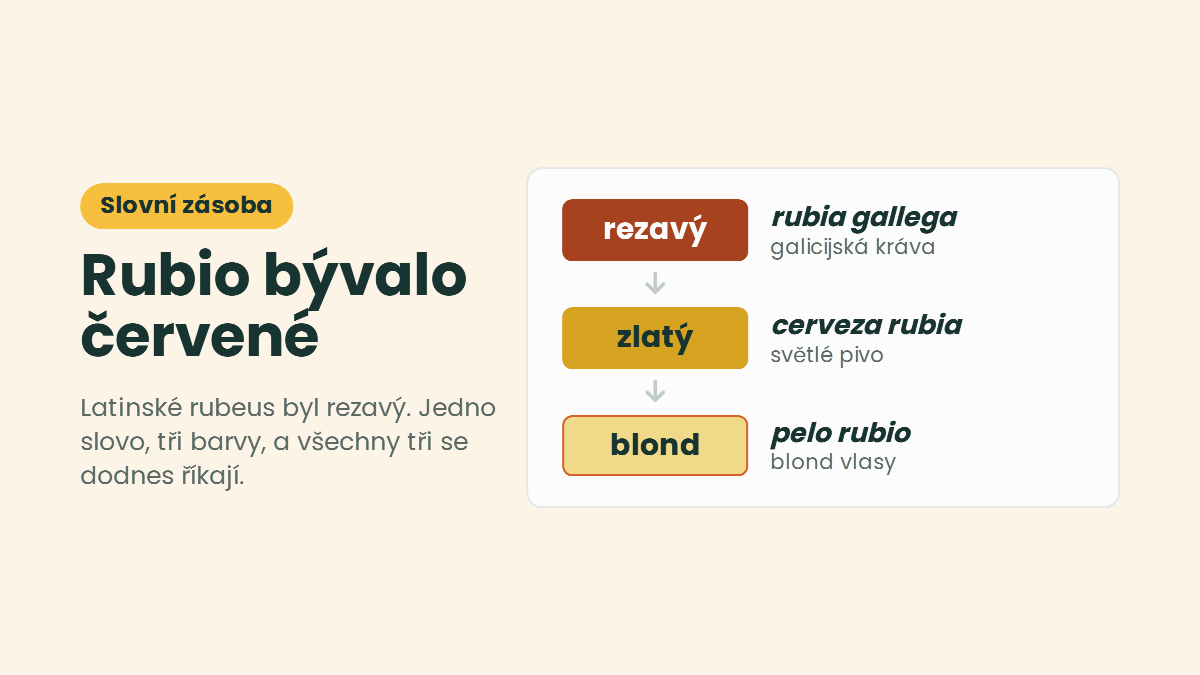
Rubio: the blond word that used to be red
Spanish rubio means blond today, yet it comes from the Latin word for red. Why is a rubia a blonde, a golden beer and a rust-coloured cow from Galicia?
Pronunciation
Perejil: the word that decided who lived
In October 1937, the story goes, the way you said perejil, Spanish for parsley, decided whether you lived or died on the Haitian–Dominican border.
Guide
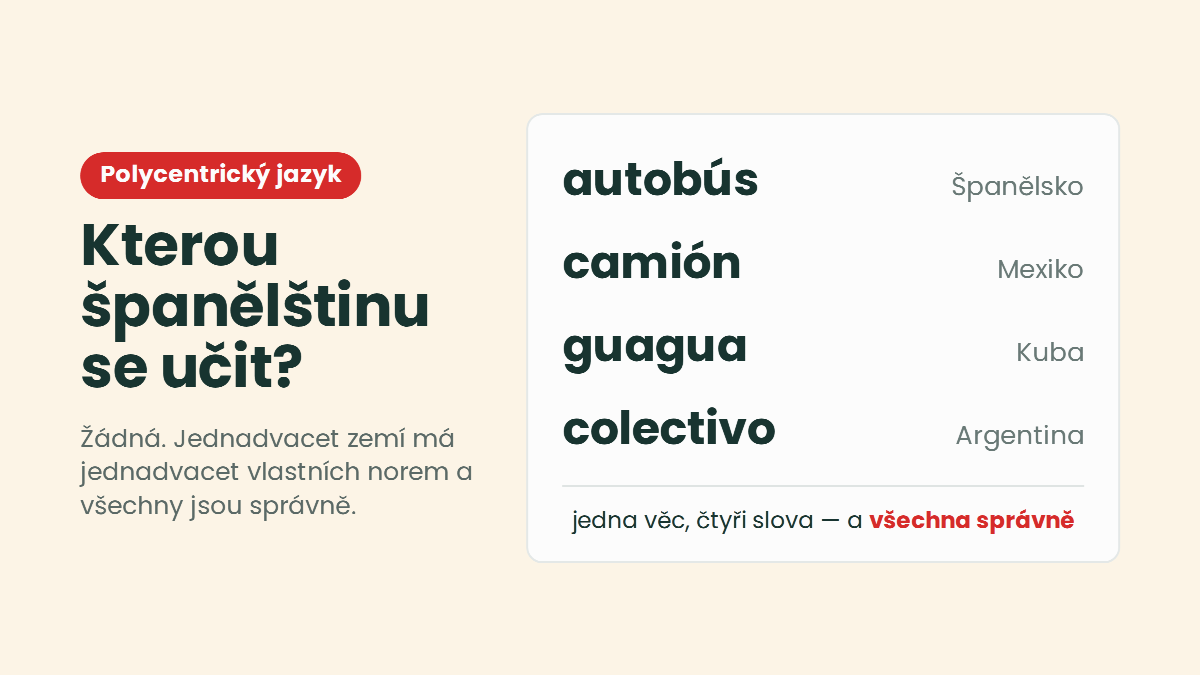
Which Spanish should you learn?
The one within reach. Spanish is a pluricentric language: each of its twenty-one countries has its own variety and all are correct. No Spanish is wrong.



