
Vocabulary
Aguacate or palta? The avocado, word to stone
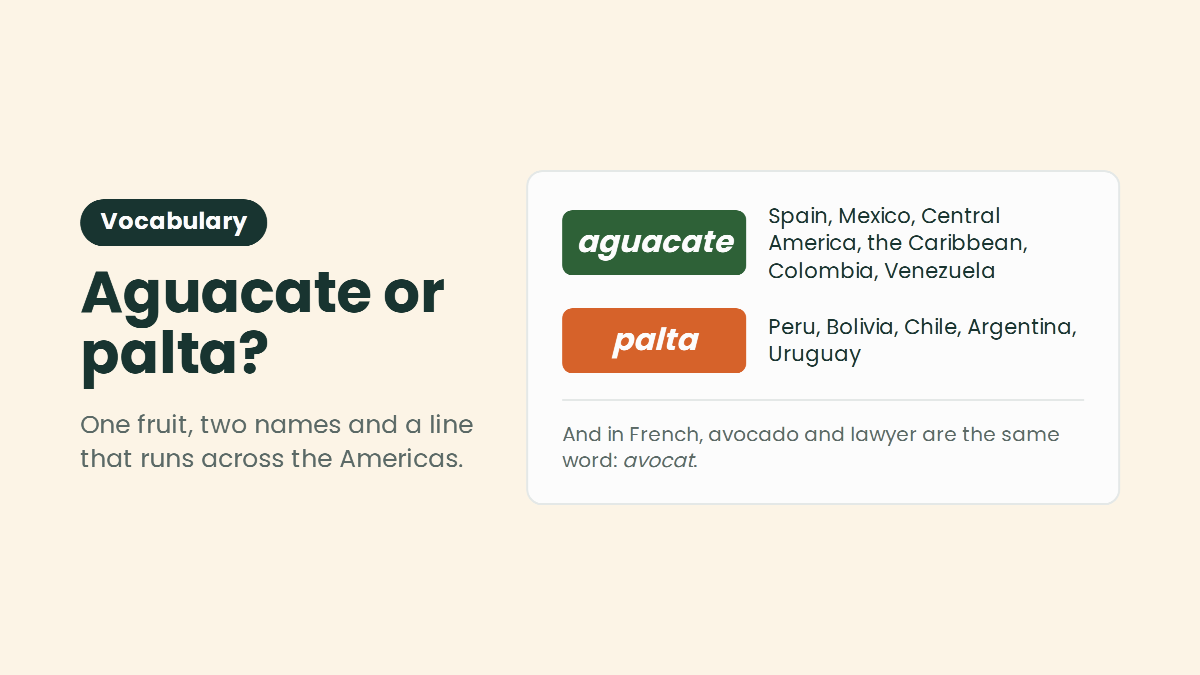
Spanish calls the avocado both aguacate and palta. Where each is said, the truth about testicles and lawyers, how to pick a ripe one and stone it safely.
In a Czech shop it is simple: the label says avokádo. It lies in the crate, hard as a rock, and you wonder whether it will be ready to eat tomorrow or in a week. In 2015 the Czech Republic imported just under two and a half thousand tonnes; in 2025, almost fourteen thousand.
In Spanish it is el aguacate. That is what you ask for in Madrid, in Mexico and in Havana. In Lima, Santiago or Buenos Aires, though, they will sell you a palta, and the tree it grows on is called a palto there.
We will take it from the word to the stone: what is said where, how testicles and lawyers got mixed up in it, where the avocado comes from, how to tell a ripe one, why it is so hard to grow, how to cut it open without cutting yourself, and what will grow from a stone on the windowsill.
Aguacate or palta
The line runs across South America. Aguacate is the word in Spain, Mexico, Central America, Cuba, the Dominican Republic, Puerto Rico, Venezuela, Colombia and, according to the Dictionary of Americanisms, Paraguay as well. Palta in Peru, Bolivia, Chile, Argentina and Uruguay. Chile’s agricultural office writes aguacate only when it is passing on news from abroad.
In Ecuador both words are used. The Dictionary of Americanisms, a joint work of the academies of the Spanish language, records palta there, while Ecuador’s ministry of agriculture writes aguacate when it means the home crop. The two names already stand side by side in a survey of Ecuador’s fruit that the American botanist Wilson Popenoe published in 1924. And palta is on the map there as well: the canton of Paltas lies in the province of Loja. We will come back to that name.
In some places the fruit has one name and the tree another. In the palta countries the tree is el palto. In the Canary Islands, Venezuela, the Dominican Republic and Puerto Rico the aguacate grows on an aguacatero; the Canarian dictionary illustrates the word with a sentence about someone who tore up the banana plants and planted the lot with aguacateros. In parts of Colombia and Venezuela a third name survives, cura for the fruit and curo for the tree. The dictionary derives it from the language of the Tunebo, who live on the border between the two countries, and notes of the fruit that the word is little used.
Where the word aguacate comes from
Aguacate is from NahuatlThe language of the Aztecs, still spoken in central Mexico today. Spanish also took the words tomate, chocolate and chile from it., the language of the Aztecs, in which the fruit was called ahuacatl. Between 1536 and 1541 the chronicler Motolinía noted that in New Spain there grew a fruit they called ahuacatl, and a few lines later he is already writing aguacates in Spanish. He added that when the native people first saw olives, they named them little avocados.
And now for the story you will find in almost every piece about avocados: ahuacatl is said to mean testicle, and guacamole to be testicle sauce. At first sight it is well supported. The dictionary of the Royal Spanish Academy gives the origin of aguacate as Nahuatl ahuacatl, with the meanings “avocado fruit” and “testicle”.
But all of it rests on a single line. In 1571 Alonso de Molina published a dictionary in two halves, Nahuatl to Spanish and Spanish to Nahuatl. The first has: Auacatl. fruta conocida, o el compañón, that is, “a well-known fruit, or the testicle”. Later dictionaries copied this from Molina until it reached the Academy. In the second half of the same dictionary, under the entry compañón o cojón, Molina is looking for the Aztec word for testicle. He did not write avocado there. What stands there is atetl.
The Danish Nahuatl scholar Magnus Pharao Hansen draws two conclusions from this. The Aztecs did use the fruit’s name that way as a joke, and often enough for Molina to notice. But it was a figurative meaning, much as when English says “nuts”. That fits the other sources too: the great dictionary of Nahuatl has a string of attestations from texts for the meaning “fruit” and not one for “testicle”, and the sixteenth-century Florentine Codex, in its list of the parts of the body, has yet another word for testicle, cuitlapanaatetl. Hansen himself derives ahuacatl from a root that meant skin or bark. Guacamole, in Molina, is auacamulli, “a dish of avocados with chilli”.
In one respect the story is true to this day. Mexicans practise a kind of verbal fencing called albur, a game of double meanings in which eggs, onions and chillies all carry a second sense, and in it aguacate really does mean testicle. In Honduras and Nicaragua the Dictionary of Americanisms has recorded the plural aguacates in that sense.
The avocado and the lawyer
In old Spanish the word for a lawyer was spelt in all sorts of ways: abogado, avogado and avocado. When Europeans tried to pronounce aguacate, they slid towards what they knew. William Dampier writes of the avogato tree in his travel book of 1697; Hans Sloane, a year earlier in Jamaica, of the avocado. How much of a hand the lawyer had in it is something the dictionaries do not agree on: one speaks of a probable influence on the pronunciation, another of folk etymology.
The French went furthest. In French avocat is both lawyer and avocado, both masculine and with the same article. The earliest French record of the fruit is from 1684 and is, oddly enough, feminine: avocates. Today it is the other way round, and the feminine is the one place where the two words part company. Une avocate is always a woman lawyer, because the fruit has no feminine form. The tree is called an avocatier.
The French are not alone in this. Older Danish had advokat-pære, Dutch advocaatpeer, Swedish advokatpäron: lawyer’s pears, every one. In Spanish, abogado for the avocado cannot be documented in the Americas. In the Philippines it can: a dictionary of 1921 recorded the tree there as abogado and the fruit as pera de abogado, with a note that this was how Spaniards spoke rather than Filipinos.
Where the avocado comes from
The avocado belongs to the genus Persea, in the laurel family. The genus is tens of millions of years old and once grew over a far larger area than it does today: its fossils have been found in California, Nevada, France and Spain.
A fruit with so large a stone raises the question of who was supposed to carry it about. In 1982 Daniel Janzen and Paul Martin proposed in the journal Science that some American fruits are adapted to large animals that died out thirteen thousand years ago. The avocado is counted among them. The hypothesis has not been confirmed. Nobody has tested it directly for the avocado, and some authors object that large fruits are dispersed by smaller animals too. The literature reports that agoutis and the spectacled bear eat avocados.
People were eating it long before they began to grow it. Under the El Gigante rock shelter in Honduras, avocado remains go back eleven thousand years. According to a study from 2025, people first tended wild trees and, some seven and a half thousand years ago, began planting stones from the best fruit. Since then the skin has grown thicker and the stones larger. That puts the avocado ahead of maize.
It has been in South America a long time too: a stone from the Huaca Prieta site on the north coast of Peru is about ten and a half thousand years old. The name palta is not explained until the chronicler Garcilaso de la Vega, in 1609. The Inca Túpac Yupanqui, he says, conquered the province of Palta in what is now Ecuador, and from there they brought to Cuzco “the tasty and delicious fruit they call palta”. This is a chronicler’s tale, and linguists do not rely on it. The Academy’s dictionary says only that the word is from Quechua, the language of the Inca empire. The old Quechua dictionaries know palta chiefly in the sense “flat”, and Garcilaso himself writes that the people of Palta had a flattened head as their distinguishing mark.
The first Spaniards did not trouble themselves over native names. In 1526 Gonzalo Fernández de Oviedo speaks simply of pears that are like butter inside, and recommends them with cheese. Pedro Cieza de León, in 1553, has both names in one book and explains both the same way: aguacates are pears and paltas are something like pears.
Three races and the Hass variety
Growers divide avocados into three races. The Mexican is from the mountains. It has small fruit with a thin skin, its leaves smell of aniseed when crushed, and it stands the most frost: 5 to 7 °C below zero, according to a French trade review. The Guatemalan has a thick, hard, knobbly skin, and its fruit takes ten months to a year to grow on the tree, longer still in the cold. The West Indian bears large, watery fruit low in oil and stands almost no frost at all. Most of the varieties in the shops are crosses.
The most famous of them has a birth certificate. In 1926 Rudolph Hass of La Habra Heights, California, bought some seedlings, meaning to graft the then popular Fuerte variety onto them. On one of them the graft did not take, so he let it grow. He did not like the fruit, with its rough, almost black skin, and it was his sons who talked him into tasting it. In August 1935 he was granted a patent on the tree, and he made just under five thousand dollars from it. The tree died of root rot in 2002.
Every Hass avocado in the world comes from that one tree, because the variety is propagated by grafting and a scion is a clone. That holds only for the crown, though. The rootstockThe lower part of a grafted tree: the roots and a length of trunk. The variety that is to bear the fruit is grafted onto it; the rootstock is chosen to suit the soil., meaning the roots and the base of the trunk, is a different plant, often chosen because it stands up better to that very root rot. Which variety the original seed came from is not known, and the geneticists do not agree either: one study found Hass to be 61 per cent Mexican race, another takes it to be purely Guatemalan. According to the California Avocado Commission, an industry body, Hass accounts for about 80 per cent of the avocados eaten in the world.
Fuerte came to California in 1911 as a scion from a garden in Atlixco, Mexico. In January 1913 a frost struck, most of the young trees in the nursery froze, and this one survived. According to the Californian growers’ own history, that is where the name comes from: fuerte is Spanish for strong. It stays green even when ripe, as do Reed, Bacon and Zutano. A University of California guide knows only two varieties whose skin darkens as they ripen: Hass to black and Dickinson to dark purple.
How to tell a ripe avocado
An avocado does not soften on the tree. It is picked hard and ripens only afterwards, so the grower needs to know whether the fruit is yet able to ripen. That is judged by its dry matterWhat is left of the fruit once all the water has been dried out of it. In avocados it rises with the oil content, which is why it shows whether the fruit is developed enough to ripen after picking.. Both the international food standard Codex Alimentarius and a European Union regulation of 2005 require at least 21 per cent for the Hass variety, and the European regulation gives as its reason the need to exclude fruit that cannot ripen. That is the first kind of ripeness, and in the shop there is nothing you can do about it. What matters to you is the second: whether the fruit is soft today.
Colour helps only with Hass and Dickinson, and even there you cannot rely on it; the California Avocado Commission itself writes that colour does not tell you everything. That leaves touch, and touch has rules. The University of California guide advises taking the fruit in the palm of your hand and squeezing gently with all your fingers. Never with your thumb. Australian research measured that even a light squeeze with the thumb, at a force of ten newtons, leaves a bruise within two days at 20 °C. Whoever squeezes a fruit all over and puts it back spoils it for the next person along.
Two pieces of advice go round about the stalk. The first the same guide gives to people with a tree of their own and a thick-skinned variety: flick off the stub of the stalk and try the hole with a cocktail stick. The second, guessing ripeness from the colour under the stalk, is an internet test. None of the specialist sources mentions it, and the instructions do not even agree on what each colour is supposed to mean. Shaking the fruit and listening for the stone to rattle is just as unfounded.
At home, put a hard avocado in a paper bag and leave it at room temperature. According to the California commission it takes two to five days, and an apple or a kiwi fruit in the bag speeds things up. Only a ripe one belongs in the fridge, where it will keep for two or three days. An unripe one, according to the university guide, may not soften there as it should.
Machines for ripeness
Growers and packhouses measure dry matter with a handheld instrument that shines near-infrared light on the fruit and shows a figure in about ten seconds. The fruit is not cut open. The same light is used by a scanner for shoppers made by the Dutch company OneThird. Tesco, the British supermarket chain, has been trialling it in five shops since September 2025: you put the avocado down and find out whether it is ready to eat now or better suited to slicing into a salad. The accuracy of around 90 per cent is the maker’s figure, and nobody independent has verified it.
In the app store you will also find programs that estimate ripeness from a photo. None of them states how accurate it is, and there is no independent test.
Why the avocado is hard to grow
The avocado is a delicate tree. Its roots are shallow and have no root hairs, and they need air: in one experiment a few hours in water without oxygen were enough for seedlings to start wilting. Wet soil also suits phytophthora, the root rot that the University of California calls the most serious avocado disease in the world. It cannot be cured, only managed.
Of all the tree crops grown in California the avocado tolerates salt worst, so on saline soil it needs more water to wash the salt out. Hass fruit is damaged by four hours at just short of 2 °C below zero. A tree may come out in up to a million flowers, and a heavy crop means that one in a thousand has set fruit. A strong year is followed by a weak one, 60 to 100 per cent lower in Californian orchards. And even a grafted tree does not bear its first fruit until its third year.
Then there is water. The often-quoted two thousand litres per kilo come from a 2011 study by Mekonnen and Hoekstra and are a world average for the years 1996 to 2005. The exact figure is 1,981 litres, and only 283 of them are irrigation water. The rest is rain that fell on the soil of its own accord, plus a calculated volume of water needed to dilute fertilisers. The appendix to the same study, moreover, gives a total of 1,173 litres.
So what matters most is where the orchard stands. In the Chilean province of Petorca the water authority restricted new groundwater abstraction as early as 1997 and 2004, because it had handed out in rights all the water that can be pumped sustainably. That was long before the drought that has afflicted central Chile since 2010. In 2014 the authority withdrew provisional water rights from 27 holders. Water was brought to people by tanker, and in 2021 the Supreme Court ruled that every resident of the province should receive at least a hundred litres a day. The growers reply that the fields are drying out for lack of rain. The drought is real and exceptional. Yet the authority wrote as early as 2014 that levels were falling steadily and that more was being taken from underground than is replenished in the long run.
The Mexican state of Michoacán, according to the US Department of Agriculture, produces 73 per cent of the crop of Mexico, the world’s largest grower. The state prosecutor there named four criminal groups that extort money from growers. Three times, for the safety of its inspectors, the United States has suspended the checks without which nothing can be exported to the US: for six days in February 2022, for about ten in June 2024 and for eight in August 2026. Mexican avocados, however, hardly come to Europe at all. The Union’s largest supplier is Peru, and almost everything reaches the Czech Republic via the Netherlands and Germany, so the statistics will not tell you where the fruit was grown.
In Spain the avocado grows mainly in Andalusia, in the provinces of Málaga and Granada. The La Viñuela reservoir, which irrigates the Axarquía district, fell to a tenth of its capacity in September 2022, and in the hydrological year 2023/24 the growers got almost nothing from it. Some felled part of their trees to keep the rest alive. In 2023, after a four-year investigation, police in the district reported more than 250 illegal wells, boreholes and ponds. In spring 2026 the reservoir was 91 per cent full.
How to cut an avocado without cutting yourself
The steps in the drawing are put together from the advice of the California Avocado Commission and of a hand surgeon at the University of Utah’s hospital. They have one thing in common: the fruit lies on a chopping board, and after the first cut the knife does not go near the stone again. The commission says in so many words that you should not strike the stone with a knife while holding the avocado in your hand.
The injury that comes of it is known as avocado hand. What gets repeated most often is that London treats four cases a week and that British plastic surgeons called for warning labels on avocados. Four a week is the estimate of one surgeon at one hospital, as he gave it to The Times in 2017. The labels were his own suggestion. His professional body, BAPRAS, states on its website that it did not call for them. There are no British or European statistics on these injuries.
The United States does have figures. According to an estimate from a database of emergency department visits, over fifty thousand people there cut themselves while cutting avocados in the twenty years to 2017, nine out of ten on the left hand, which is most likely the one that was holding the fruit. British surgeons, for their part, described 35 patients from three units: 85 per cent of the injuries happened while the stone was being removed, and every one of the patients needed an operation.
How to grow an avocado from a stone
How long a stone takes to sprout is something nobody can honestly tell you. The instructions differ and no university source gives the figure. Something else is certain. A seedling starts to fruit after eight to twenty years, if it ever does, whereas a grafted tree from a nursery does so within a few years. And even if you lived to see it, the fruit would be different from the avocado the stone came from, because a seedling does not inherit its parent’s variety. Hass, according to California’s fruit gardeners, stands roughly 3 °C below zero, so it will get through a Czech winter only on the indoor side of the window.
Should it flower all the same, you will see something odd. Each flower opens twice, first as female and a day later as male. Type A varieties are female in the morning and male in the afternoon of the next day; type B varieties do it the other way round.
That is why orchards plant the two types side by side. People often conclude from this that a single tree cannot fruit by itself, and that is not true. A second type nearby raises the crop; it is not a condition of it. The alternation of the two phases is seldom complete, and a tree will pollinate itself as well.
Words for the market
At an avocado stall these will come in handy. In Peru the stone is also called pepa, but in several countries that word has a vulgar meaning as well. With hueso you cannot go wrong.
| Spanish | English |
|---|---|
| el aguacate, in the south of South America la palta | avocado |
| el hueso, la semilla | stone |
| la pulpa | flesh |
| la cáscara | skin |
| maduro | ripe |
| verde | unripe, literally green |
| madurar | to ripen, to leave to ripen |
| pasarse | to go over, to start to spoil |
| machacar | to mash |
| el guacamole | guacamole |
| el injerto | graft |
Aguacate and palta are both correct; it only depends on where you are asking for your avocado. Spanish is full of pairs like these, and they come up early in lessons, in group courses and in one-to-one tuition.
- The map, the step-by-step drawings, the chart and the diagrams are our own drawings; the national borders in the map are from Natural Earth, public domain.
- Names by country: Diccionario de americanismos (ASALE) and the usage of the local ministries of agriculture and growers’ associations. Also Real Academia Española, Diccionario de la lengua española, entries aguacate and palta; Academia Canaria de la Lengua, Diccionario básico de canarismos; El Colegio de México, Diccionario del español de México. Ecuador: W. Popenoe, Economic fruit-bearing plants of Ecuador, Contributions from the United States National Herbarium 24 (1924).
- Nahuatl: Alonso de Molina, Vocabulario de la lengua mexicana (1571), Platzmann facsimile, 1880; Gran Diccionario Náhuatl (IIB UNAM); Magnus Pharao Hansen, Avocado og testikelsovs, Mål og Mæle 42/3 (2021).
- French: Trésor de la langue française informatisé (ATILF – CNRS) and Larousse.
- Origin and domestication: R. W. Scora and B. O. Bergh, Proceedings of the Second World Avocado Congress (1992); D. H. Janzen and P. S. Martin, Science 215 (1982); A. M. VanDerwarker et al., PNAS 122 (2025); T. D. Dillehay et al., Science Advances 3 (2017). The account of the province of Palta is from Garcilaso de la Vega, Comentarios reales (1609).
- Varieties and flowering: the variety collection and Avocado Flowering Basics of the University of California, Riverside; J. Shepherd and G. Bender, California Avocado Society Yearbook 85 (2001); W. M. Wood, South African Avocado Growers’ Association Yearbook 7 (1984); FruiTrop 255 (2018).
- Ripeness: CODEX STAN 197-1995; Commission Regulation (EC) No 387/2005; University of California ANR, When to pick avocados; California Avocado Commission; Hort Innovation, project AV15009 (2018).
- Instruments: Felix Instruments, F-751 Avocado Quality Meter; OneThird; The Grocer, 4 September 2025 (the Tesco trial).
- Injuries: K. X. Farley et al., American Journal of Emergency Medicine 38 (2020); S. Sajid et al., Journal of Hand Surgery (Asian-Pacific Volume) 25 (2020); BAPRAS, 19 May 2017.
- Water, production and growing: M. M. Mekonnen and A. Y. Hoekstra, Hydrology and Earth System Sciences 15 (2011); Dirección General de Aguas (Chile); USDA FAS, GAIN report Avocado Annual Mexico; Junta de Andalucía; FAOSTAT and Eurostat Comext.
Frequently asked questions
How do you say avocado in Spanish?
Does aguacate really mean testicle?
How can I tell a ripe avocado?
How do I ripen an avocado faster?
How do I remove an avocado stone safely?
Will an avocado grown from a stone bear fruit?
Article topics Varieties of Spanish
Share this article
What to read next
Vocabulary
Rubio: the blond word that used to be red
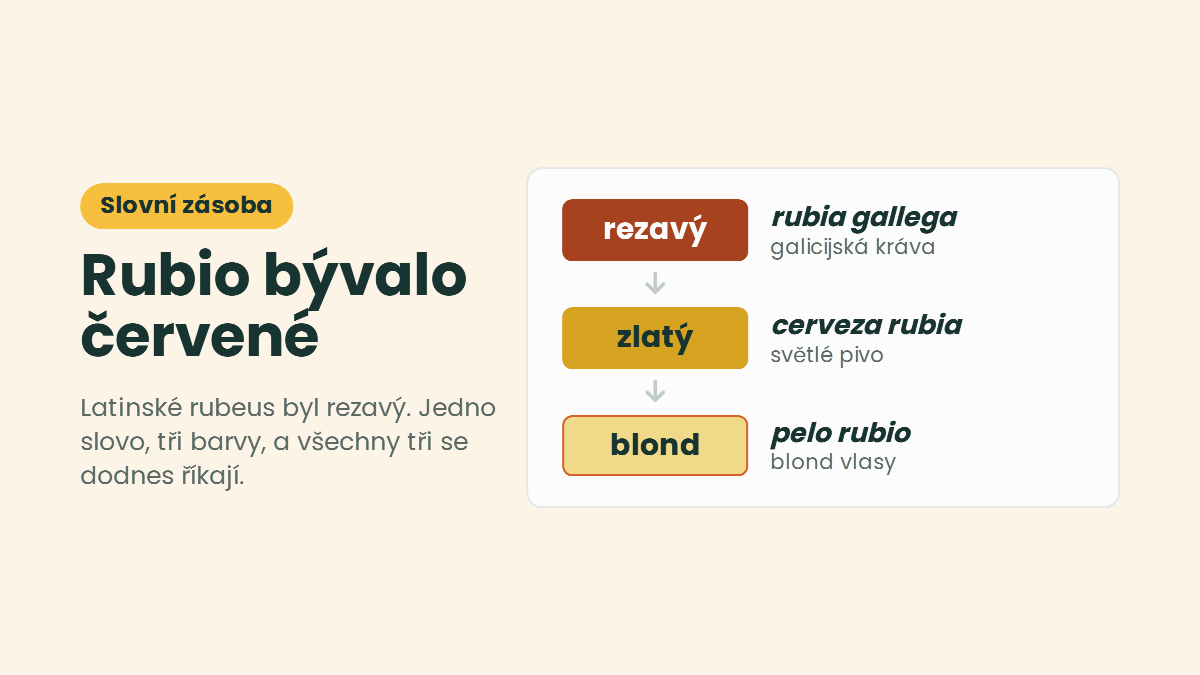
Spanish rubio means blond today, yet it comes from the Latin word for red. Why is a rubia a blonde, a golden beer and a rust-coloured cow from Galicia?
Vocabulary
Papa or patata? Potatoes as Peru knows them
Why Spanish calls the potato both papa and patata, how many varieties grow in Peru, what chuño is, and how the Colorado beetle became the American beetle.
Pronunciation
Perejil: the word that decided who lived
In October 1937, the story goes, the way you said perejil, Spanish for parsley, decided whether you lived or died on the Haitian–Dominican border.
