
Vocabulary
Piña or ananá? The pineapple, cone to cocktail

Spanish calls the pineapple piña, but ananá in Argentina and Uruguay. Where both words come from, how it grows and why piña colada means strained.
In Czech it is simple: ananas. The French, the Germans, the Italians, the Poles and the Swedes all say the same. Two big languages went another way. English has pineapple and Spanish has piña.
And Spanish does not agree with itself. In Madrid, Mexico or Lima you buy a piña; in Buenos Aires and Montevideo, an ananá. Yet the cocktail is called a piña colada even where the price tag on the fruit says ananá.
We will take it from cone to cocktail: what is said where, where the word ananá comes from, why the Spanish named a tropical fruit after a pine cone, where the pineapple is from, how it grows, and what a strainer has to do with a piña colada.
Piña or ananá
Piña is the word in Spain and in seventeen countries of the Americas, from Mexico to Chile. Ananá is used in just two, Argentina and Uruguay. The words differ in gender as well: la piña is feminine, el ananá is masculine, and the plural is los ananás. The singular ananás is little used.
The border is not a sharp one, though. The Argentine food code lists the fruit as “Ananá o Piña”. In an Argentine supermarket you will find ananá sold by weight and, not far from it, Piña Gold: a variety also sold as piña golden in Colombia and Peru. The Uruguayan wholesale market has ananá Hawai on its price list, but adds (Piña) in brackets to the Brazilian variety Pérola. And in Paraguay, where people say piña, you see ananá on imported goods, on a sachet of powdered drink or a bottle of cider.
Officialdom has its own way. In the customs tariff the pineapple has the line Piñas (ananás), and it reads the same in the tariff of Mercosur, to which Argentina and Uruguay belong. But when Uruguayan customs send importers an ordinary circular, it says ananá.
Where the word ananá comes from
The word is from the Tupi-Guarani languages of South America, in which the fruit was called naná. The Portuguese brought it to Europe as ananás, and from Portuguese it passed into Spanish and into other European languages.
We have it in print from two Frenchmen who wrote about Brazil. In 1557 André Thevet described a fruit the people there used as medicine: it “is called nana”, it is the size of a medium pumpkin and all round it looks like a pine cone. He added that it could only be brought to Europe preserved, because a ripe one does not keep. Twenty-one years later Jean de Léry already writes ananas and compares the fruit to a medium-sized melon.
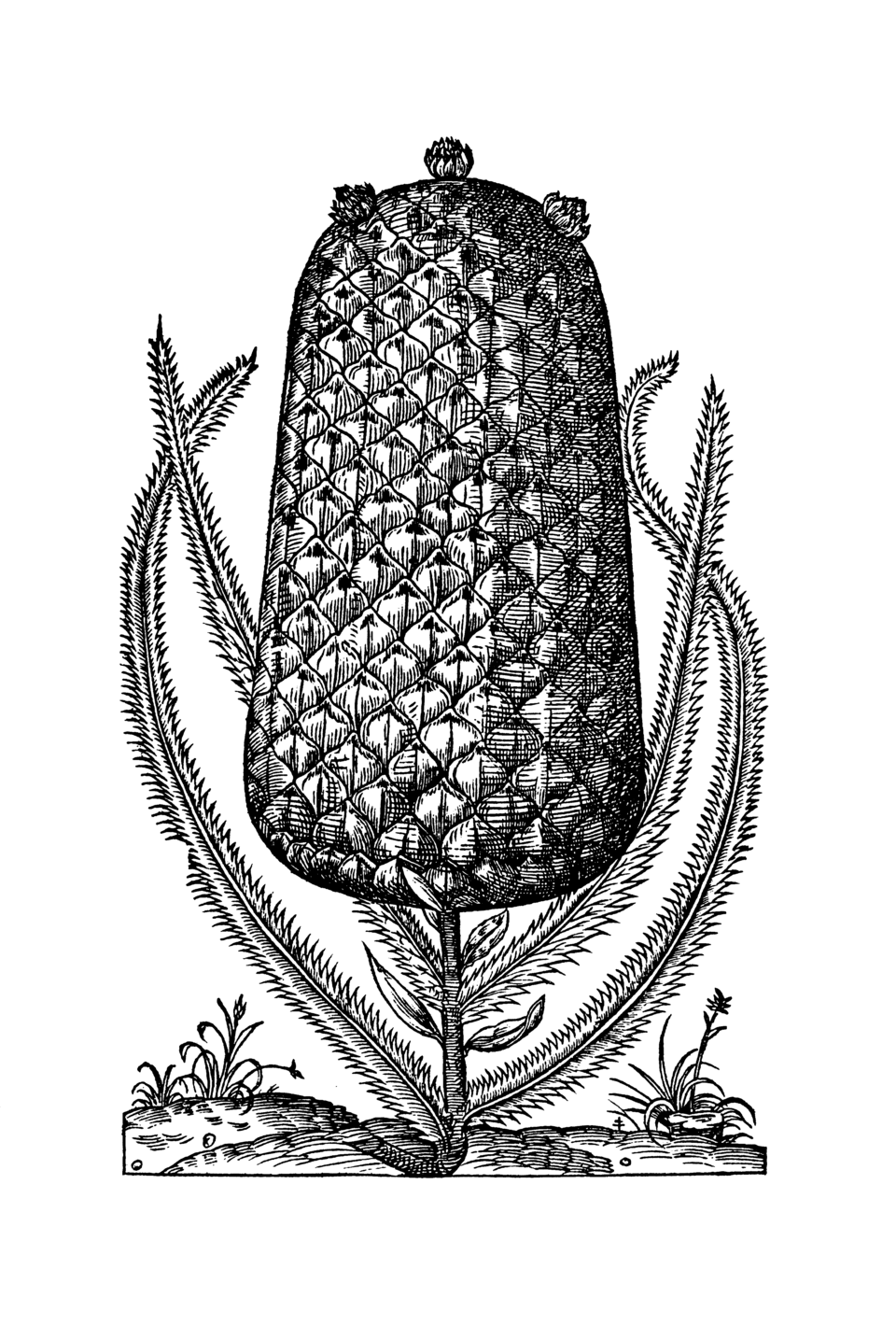
Before long the two names met in a dictionary. In a Guarani–Spanish dictionary of 1639, one example sentence has the Guarani nänä, and its Spanish translation has piña.
English took the same route as Spanish. A pineapple was originally a pine cone, the “apple” of the pine, and only later was the word carried over to the fruit that looks like one.
Why piña
Piña is Spanish for a pine cone. The word comes from Latin pinea, itself from pinus, pine. The Spaniards who saw the pineapple in the Caribbean had no name for it, so they reached for what it reminded them of. Nobody in particular coined it. The first to write it down, in 1526, was the chronicler Gonzalo Fernández de Oviedo.
“There is a fruit they call piñas,” Oviedo writes. It grows on a plant like a thistle, and the fruit is “a little smaller than a child’s head”, covered in scales like those of cones that hold pine nuts, “but they do not separate or open”. It smells better than peaches, one or two of them scent the whole house, and Oviedo thinks it is one of the best fruits in the world.
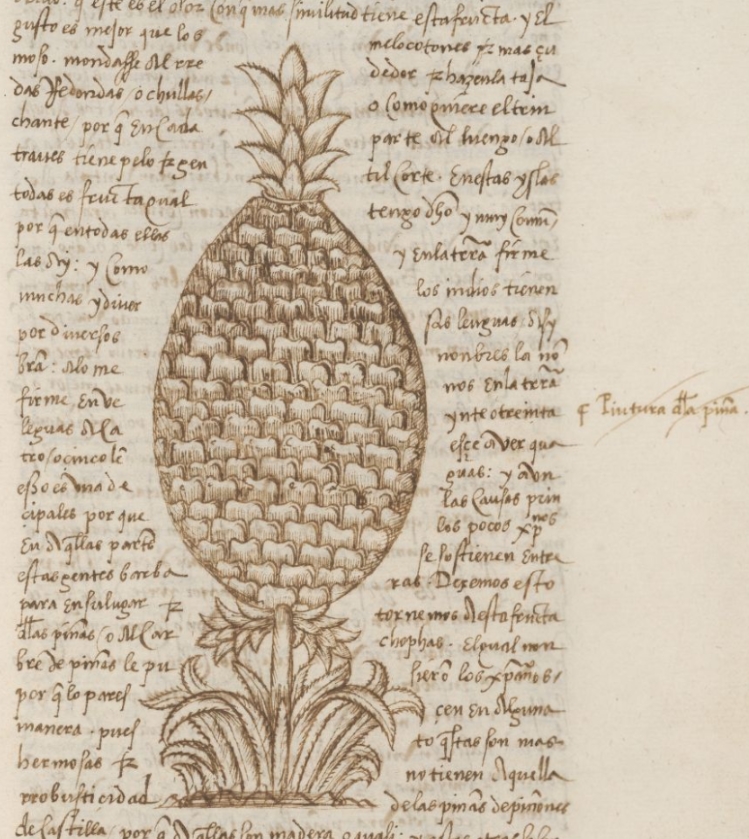
In the manuscript Oviedo wrote later, the pineapple is drawn as well. The text round the drawing explains that the name was given by the Christians, that is the Spaniards, because the fruit looks something like a pine cone. Both Frenchmen make the same comparison: comme une pomme de pin, like a pine cone.
With the Spaniards the pineapple travelled as far as the Philippines, and there the word piña gained one more meaning. The fibres of pineapple leaves are woven into a white, sheer and very fine cloth that is also called piña. Shirts, scarves and dresses are made of it.
Where the pineapple is from
The cultivated pineapple descends from a wild one that still grows in the lowlands east of the Andes, from the northern coast of South America to southern Brazil and Paraguay. In the south its fruits are small and full of fibre; in the north there are also forms with larger, fleshier ones.
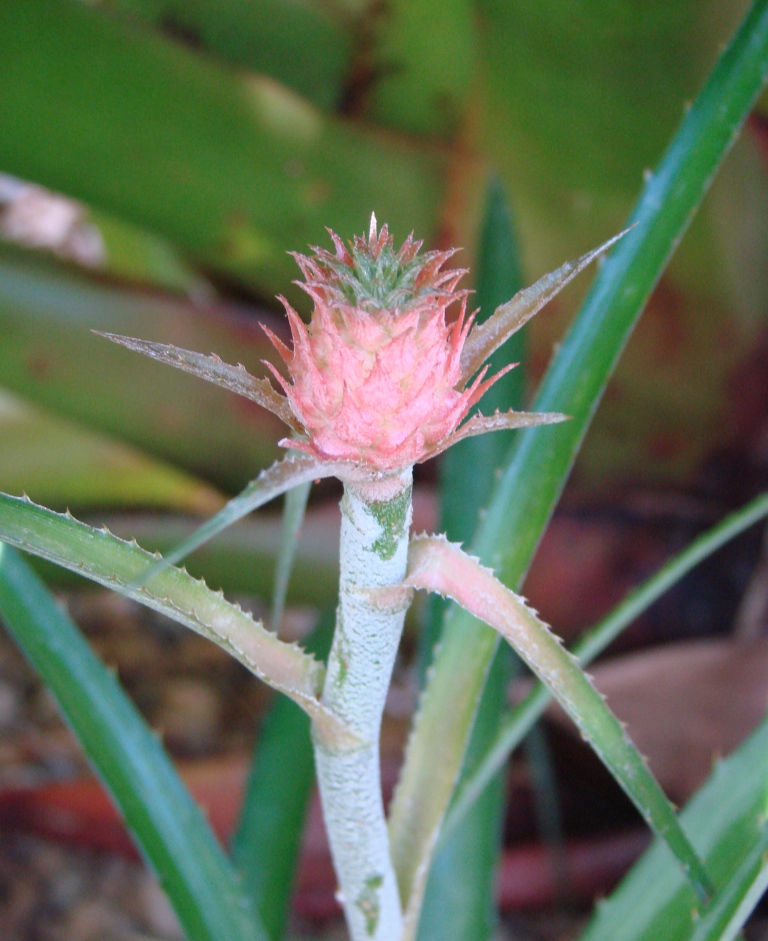
Exactly where people domesticated it is not certain. It used to be placed in the south, in the basin of the Paraná and Paraguay rivers. Today it is placed in the north instead, on the Guiana Shield: the greatest diversity is there, wild forms with large fruits grow there, and people there still move plants from the forest into their gardens. Most of the varieties then arose in western Amazonia.
The age is an estimate too. The oldest finds, from the Peruvian coast, are about three thousand years old, and those from the Tehuacán Valley in Mexico are younger still. Botanists nevertheless reckon that the cultivated pineapple parted from the wild one six to ten thousand years ago. It reproduces almost entirely by offshoots, and breeding varieties worth trading in that way must have taken thousands of years.
When Europeans reached the Americas, the pineapple was grown from Mexico and the Antilles to Paraguay. Columbus saw it in 1493 on the island of Guadeloupe. By the end of the sixteenth century it was growing in the tropics all round the world.
How pineapples are grown
Pineapples are not grown from seed. They are planted from the crown, the tuft of leaves you twist off the fruit in the kitchen, or from the offshoots the plant sends out below the fruit, between the leaves and at ground level. Oviedo described it the same way in 1526: they just put the crown in the ground “and it takes at once”. Seeds are of interest only to breeders.
Then you wait. From planting to harvest takes fifteen to twenty-two months, and in that time the plant produces a single fruit. A stalk rises from the middle of the rosette of leaves, a flower head forms on it, and the flower head becomes the pineapple.
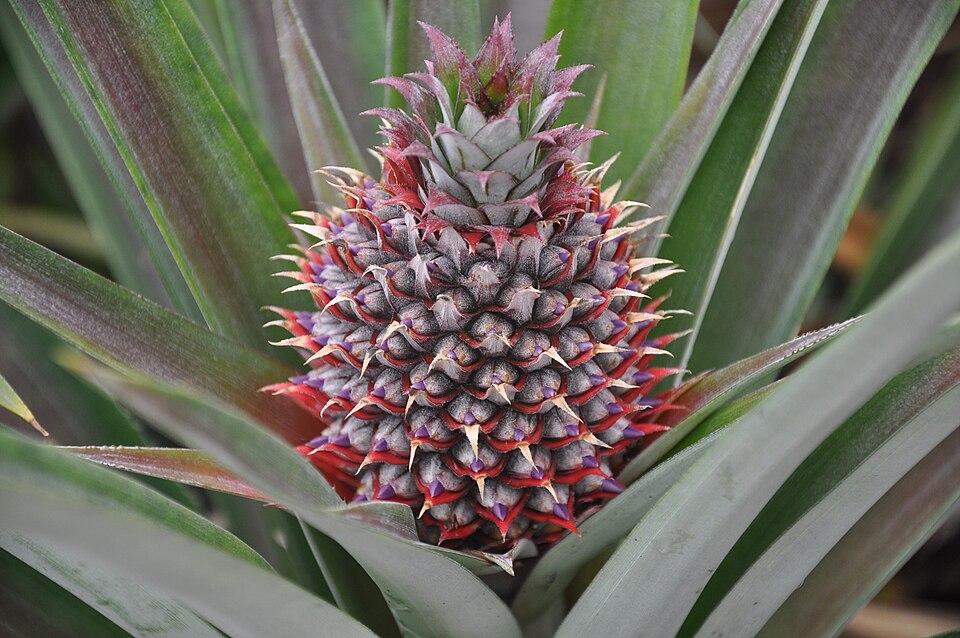
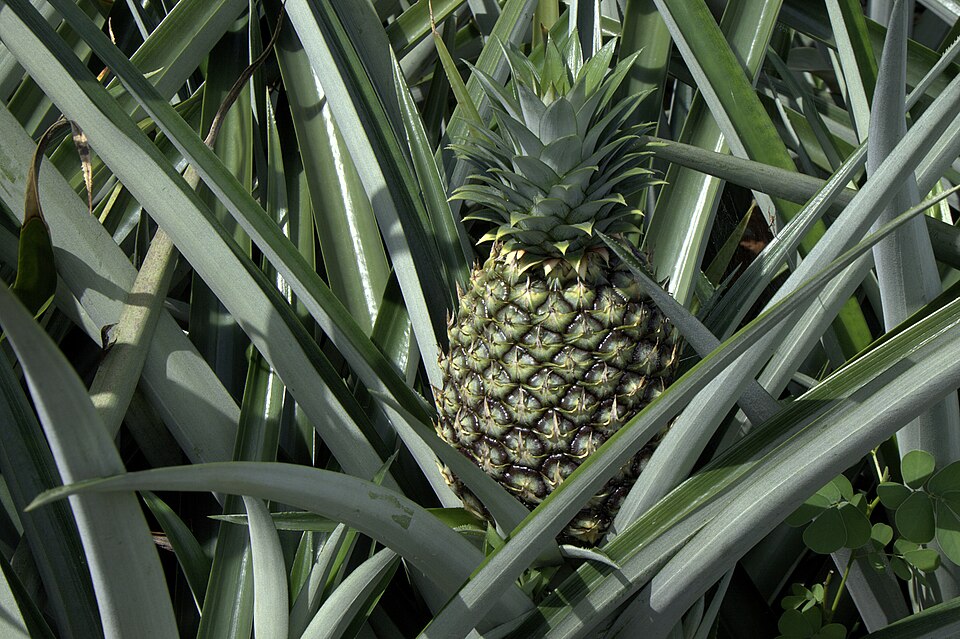
After the harvest that plant will not fruit again. Oviedo noticed it too: the thistle the pineapple grew on, once it is picked, “is worth nothing and gives no more fruit”. The second crop comes from the offshoots. The grower leaves two on the plant and harvests again fifteen to eighteen months later, though less. In one trial in Puerto Rico the first harvest gave 86 tonnes per hectare and the second 45. Sometimes there is a third or fourth harvest; then the field is cleared and replanted. A hectare holds 34 to 43 thousand plants.
So that a field ripens all at once, growers make the plants flower. It was found by accident: in the Azores in 1874 someone noticed that pineapples exposed to smoke flowered within six weeks. The active ingredient is ethylene. Smoke later gave way to acetylene, calcium carbide and finally to preparations that release ethylene.
A pineapple wants temperatures between 18 and 35 degrees, acid, well-drained soil and a low altitude. It will take anything from 650 to 3,800 millimetres of rain a year, as long as it does not stand in the wet. In the cold it grows slowly and the fruit is more acid. In Ecuador it is grown up to 2,300 metres above sea level, but highland pineapples are not as sweet as those from the coast.
And then there are hummingbirds. They are the pineapple’s main pollinators, and a pollinated fruit has hard seeds that nobody wants. Hummingbirds are therefore banned in Hawaii.
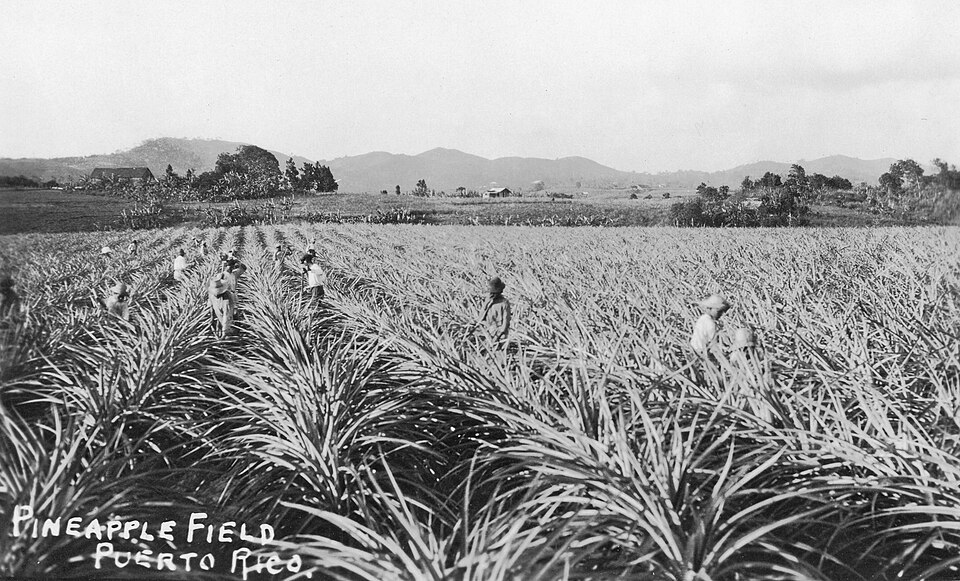
Today Costa Rica harvests the most pineapples: more than three million tonnes in 2024, out of just under thirty million worldwide. The Philippines and Indonesia come next. In Costa Rica pineapples cover 53 thousand hectares.
Piña colada
Colar means to strain, to pass a liquid through a cloth or a sieve. Colada is strained. A piña colada is literally a strained pineapple, and that is exactly what it used to be. In Cuba it was the name for fresh pineapple juice, pressed, strained and sweetened, sometimes with coconut water. There was no alcohol in it.
Rum got into it before today’s cocktail existed. In 1922 the American magazine Travel reported from Cuba that best of all was a piña colada: the juice of a perfectly ripe pineapple, rapidly shaken up with ice, sugar, lime and Bacardi. There is no coconut in it. By 1950 the New York Times describes Cuba’s piña colada as rum, pineapple and coconut milk.
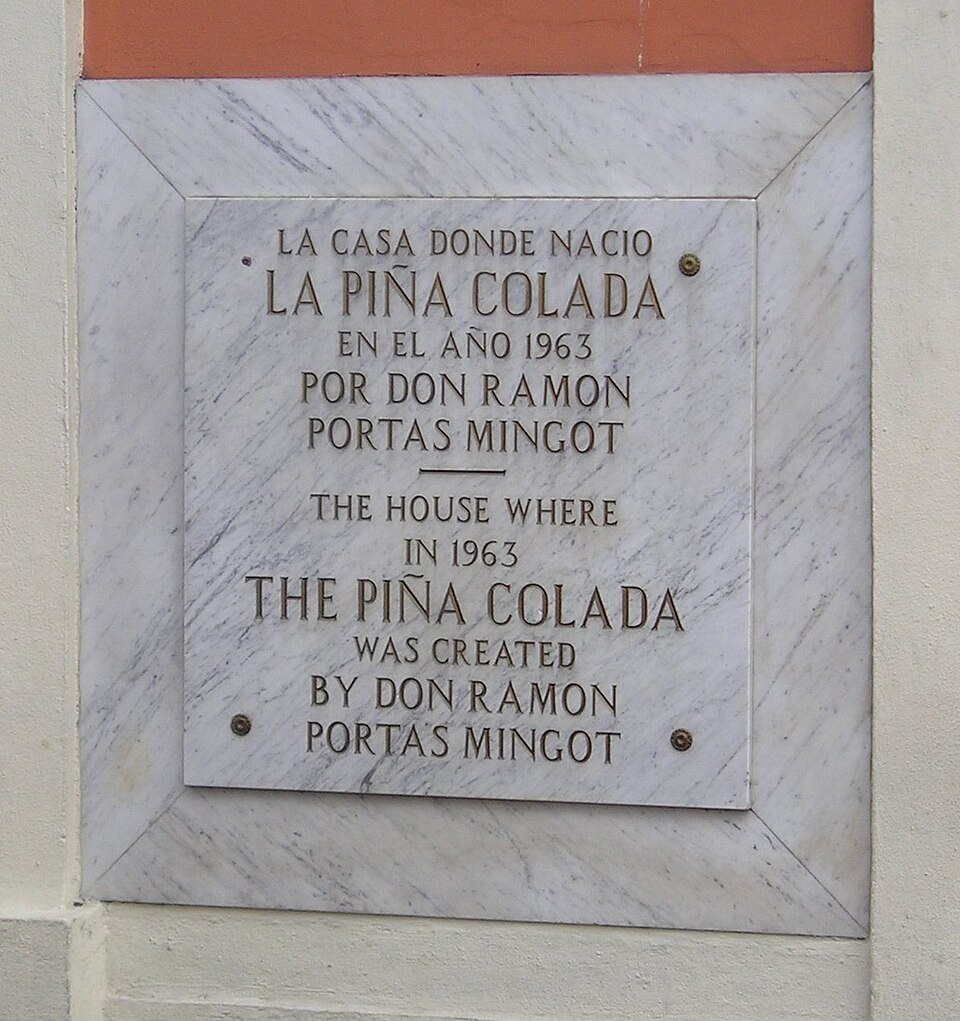
The drink as we know it is from Puerto Rico, and it depends on a tin. After the war a sweetened cream of coconut, Coco López, went into production there, and someone in San Juan mixed it with pineapple juice and rum. Who, and when, is disputed. The Caribe Hilton hotel says it was its barman Ramón Marrero, known as Monchito, in 1954. The Barrachina restaurant in Old San Juan put up a marble plaque saying that Ramón Portas Mingot created the piña colada there in 1963. Neither date is trouble-free. Newspapers were still calling Barrachina a new restaurant in 1965, and in the hotel’s advertisements from the 1950s coconut and pineapple never appear in the same glass. What is certain is that in the late 1960s the piña colada with rum took off round the world, and that Puerto Rico declared it its national drink in 1978.
The International Bartenders Association’s recipe is short: 50 ml of white rum, 30 ml of coconut cream and 50 ml of fresh pineapple juice, blended with ice. Instead of the juice you can use four slices of fresh pineapple. Notice two things. The juice should be fresh, and the coconut cream is the thick, sweetened kind from a tin, not coconut milk. You need not strain anything these days; the blender takes care of it. But the name still remembers a pineapple that somebody cut open, pressed and strained, and juice from a carton has nothing to do with it.
And what happens where the fruit is called ananá? The cocktail has not been renamed. An Argentine supermarket sells pulpa de ananá para coctel, pineapple pulp for cocktails, and in the same range coctel piña colada. A barman in the Uruguayan seaside resort of Aguas Dulces told reporters how he came up with a new drink of pineapple and Amarula liqueur. He had the ingredients to hand: Por la piña colada ya tenemos el ananá. Because of the piña colada, we already have the pineapple.
Words for the market and the bar
At the market you will get by with two words, provided you know which country you are standing in. At the bar one is enough, and it works everywhere.
| Spanish | English |
|---|---|
| piña f | pineapple; also pine cone |
| ananá m, ananás mpl | pineapple (Argentina, Uruguay) |
| jugo de piña m, jugo de ananá m | pineapple juice |
| piña en rodajas f | pineapple slices |
| piña en almíbar f | pineapple in syrup |
| colar | to strain |
| piña colada f | piña colada, literally strained pineapple |
| tepache m | a Mexican fermented drink made from pineapple and sugar |
Piña and ananá are both correct; it only depends on where you are asking for your pineapple. Spanish is full of pairs like these, and they come up early in lessons, in group courses and in one-to-one tuition.
- Thevet’s woodcut — Nana Thevet 1557 89v, André Thevet, Les Singularitez de la France antarctique (1557), public domain.
- Oviedo’s drawing — Drawing of pineapple from Oviedo, Natural y general hystoria, Gonzalo Fernández de Oviedo, manuscript in the Huntington Library (1539–1548), public domain.
- Wild pineapple — Ananas ananassoides, João Medeiros, CC BY 2.0.
- Flower head — Pineapple flower in Thailand, Celouu78, CC BY-SA 3.0.
- Fruit on the plant — AnanasComosusOnPlant, Markus Leupold-Löwenthal, CC BY-SA 3.0.
- Field in Puerto Rico — Puerto Rico – Pineapple field, Attilio Moscioni, postcard, around 1920, public domain.
- Barrachina plaque — Piña Colada plate in Old San Juan, Puerto Rico, Alessandro Cai (OliverZena), December 2007, public domain.
- The map is our own drawing; national borders are from Natural Earth, public domain.
- Names by country: local shop catalogues and wholesale price lists as at 21 November 2026; Código Alimentario Argentino (Boletín Oficial, 17 April 2019); Unidad Agroalimentaria Metropolitana (Montevideo), price list of 9 November 2026; Dirección Nacional de Aduanas (Uruguay), Comunicado 16/2025; the Mercosur tariff as in Uruguayan decree 515/2021. Real Academia Española and ASALE, Diccionario de la lengua española, entries piña, ananás and colar; Diccionario panhispánico de dudas, entry ananá; Diccionario de americanismos.
- Word origins: André Thevet, Les Singularitez de la France antarctique (1557), ch. 46; Jean de Léry, Histoire d’un voyage faict en la terre du Brésil (1578), ch. 13; Antonio Ruiz de Montoya, Tesoro de la lengua guaraní (1639); W. Pfeifer, Etymologisches Wörterbuch des Deutschen, entry Ananas. Gonzalo Fernández de Oviedo, Sumario de la natural historia de las Indias (1526).
- Origin and domestication: C. R. Clement et al., Origin and Domestication of Native Amazonian Crops, Diversity 2 (2010).
- Cultivation: Julia F. Morton, Pineapple, in Fruits of Warm Climates (1987); CANAPEP (Costa Rica); FAOSTAT, 2024 harvest.
- Piña colada: Wayne Curtis, entry Piña Colada, in The Oxford Companion to Spirits and Cocktails; International Bartenders Association, Piña Colada; Travel, December 1922; The New York Times, 16 April 1950; Montevideo Portal, 24 February 2026.
Frequently asked questions
How do you say pineapple in Spanish?
Why is the pineapple called piña in Spanish?
Where does the word ananas come from?
What does piña colada mean?
Is it still called a piña colada in Argentina?
How long does a pineapple take to grow, and how many fruits does a plant give?
Where does the pineapple come from?
Article topics Varieties of Spanish
Share this article
What to read next

Vocabulary
Bolígrafo or birome? The biro and its names
Spanish calls the ballpoint pen bolígrafo, birome, pluma, lapicero or esfero. Where each is said, which words can trip you up and who László Bíró was.

Vocabulary
Aguacate or palta? The avocado, word to stone
Spanish calls the avocado both aguacate and palta. Where each is said, the truth about testicles and lawyers, how to pick a ripe one and stone it safely.

Vocabulary
Rubio: the blond word that used to be red
Spanish rubio means blond today, yet it comes from the Latin word for red. Why is a rubia a blonde, a golden beer and a rust-coloured cow from Galicia?



