
Grammar
Mi mamá: my, mine and our in Spanish
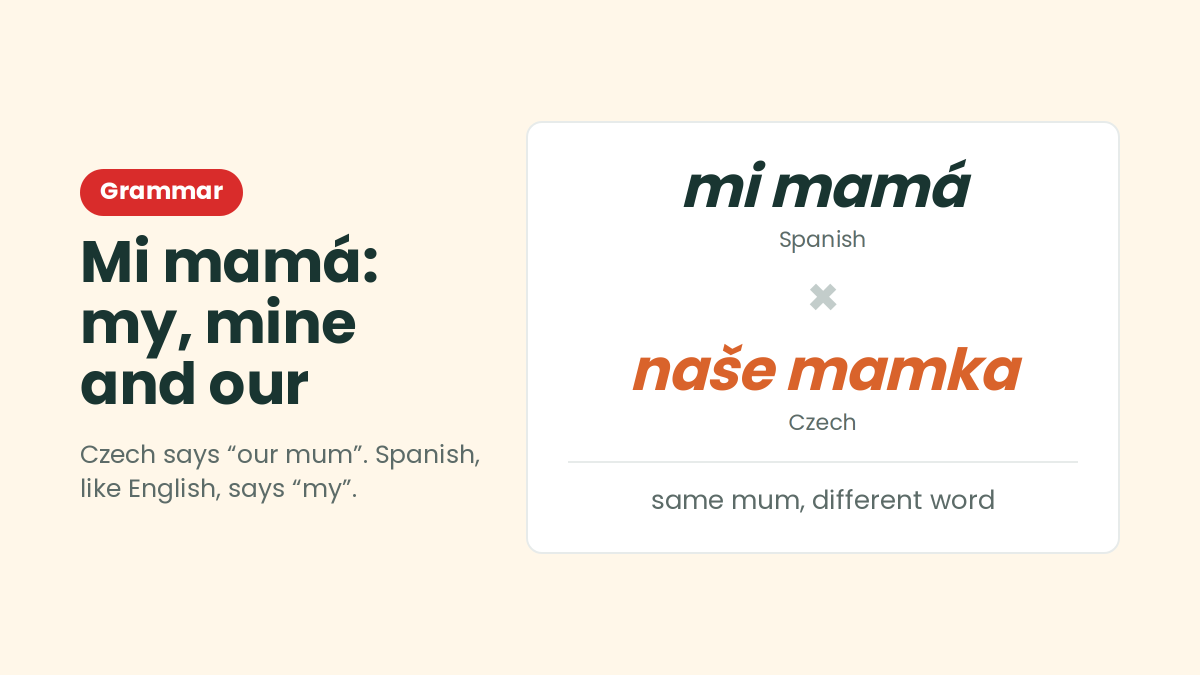
Spanish says mi mamá, as English says my mum, while Czech says “our mum”. See when to use mi, when nuestro and when mío, and why su is his, her and your.
In Spanish you say mi mamá and mi papá, even if you have three brothers and sisters. The dog is mi perro, the house mi casa, your gran mi abuela. So far, no surprise: English does the same with my mum.
The surprise is for Czech and Slovak speakers, who say naše mamka, “our mum”, even when only one of them is talking. If you learn Spanish in Czechia, you will hear classmates say nuestra mamá, and this article tells you where that comes from. For you the traps lie elsewhere: mi against mío, endings that follow the thing and not the owner, and su, which covers his, her, their and your.
Spanish speaks for one person, and so does English
Spanish starts from one person. The speaker speaks for themselves and says mi mamá. That does not take the mother away from the brothers and sisters. Mi only says that she is the speaker’s mother; who else calls her mum is left open. In the same way mi casa is the house I live in, and the word tells you nothing about who lives there with me.
Czech starts from the group. A Czech who says naše mamka is speaking as a member of the family: she is mum to all of us, my brother, my sister and me, so she is “ours”, even though only one of us is talking. Czech does the same with the house, the dog and the home town.
Work is a good test. An employee says en mi empresa trabajamos ocho horas al día, at my company we work eight hours a day. The company itself writes nuestra empresa, our company, because there a group is speaking. English can make the same split.
There is one difference of degree. English is quite happy with our house and our dog from one member of a family. Spanish nuestra casa is correct too, and everyone will understand you, but it sounds as if you were speaking for the whole family. When you speak for yourself, mi casa is the closer fit.
What your Czech classmates are translating
If you sit in a class with Czechs or Slovaks, or are learning Czech yourself, this is the pattern behind their nuestra mamá. Where Spanish and English say “my”, Czech says “our” or u nás, which is roughly “at our place”.
| Spanish | English | Czech, word for word |
|---|---|---|
| mi mamá | my mum | naše mamka, “our mum” |
| mi papá | my dad | náš taťka, “our dad” |
| mis padres | my parents | naši, “ours” |
| mi abuela | my gran | naše babička, “our gran” |
| mi perro | my dog | náš pes, “our dog” |
| en mi casa | at my house | u nás doma, “at our place, at home” |
| en mi empresa | at my company | u nás ve firmě, “at our place, in the company” |
| en mi país | in my country | u nás v Česku, “at our place, in Czechia” |
| mi ciudad | my town | naše město, “our town” |
| mi profesor | my teacher | náš učitel, “our teacher” |
A word on mum. Alongside mi madre and mi padre you will also hear mi mamá and mi papá, from adults too. Madre and padre sound a little more formal and are safe everywhere. The possessive is the same in all four: mi.
Mind the accent mark: mi is my, mí is me (para mí, for me). Likewise tu is your and tú is you.
When to say nuestro
Nuestro is not a mistake and you will need it. Use it when you really are speaking for a group, or when the thing belongs both to you and to the person you are talking to.
- Speaking for several people. A brother and sister together say nuestra madre está enferma, our mother is ill.
- A company, a school or a team about itself. Nuestros cursos empiezan en septiembre. Our courses start in September.
- Shared with you. Nuestra clase es a las seis. Our class is at six, yours and mine.
- In speeches. Nuestro país, our country.
Mi or mío
Spanish has two forms for “my”, much as English has my and mine. Short mi goes only before a noun. Full mío goes after the noun, or stands with no noun at all. Nuestro and vuestro look the same in both positions.
A note on the names, because they trip people up. English-language textbooks usually call mi a possessive adjective and el mío a possessive pronoun. Spanish grammars group both as possessivesThe umbrella term for words like my, mine and our; in Spanish mi, mío, nuestro. Grammars disagree on whether they are pronouns: mi sits in the article slot, mío behaves like an adjective. And they need not mean ownership: mi vereda is the pavement the speaker just happens to be walking along. and do not agree on what to call them; the newer ones often do not count them as pronouns at all. How the two forms behave will help you more than the label. Mi sits in the article slot, which is why today’s standard Spanish does not say el mi libro, just as English does not say “the my book”. Mío behaves like an adjective, and that is where it parts company with mine: it can follow a noun, as in un amigo mío, a friend of mine.
| Whose | Before the noun | After it or without it |
|---|---|---|
| my | mi, mis | mío, mía, míos, mías |
| your (tú) | tu, tus | tuyo, tuya, tuyos, tuyas |
| his, her, its, their, your (usted, ustedes) | su, sus | suyo, suya, suyos, suyas |
| our | nuestro, nuestra, nuestros, nuestras | looks the same |
| your (vosotros, in Spain only) | vuestro, vuestra, vuestros, vuestras | looks the same |
The ending follows the thing, not the owner: mis hermanos, my brothers, because there are several brothers. Nuestra casa is feminine because casa is feminine, whether the people speaking are men or women. English his and her work the other way round and follow the owner, so su hermana is both his sister and her sister. The person, on the other hand, does come from the owner, which is why it is mi and not tu.
With mi, tu and su only the number changes, never the gender: mi hermano and mi hermana, but mis hermanos. Gender shows only in the full forms and in nuestro and vuestro.
You need the full form in three situations.
- One of several. Un amigo mío is a friend of mine. Mi amigo is one particular friend.
- No noun. La mía es azul, mine is blue.
- After the verb ser. Es mío, it is mine. La casa es suya, the house is his.
A common mistake is es mi. The short form cannot stand alone, just as English does not say “it is my”. The right form is es mío.
Su is his, her, their and your
English keeps his book, her book, their book and your book apart. In Spanish all four are su libro. Most of the time the sentence tells you which one is meant.
When it does not, use de with a personal pronoun: el libro de él, de ella, de ellos, de ellas, de usted, de ustedes. It does not work for yourself: un libro de mí is a mistake. Say un libro mío, a book of mine.
English your is the trap in the other direction, because Spanish has three words for it: tu for one person you call tú, su for anyone you call usted or ustedes, and vuestro for vosotros, which is used only in Spain.
You can read the rules in ten minutes. That you still say es mi, or su with the wrong ending, only shows when you speak, and for that you need someone who hears you. We correct it in our group courses and in one-to-one lessons.
What to take away.
- Spanish speaks for one person, as English does: my mum is mi mamá. Czech and Slovak say “our mum”.
- Use mi for your own family, house, town and job: mi casa, mi perro, mi empresa, mi ciudad.
- Keep nuestro for when you speak for several people, or share the thing with the person you are talking to.
- Mi amigo is one particular friend, un amigo mío a friend of mine. With no noun el mío, after ser mío, never es mi.
- Endings follow the thing, not the owner: su hermana is his sister and her sister.
- Su is his, her, their and your. Make it clear with de él, de ella, de usted, but never de mí.
- Possessives in Spanish: Nueva gramática de la lengua española (Real Academia Española and Asociación de Academias de la Lengua Española), chapter 18: § 18.1 (forms, agreement, the six meanings of su), § 18.2 (el mío, es mío), § 18.3 (before and after the noun), § 18.4 (de él), § 18.5 (what a possessive means).
- Mamá and madre, papá and padre in Spain and in the Americas: Diccionario panhispánico de dudas (2nd edition, RAE and ASALE), entries mamá and papá.
- Czech náš for a close relationship rather than ownership: Slovník spisovného jazyka českého, entry náš, sense 2.
- Both diagrams are our own drawings.
Frequently asked questions
Is it mi mamá or nuestra mamá in Spanish?
Why do Czech speakers say nuestra mamá?
When do you use nuestro in Spanish?
What is the difference between mi amigo and un amigo mío?
What does su mean: his, her or your?
Does su hermana mean his sister or her sister?
Article topics Common mistakes Varieties of Spanish
Share this article
What to read next
Grammar
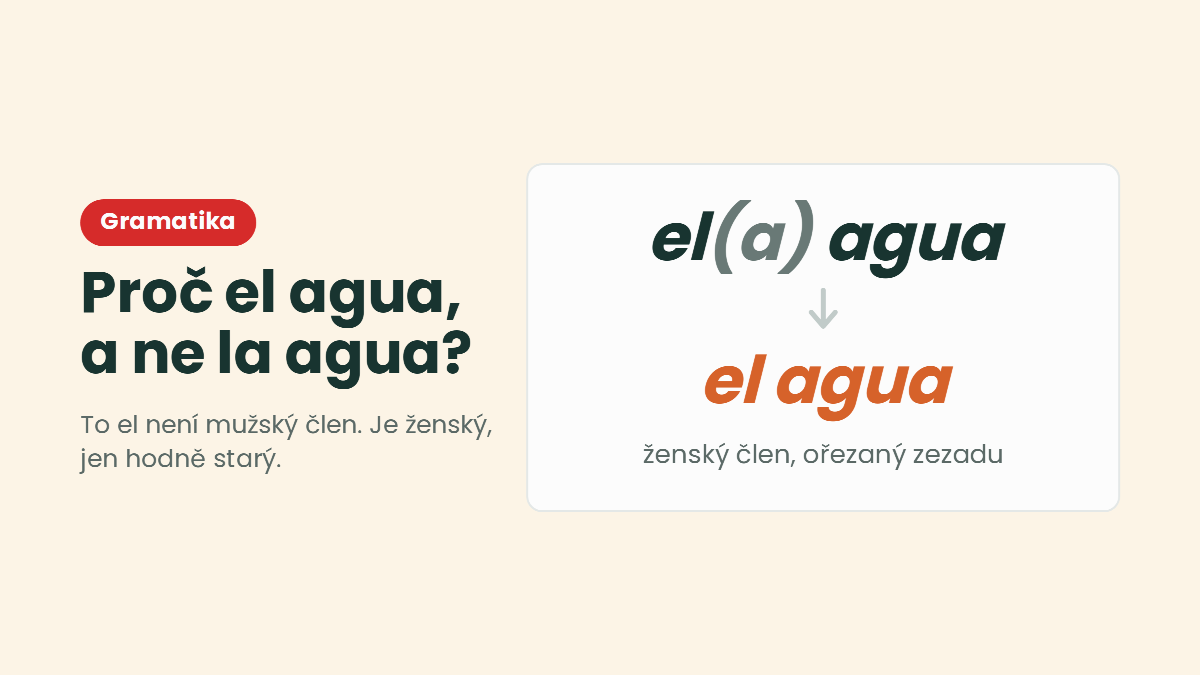
Why Spanish says el agua and not la agua
The el in el agua is not the masculine article but the feminine one in an old form. Where it came from, when you use it and why the word stays feminine.
Grammar
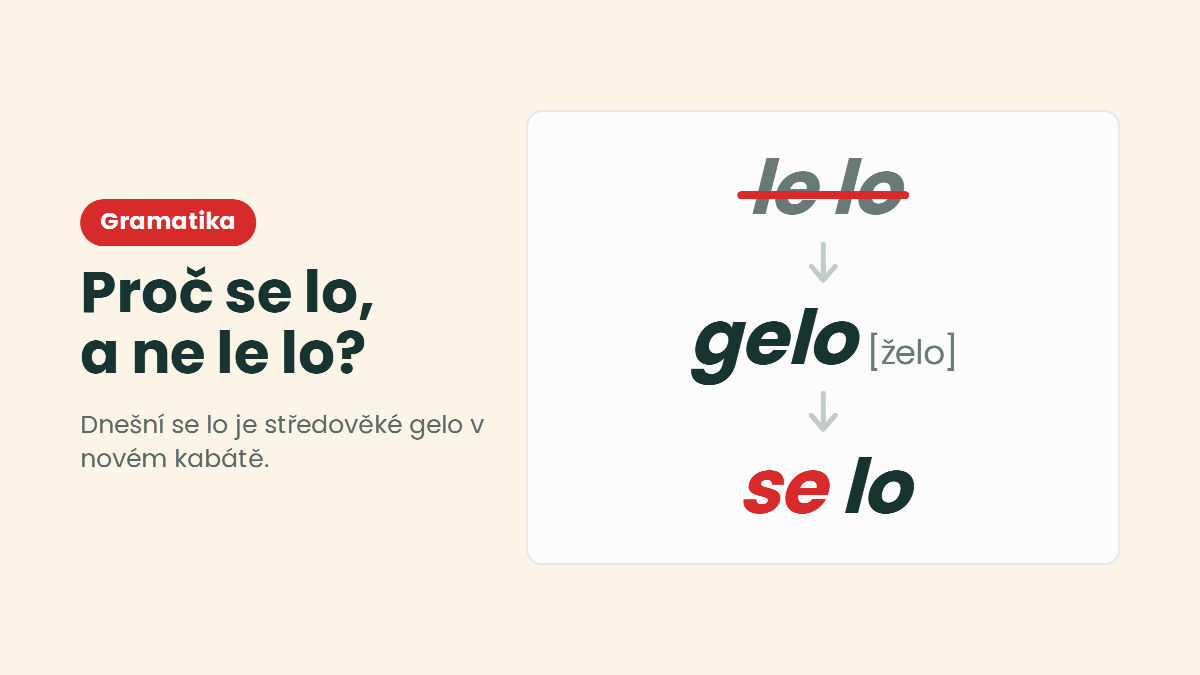
Why Spanish says se lo and not le lo
Spanish se lo comes from medieval gelo, its g said like the s in measure. Its se is le in disguise and shares only sound and spelling with reflexive se.
Guide
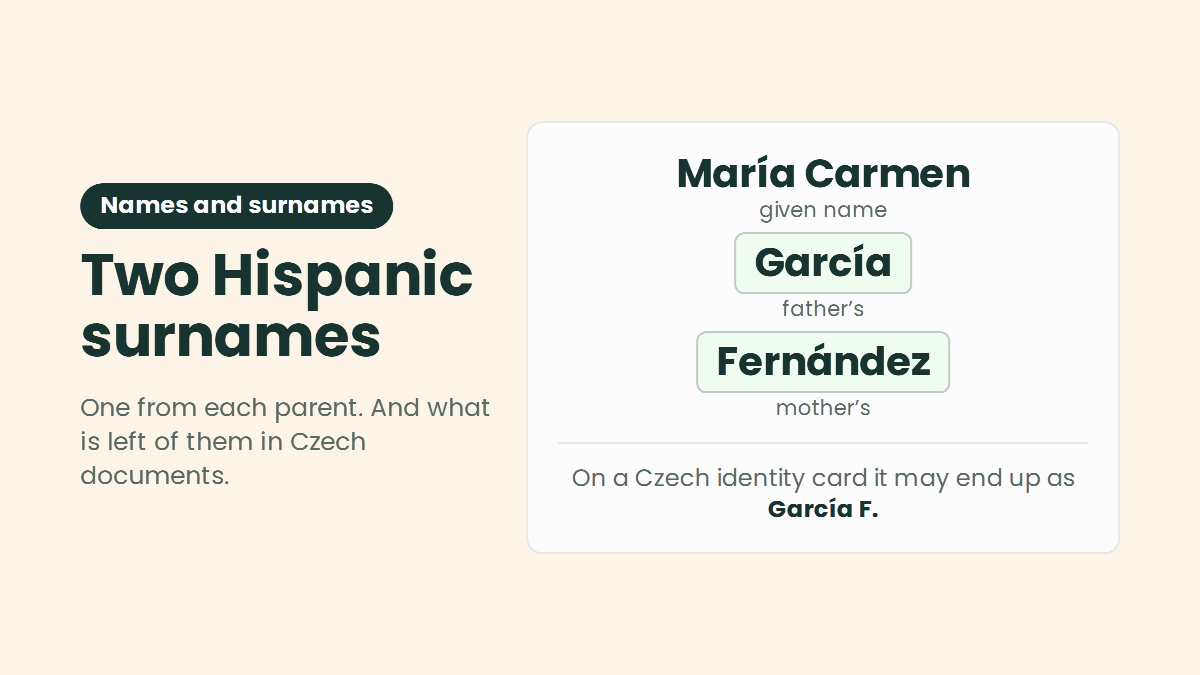
Why Spanish speakers have two surnames
People in Spanish-speaking countries have two surnames, one from each parent. Which is the main one, what marriage changes and how Czechia records them.
